
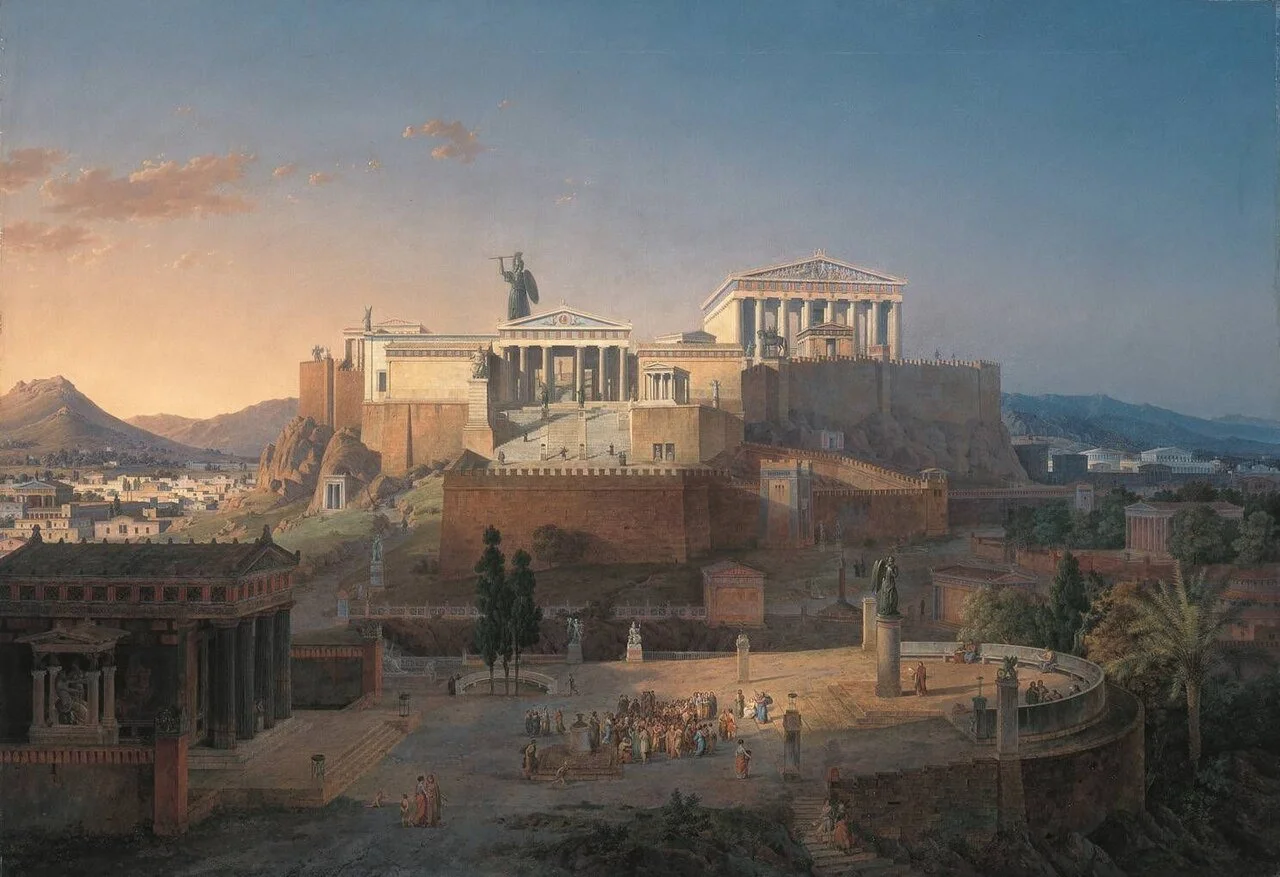
Imperial court society, elite property, and the historical record of seventeenth-century Athens.
Athens Beyond Its Classical Past
Athens is internationally associated with ancient temples, philosophical schools, and the monuments of classical Greece. Yet the city's history continued through the Byzantine, Frankish, and Ottoman periods, each of which shaped its buildings, population, and institutions.
During the seventeenth century, Athens existed within the Ottoman Empire. Its urban environment included homes, markets, religious buildings, fountains, workshops, and spaces connected with local administration. The city was part of a much larger political and economic system in which imperial officials, merchants, religious institutions, and local elites maintained relationships across considerable distances.
The title's reference to Ottoman eunuch palaces suggests a possible connection between Athens and influential figures associated with the imperial court. However, the specific claim that eunuchs maintained palaces in seventeenth-century Athens remains unverified without a reliable historical or archaeological source.
Eunuchs and the Ottoman Imperial Household
Eunuchs occupied important positions within parts of the Ottoman imperial household. Depending on their rank and responsibilities, they could serve in roles connected with the palace, the protection and administration of members of the ruling household, and the management of important institutions.
Some high-ranking eunuchs became influential political figures. Their positions could provide access to the sultan, members of the imperial family, and officials responsible for administering the empire.
Their influence was not limited to personal service at court. Certain individuals became patrons of religious institutions, supported charitable foundations, and managed property. These activities could extend their influence into cities and regions far from the imperial capital.
Nevertheless, the existence of powerful eunuchs within the empire does not establish that they owned or occupied palaces in every major Ottoman settlement.
What Would Count as a Palace?
The word palace can describe a royal residence, a substantial elite household, or a complex used for administrative and ceremonial purposes. Historical sources do not always employ architectural terms in the same way that modern researchers do.
A large Ottoman residence in Athens might have belonged to an official, wealthy merchant, local notable, or member of an elite household. Size and decoration alone would not establish that the owner was a eunuch or that the building had a direct connection with the imperial court.
Archaeologists would examine the building's layout, construction phases, materials, inscriptions, and relationship to nearby structures. Researchers would also investigate whether the site had been altered, divided, or reused during later periods.
Property and Charitable Foundations
Property was an important source of wealth and influence in Ottoman society. Officials and wealthy individuals could support mosques, schools, fountains, roads, and other institutions through endowed property, often known as a waqf.
These foundations helped finance public and religious services. Their records could describe buildings, rents, maintenance responsibilities, and the distribution of income from property. Such documents provide valuable information about the relationship between private wealth and public life.
A document showing that an influential official owned property in Athens would be important, but it would not automatically establish that the building was a palace. The nature of the property and the identity of its owner would need to be demonstrated through the wording of the record and supporting evidence.
Athens and the Wider Ottoman Network
The Ottoman Empire connected provincial towns and cities through administrative appointments, trade, religious institutions, and patronage. Officials could move between different regions during their careers, while property and charitable foundations created relationships that lasted beyond an individual's lifetime.
These connections offer a useful framework for investigating whether an influential court figure had property in Athens. Yet the broader existence of such networks should not be used as a substitute for evidence about a particular building.
Researchers would need to identify the individual, establish the chronology, and link the person to a specific property through archival records or other reliable documentation.
Archaeological and Documentary Investigation
A credible investigation would begin with a clearly identified site. Architectural remains could be compared with other Ottoman-era buildings, while historical maps and property records might reveal the structure's location and development.
Inscriptions could provide names or dates, although inscriptions may have been reused from earlier buildings or added during later renovations. Written descriptions would need to be examined for changes in terminology and place names.
If the alleged palace no longer survives, its history might still be reconstructed from property boundaries, old maps, excavation reports, or descriptions recorded before demolition.
A More Complete History of Ottoman Athens
The history of Ottoman Athens becomes richer when it includes the people and institutions that shaped the city after antiquity. Court patronage, property ownership, charitable foundations, and local administration all deserve careful investigation.
The specific claim of seventeenth-century eunuch palaces in Athens remains unverified. If reliable records establish such a connection, it could illuminate how elite Ottoman networks operated beyond the imperial capital. Until then, the subject should be treated as a historical question rather than an established discovery.







