Introduction
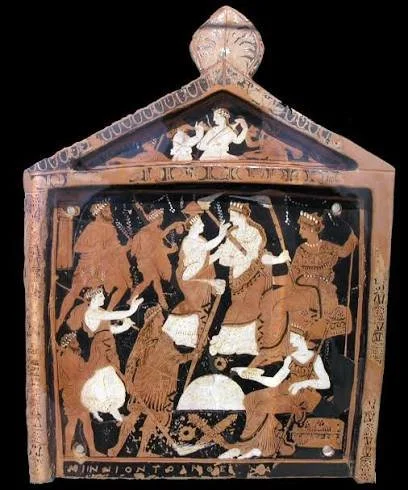
The religious life of ancient Greece included public festivals, household rituals, civic ceremonies, and initiation rites whose meanings varied between communities. Among the most famous of these religious institutions were the Eleusinian Mysteries, sacred ceremonies associated with Demeter and Persephone and celebrated at Eleusis in Attica. For centuries, the Mysteries attracted initiates from different parts of the Greek world and became closely associated with questions of divine favor, agricultural renewal, and hopes concerning life after death.
Modern festivals in Boeotia, the region northwest of Attica, provide an opportunity to examine how agricultural customs, seasonal celebrations, and local religious traditions can be compared with ancient Greek ritual practices. However, geographical proximity and thematic similarities do not prove direct continuity. The Eleusinian Mysteries were centered at Eleusis, not Boeotia, and modern festivals have developed within different historical, religious, and social circumstances.
The idea of the Mysteries' “echoes” in modern festivals is therefore most useful when understood as a question of cultural comparison rather than an assertion that ancient initiation ceremonies survive unchanged today. By examining the ancient rites, the agricultural environment of Boeotia, and the transformation of festival traditions, we can explore how communities remember the past without confusing historical influence with uninterrupted ritual survival.
Demeter, Persephone, and the Eleusinian Tradition
The Eleusinian Mysteries were among the most significant religious institutions of the ancient Greek world. Their central deities were Demeter, associated with grain and agricultural fertility, and her daughter Persephone, whose myth explained her periodic separation from and return to her mother.
In the best-known version of the myth, Persephone is taken to the underworld by Hades. Demeter searches for her daughter, and the earth becomes unproductive as the goddess grieves. An agreement eventually allows Persephone to return to the world of the living for part of each year, while she spends another portion with Hades. Ancient interpretations of the myth connected it with the agricultural cycle, seasonal change, and the relationship between life and death.
At Eleusis, the Mysteries developed into a complex series of rites that attracted participants from across the Greek-speaking world. Initiation was not identical to ordinary attendance at a public festival. It involved participation in ceremonies whose central experiences were restricted to initiates.
The Mysteries were connected to the wider religious landscape of ancient Greece, but they possessed distinctive institutions, sacred spaces, and ritual traditions. Their reputation was closely linked to the promise that participation could bring a more favorable relationship with the divine and improve one's hopes concerning existence after death.
The Sanctuary at Eleusis
Eleusis lies in Attica, west of Athens. Its sanctuary was connected to a sacred route that linked the city of Athens with the religious center. During the classical period, the sanctuary became an important destination for participants traveling from different communities.
The religious calendar included the Greater Mysteries, which were associated with a sequence of preparations and ceremonies. Initiation involved restrictions and ritual requirements, and some participants underwent preliminary rites before taking part in the central ceremonies.
Ancient sources describe processions, purification, sacrifices, and other elements associated with the festival. However, the central initiatory experiences were deliberately protected from public disclosure. The surviving evidence consequently provides only a partial picture of what initiates saw or experienced.
This secrecy has encouraged speculation across many centuries. Writers have proposed different interpretations of the ritual objects, dramatic performances, sacred drinks, and symbolic experiences involved in initiation. Some interpretations are supported by archaeological or textual evidence; others remain hypothetical.
A careful account must distinguish what ancient sources explicitly describe from what modern scholars infer. The absence of a complete ritual script is not an invitation to invent one.
Why Agriculture Matters to the Comparison
Boeotia, like much of central Greece, possessed a long agricultural history. Its plains and valleys supported the cultivation of cereals, olives, grapes, and other crops, while local communities developed seasonal practices associated with planting, harvesting, and food preparation.
Agriculture influenced religious life in ancient Greece because crops depended on rainfall, seasonal temperatures, soil conditions, and the successful coordination of human labor. Communities expressed concern about fertility and abundance through offerings, sacrifices, prayers, and festivals.
Demeter was particularly important within this religious environment. Her association with grain made her relevant to communities whose food supply depended on cereal cultivation. Her cult, however, was not confined to Eleusis. Different Greek communities honored Demeter through local sanctuaries and festivals, each with its own history and customs.
This broader religious landscape provides a legitimate basis for comparing ancient and modern agricultural celebrations. Both may involve gratitude for harvests, community meals, seasonal gatherings, or symbolic expressions of fertility and renewal.
Nevertheless, similar themes do not demonstrate that one festival directly descends from another. Agricultural societies often develop comparable customs independently because they respond to similar seasonal and social needs.
Boeotia's Festival Traditions
Boeotia's historical communities included cities, villages, agricultural settlements, and sanctuaries associated with different local deities. Ancient religious life in the region was diverse, and festivals varied according to community identity and local circumstances.
Modern festivals in Boeotia likewise take place within a complex cultural landscape. Some are connected to Orthodox Christian feast days, local patron saints, agricultural work, music, dance, and community gatherings. Others may be organized around regional heritage, seasonal events, or tourism.
Such festivals can preserve customs that have changed over generations. A procession may retain an older local route while acquiring new religious meanings. A harvest celebration may incorporate traditional foods or dances without reproducing an ancient ceremony. A community gathering may express regional identity through practices that have been adapted to modern social life.
It is important not to assume that all modern Boeotian festivals share the same origins. Each has its own documentary history and should be studied individually.
To establish a direct connection with the Eleusinian Mysteries, researchers would need evidence showing how a particular practice was transmitted across the intervening centuries. Without such evidence, a comparison should be presented as thematic or cultural rather than as proof of continuous ritual survival.
Continuity, Transformation, and Reinvention
Cultural traditions rarely remain unchanged. They can disappear, be adapted, merge with other practices, or be revived after long periods of interruption. Communities may also reinterpret older customs in response to new religious, political, or social circumstances.
The transition from ancient Greek religion to Christianity fundamentally changed the religious institutions of Greece. The Eleusinian Mysteries ceased to operate as an ancient initiatory institution. Their sanctuary experienced the transformations associated with the decline of traditional public cults in late antiquity.
Modern festivals exist within a different religious framework, particularly the traditions of Greek Orthodox Christianity and contemporary civic life. Some customs may preserve older seasonal patterns or regional forms of celebration, but this does not mean that the original theology or ritual structure survived intact.
The distinction between continuity and reinvention is essential. A community may consciously revive an ancient symbol or festival as part of cultural heritage. Such a revival can be historically meaningful even when it is a modern reconstruction rather than an unbroken tradition.
Likewise, a custom that resembles an ancient practice may have developed independently. Similarity alone cannot reveal the route by which a tradition emerged.
What Archaeology and Written Sources Can Establish
Archaeology provides evidence for the sanctuary at Eleusis, its buildings, inscriptions, dedications, and development across different periods. These materials help researchers reconstruct the physical setting of the Mysteries and the communities that supported them.
Ancient literary sources provide additional information about Demeter, Persephone, the festival calendar, and the reputation of initiation. Yet these sources differ in date, purpose, and degree of access to the rites. Some writers described public ceremonies, while others discussed the Mysteries in broader philosophical or religious contexts.
For modern Boeotian festivals, different evidence is required. Researchers can examine local histories, church records, municipal archives, ethnographic studies, photographs, oral histories, and descriptions of festival practices across generations.
A direct connection between an ancient rite and a modern festival would require evidence linking these separate bodies of material. A shared agricultural theme, a local story about Demeter, or a resemblance between two ceremonies would be insufficient on its own.
Why the Idea of “Echoes” Remains Valuable
Even without proving direct continuity, comparisons between the Eleusinian Mysteries and modern festivals can illuminate the enduring importance of agriculture, communal celebration, and the symbolic relationship between life and renewal.
Both ancient and modern communities have used ritual to organize time, express gratitude, reinforce social relationships, and respond to uncertainty. Festivals can provide occasions for families to gather, for communities to reaffirm local identity, and for people to connect the present with inherited stories about the past.
The similarities are most meaningful when they are examined alongside the differences. Ancient initiation took place within a polytheistic religious system with specific sacred institutions and restrictions. Modern festivals generally operate within different religious, civic, and cultural settings.
Recognizing these differences does not diminish the value of comparison. It makes the comparison more accurate by showing how human communities repeatedly use ritual to address recurring concerns without necessarily preserving the same ceremonies.
Conclusion
The Eleusinian Mysteries were a distinctive ancient religious institution centered at Eleusis in Attica. Their associations with Demeter, Persephone, agricultural renewal, and hopes concerning the afterlife made them influential within the wider Greek religious world.
Modern Boeotian festivals offer opportunities to examine regional customs, agricultural traditions, and the ways communities maintain or reinterpret cultural heritage. Some practices may share broad themes with ancient Greek celebrations, but direct continuity from the Eleusinian Mysteries cannot be assumed without specific evidence.
The most productive approach is to investigate individual festivals through local documentation, ethnographic research, and historical comparison. By distinguishing continuity from resemblance and modern revival, researchers can explore the ancient past's cultural significance without claiming that secret initiation rites survive in contemporary celebrations.
The “echoes” of Eleusis are therefore best understood as questions about memory, seasonal life, and the transformation of ritual. They invite us to study how the past remains meaningful while recognizing that every historical period develops its own forms of religious and communal expression.