Introduction
The Gulf of Pagasitikos, located in Thessaly in central Greece, forms a sheltered body of water connected to the Aegean Sea. Its coastline, natural harbors, and access to inland routes have made it important to communities engaged in agriculture, maritime trade, fishing, and regional defense. The modern city of Volos lies near the gulf's northern edge, close to routes leading toward the Thessalian plain and the mountainous interior.
The gulf's history reflects the changing influence of Byzantine, Latin, Venetian, Genoese, and Ottoman powers in the eastern Mediterranean. Maritime republics and regional rulers competed for access to ports and commercial networks, while coastal settlements developed fortifications to protect harbors, populations, and valuable routes.
The title “Forgotten Genoese Forts Along the Gulf of Pagasitikos” raises an interesting historical question: did Genoese merchants or military forces establish fortifications along this coastline, and what remains of their presence? Genoese activity was extensive in the medieval eastern Mediterranean, but the existence of a Genoese-built fort at a specific location around the gulf must be demonstrated rather than assumed.
A careful examination therefore considers the wider history of Genoese maritime expansion, the strategic value of the gulf, the changing ownership of coastal fortifications, and the difficulty of assigning a building to a particular power solely on the basis of its location or architectural appearance.
The Gulf of Pagasitikos and Its Strategic Geography
The Gulf of Pagasitikos is partly enclosed by the Thessalian coastline and the Magnesia peninsula. Its relatively sheltered waters provide a natural maritime environment in contrast to some of the more exposed routes along the Aegean coast.
The gulf's strategic value derives from its relationship with the surrounding landscape. Coastal settlements could connect maritime trade with inland agricultural production, while roads and mountain passes linked the coast to other parts of Thessaly. Control of a harbor could support commercial exchange and provide a location for ships to obtain supplies.
The wider region also had access to timber, agricultural goods, livestock, and other resources. These could support local consumption as well as regional trade. Coastal communities were connected to the Aegean world through shipping, but their fortunes also depended on the security of inland routes and the political authority controlling surrounding territory.
Such geography encouraged the development and reuse of defensive structures. Fortifications could protect a settlement from raiders, provide shelter during conflict, serve as administrative centers, or help authorities collect taxes and control movement.
However, a fortification's location beside a valuable harbor does not establish who built it. A structure might have originated under Byzantine rule, been modified by a later Latin authority, and subsequently been adapted by Ottoman administrators. The history of a building can span several political periods.
Genoa and the Medieval Eastern Mediterranean
Genoa became one of the major maritime powers of medieval Europe. Its merchants operated across the Mediterranean and Black Sea, establishing commercial connections with ports in the Byzantine world and beyond. Genoese shipping, financial arrangements, and merchant communities contributed to the movement of goods and people across long distances.
The city's overseas presence did not take the form of a single continuous territorial empire. Genoese influence varied according to treaties, commercial agreements, local alliances, and the ability to defend particular settlements. In some locations, Genoese communities held substantial political authority; elsewhere, they operated as merchants within territories controlled by other powers.
The Genoese presence in the Byzantine world was particularly significant. Agreements with Byzantine emperors provided commercial privileges and access to important ports. Genoese communities became established in several strategic locations, most famously in the Black Sea region and at Galata, across the Golden Horn from Constantinople.
Genoese merchants also operated in the Aegean and the eastern Mediterranean. Their activity brought them into contact with Venetian, Byzantine, Catalan, and other commercial and political networks. These relationships involved competition, cooperation, and occasional conflict.
Nevertheless, Genoese participation in regional trade should not be interpreted as evidence that Genoa controlled every harbor where its merchants appeared. Commercial access and territorial sovereignty were different things. A Genoese trader could conduct business at a port without the city of Genoa possessing the settlement or its fortifications.
Why Coastal Fortifications Mattered
Fortifications served several purposes in medieval maritime societies. They could protect residents from attack, shelter valuable goods, defend an anchorage, and support the movement of troops. In contested regions, a fortified harbor could help a ruler maintain contact with allies and control the arrival of ships.
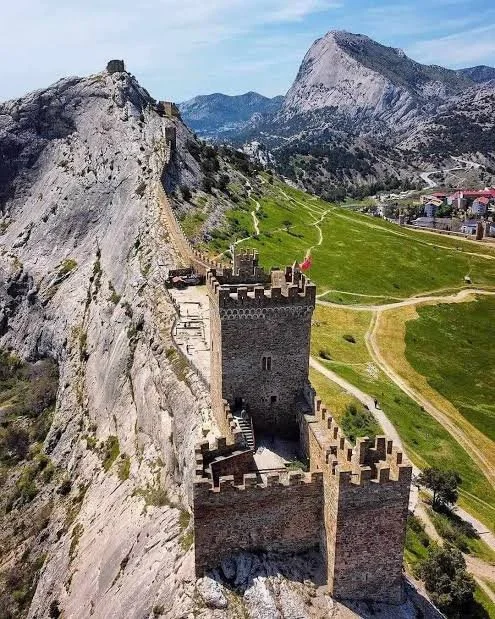
A defensive complex might include walls, towers, gates, elevated observation points, and storage buildings. Its design depended on the terrain, the resources available to its builders, and the threats it was intended to resist. Some structures were designed to protect an entire settlement, while others guarded a smaller strategic position.
Fortifications also had political meaning. A ruler who repaired walls or stationed a garrison at a harbor demonstrated an interest in controlling the surrounding territory. The ability to maintain a fortress could indicate access to revenue, labor, and military resources.
For Genoese merchants and officials, secure ports were valuable because ships and goods needed protection. Yet Genoa did not always build new defenses from the ground up. Where a fortified settlement already existed, a new authority might repair, expand, or occupy it.
This pattern makes the attribution of coastal forts complicated. A fortification that later came under Genoese influence might contain Byzantine foundations and later additions from other periods. Its history would need to be reconstructed through archaeological investigation and documentary research.
Byzantine and Latin Powers in Thessaly
Thessaly experienced changing political conditions during the medieval period. Byzantine authority, regional rulers, and Latin powers all influenced the broader political landscape at different times. The Fourth Crusade of 1204 and the fragmentation of Byzantine territory created new political arrangements across Greece.
Latin states and local lordships emerged in several regions, while maritime powers sought to secure trade routes and coastal possessions. Venice established important positions in the Aegean, and Genoese merchants pursued their own commercial interests. Their activities sometimes overlapped, but their territorial holdings were not identical.
The political history of Thessaly was particularly complex because control of the region could change without every settlement experiencing the same outcome. A coastal town might be influenced by one authority while nearby inland communities remained under another. Local elites could also retain influence across changes in sovereignty.
These circumstances created opportunities for maritime powers to negotiate access to ports or become involved in local conflicts. They do not, however, establish the presence of Genoese forts around the Gulf of Pagasitikos without more specific evidence.
A reliable account must identify the site, establish its date, and determine which political authority was responsible for its construction or modification. Without those steps, the label “Genoese” may obscure a more complicated architectural and political history.
Distinguishing Genoese Forts from Later Structures
Identifying the origin of a fortification requires several kinds of evidence. Architectural style can provide clues, but defensive buildings often share features across regions because they respond to similar practical needs. Thick walls, towers, narrow entrances, and elevated positions are not exclusive to one maritime power.
Archaeological stratigraphy can help establish the sequence in which walls and other structures were built. Excavations may reveal whether a fortification rests on earlier foundations or contains later repairs. Dating materials from secure archaeological contexts can help determine when different construction phases occurred.
Inscriptions, coats of arms, official documents, and contemporary descriptions can provide more direct evidence. A dated inscription naming a patron or a document recording the construction of a tower would be particularly useful. Even then, the evidence must be interpreted carefully: a building could be commissioned by one authority and later modified by another.
Researchers may also compare a site with other well-documented fortifications, but similarities alone are insufficient to prove common ownership. Local builders frequently adapted techniques and designs from neighboring regions.
The most reliable identification emerges when architectural evidence, archaeological dating, and written documentation support the same interpretation.
The Legacy of Reused Fortifications
A fortification's later history can be as important as its original construction. Buildings that once served medieval rulers might be occupied by Ottoman forces, adapted for local administration, or incorporated into later settlements. Some were repaired repeatedly; others fell into disuse as military technology and political priorities changed.
The introduction of more powerful artillery altered the requirements of coastal defense. Older walls and towers might become inadequate against new weapons, prompting modifications or the construction of different defensive systems. At the same time, a structure that no longer served a major military purpose could continue to function as a shelter, administrative building, or local landmark.
Over time, later uses could obscure a site's original function. Stones might be reused in houses, churches, or agricultural buildings. Walls could become integrated into newer structures, while records of the earliest construction disappeared.
This process helps explain why a region's medieval defensive history can be difficult to reconstruct. The absence of a visibly intact Genoese fort does not prove that Genoese merchants never visited the area. Conversely, the presence of an old coastal tower does not establish Genoese construction.
Trade, Security, and Local Communities
Fortifications were connected to the economic life of surrounding settlements. Merchants needed safe places to store goods, sailors required access to supplies, and local authorities sought to protect revenue from trade and taxation.
The presence of a garrison could stimulate demand for food, building materials, clothing, transport, and services. Yet military installations could also burden local populations through the demands of provisioning, labor, and maintenance.
The relationship between coastal settlements and maritime powers was therefore not purely military. A harbor could become a meeting point for local producers and foreign merchants, while the authorities controlling its defenses influenced the conditions under which trade occurred.
Genoese commercial activity, where documented, should be understood within this broader environment. Merchants depended on local labor, regional markets, and agreements with political authorities. Their commercial presence might leave traces in documents and material culture even when they did not build or control a fortress.
Conclusion
The Gulf of Pagasitikos occupies a strategic position within the history of Thessaly and the eastern Mediterranean. Its sheltered waters, access to inland routes, and connection to Aegean shipping made its coastal settlements valuable to rulers, merchants, and military authorities.
Genoa's wider commercial networks brought its merchants into contact with many parts of the Byzantine and post-Byzantine world. However, the presence of Genoese traders in a region does not by itself prove that they built or controlled specific fortifications along the gulf.
Establishing the origin of a coastal fort requires precise site identification and evidence from archaeology, inscriptions, architectural analysis, and historical documents. Some structures may preserve multiple phases of construction, reflecting successive Byzantine, Latin, and Ottoman authorities.
The history of the gulf's defenses is therefore best approached as a layered story of maritime commerce, regional conflict, and architectural reuse. Rather than assigning every medieval ruin to a famous maritime republic, researchers can reconstruct the changing relationships between ports, local communities, and the powers that sought to control them.