Introduction
The Gulf of Corinth occupies a strategically important position in southern Greece. Connecting the Ionian Sea with the waters near the Saronic Gulf through the Corinthian region, it has served as a corridor for maritime movement, military logistics, and commercial exchange. Throughout the Ottoman period, the surrounding territories experienced repeated changes in political control, particularly during conflicts between the Ottoman Empire and the Republic of Venice.
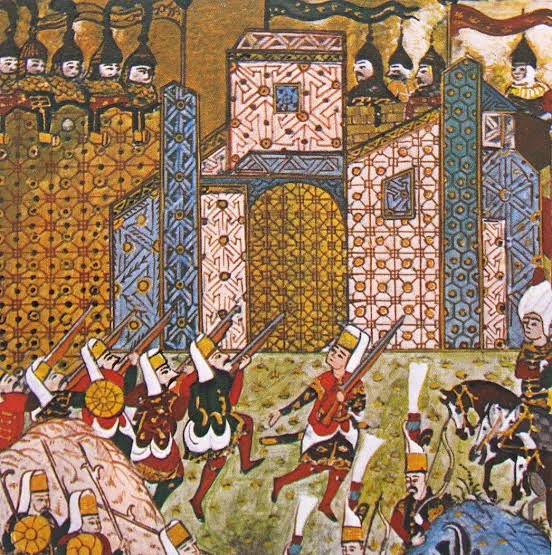
Within this setting, the Ottoman military played a major role in maintaining garrisons, protecting strategic routes, and supporting campaigns across the Morea and central Greece. Among the most recognizable elements of the Ottoman army were the Janissaries, an elite infantry corps that evolved considerably from its early imperial form into a powerful military institution with political and economic influence.
Desertion was a recurring problem in early modern armies, including Ottoman forces. Soldiers could abandon their units because of unpaid wages, harsh service conditions, prolonged campaigns, inadequate supplies, fear of punishment, or opportunities to return to their families and livelihoods. The Gulf of Corinth provides a useful geographical setting for examining the pressures facing Ottoman troops in Greece. However, a specific incident of Janissary desertion in the gulf should not be asserted without a reliable historical source identifying the event.
The Janissaries and Their Changing Role
The Janissaries developed as an elite infantry corps serving the Ottoman sultan. In their earlier institutional history, they were associated with the devshirme system, through which some Christian boys from the empire’s Balkan provinces were recruited, converted to Islam, and trained for state service. The system changed over time, and the composition and recruitment practices of the Janissary corps evolved substantially.
Janissaries were trained to serve the sultan and participate in military campaigns. Their discipline, access to state resources, and organization helped make them a central component of Ottoman military power. In later centuries, however, the corps became more socially and politically complex. Membership expanded through different routes, and some Janissaries developed commercial interests, family connections, and roles in urban life.
These transformations affected military discipline. The Janissaries were not a uniform body whose members behaved identically across three centuries. Their experiences depended on the period, the location of their garrison, their officers, the conditions of service, and the political circumstances surrounding a campaign.
Desertion must be understood within this changing institutional history. The decision to leave a unit could reflect individual hardship, broader dissatisfaction, or the collapse of military authority during a crisis. It did not necessarily indicate opposition to the Ottoman state as a whole.
The Gulf of Corinth as a Military Corridor
The Gulf of Corinth lies between the Peloponnese and mainland Greece. Its surrounding coastline includes harbors, fortified settlements, mountain routes, and narrow passages that could influence military movement. Control of these areas mattered because armies required secure roads, dependable supply lines, and access to ports.
The gulf was particularly important during conflicts involving the Morea, the peninsula that forms much of southern Greece. Ottoman and Venetian forces competed for control of fortresses, towns, and maritime routes. The strategic value of these locations could turn a relatively small garrison into an important element of a wider campaign.
Military service in such a region could be demanding. Soldiers might be required to defend fortifications, escort supplies, maintain communications, or move between posts. When campaigning forces depended on transport by sea, unfavorable weather and naval threats could delay provisions and reinforcements.
These conditions created the possibility of frustration and desertion. A garrison cut off from supplies or uncertain about its prospects could face declining morale. Yet the geography alone cannot prove that Janissaries deserted at a particular harbor or during a particular operation. To establish an individual episode, researchers would need to consult contemporary military correspondence, chronicles, administrative records, or other documentation.
The Morean War and the Struggle for the Peloponnese
One of the major conflicts affecting the region was the Morean War of 1684–1699, during which Venice and its allies fought Ottoman forces for control of territories in southern Greece. Venetian military operations changed the political landscape of the Peloponnese, and the conflict placed pressure on Ottoman garrisons and supply systems.
The war involved sieges, naval operations, shifting front lines, and the need to defend numerous fortified positions. Such conditions could strain the finances and organization of the Ottoman military. Soldiers faced the risks of battle, disease, shortages, and extended separation from their communities.
The Treaty of Karlowitz in 1699 formalized major territorial changes, including Venetian control of the Morea. Ottoman power returned to the peninsula during the Ottoman reconquest of 1715. This sequence of conquest, administration, and reconquest demonstrates how unstable military conditions could become in the region.
It also provides a context in which desertion could occur. Soldiers serving in threatened fortresses might seek opportunities to escape, while others might abandon their posts during retreats or after the breakdown of a defensive position. However, the general pressures of the war should not be confused with proof of a particular Janissary mutiny or desertion near the Gulf of Corinth.
Why Soldiers Deserted
Desertion had several possible causes in early modern armies.
Wages and financial insecurity could be significant. Military institutions needed to pay soldiers regularly, but warfare, administrative problems, and fiscal pressure could interfere with payment. Delayed wages could create hardship, particularly for soldiers responsible for dependents or accustomed to supplementing their income through other work.
Food and supply shortages also affected military morale. Armies depended on complex networks of transport, storage, purchasing, and distribution. A failure at any point could leave troops without adequate provisions. In a region where roads crossed difficult terrain and maritime access could be contested, supply problems might become especially serious.
Campaign fatigue and danger offered another possible explanation. Soldiers who spent long periods away from home could become increasingly unwilling to remain in service. Disease, harsh weather, and the prospect of defeat could intensify this pressure.
Local opportunities could also encourage desertion. A soldier might know the surrounding countryside, possess family connections nearby, or believe that he could disappear into civilian life. Others might leave a unit during a retreat or after becoming separated from their comrades.
These explanations are possibilities, not universal motives. A historian must avoid assuming that every deserter was unpaid, frightened, or politically dissatisfied. Different circumstances produced different decisions.
Desertion, Mutiny, and Military Discipline
Desertion and mutiny are related but distinct. Desertion usually means leaving military service or abandoning a post without authorization. Mutiny involves collective refusal to obey orders or organized resistance to military authority.
A group of soldiers who fled a threatened position would not necessarily constitute a mutiny. Conversely, soldiers who remained at their posts but collectively refused orders might be participating in a mutiny without deserting.
This distinction is important when interpreting historical accounts. Chroniclers sometimes described military failures in moral or political terms, emphasizing cowardice, disobedience, or the misconduct of commanders. Administrative records might instead focus on missing personnel, unpaid wages, disciplinary proceedings, or the loss of a strategic position.
The terminology used by a source can therefore shape the story historians reconstruct. An account describing troops as having “abandoned” a fortress may not establish whether they fled individually, retreated under orders, or acted collectively against their commanders.
The Ottoman Military and Local Society
Ottoman soldiers were not isolated from the communities in which they served. Garrison life involved contact with merchants, artisans, landholders, religious institutions, and local officials. Soldiers purchased food and supplies, rented accommodation, and sometimes developed family or business relationships.
These connections could influence decisions about remaining in service. A soldier with local ties might find opportunities for work or shelter if he left his unit. Others might have stronger obligations to their regiment or commanders, making desertion less attractive.
The presence of soldiers could also place demands on local populations. Authorities had to arrange supplies and maintain military infrastructure, while communities could be affected by taxation, requisitioning, and the movement of armed forces. The relationship between garrison and population therefore varied according to local conditions.
For historians, these social dimensions help explain why military behavior cannot be understood solely through battlefield strategy. A soldier’s decision might be influenced by personal finances, local relationships, the reliability of officers, and the likelihood of punishment.
How Historians Can Investigate the Subject
A detailed history of Janissary desertion in the Gulf of Corinth would require evidence that connects individual soldiers or military units to identifiable events. Relevant material could include Ottoman administrative and military documents, records of pay and provisioning, Venetian reports, local chronicles, and diplomatic correspondence.
Foreign observers can provide valuable information, but their accounts also require scrutiny. A Venetian official reporting that Ottoman soldiers had fled might have been describing a genuine event, interpreting an enemy’s movement in favorable terms, or repeating information supplied by an informant. Comparison with independent sources would help clarify the reliability of the report.
The location and date also matter. An event near the Gulf of Corinth during the Morean War would belong to a different military context from an incident in the eighteenth century after Ottoman control had been restored. Combining events from different periods into a single narrative would create a misleading impression of continuous instability.
Archaeological evidence can help reconstruct the military landscape through fortifications, roads, harbor installations, and material remains. However, archaeology alone rarely identifies the motives of individual soldiers. Documentary and material evidence must be interpreted together.
Conclusion
The possibility of Ottoman Janissary desertion around the Gulf of Corinth can be understood within the wider challenges of early modern warfare. The region’s strategic importance, the Ottoman-Venetian struggle for the Morea, and the practical difficulties of maintaining garrisons all provide a historical context for military indiscipline.
The Janissaries themselves changed considerably over time, and their experiences varied according to the period and the circumstances of their service. Unpaid wages, supply problems, campaign fatigue, and local opportunities could contribute to desertion, but these factors cannot be assigned to a specific incident without evidence.
A careful study of the subject must distinguish documented desertions from general military pressures and must not confuse desertion with mutiny or an authorized retreat. By doing so, the history of Ottoman soldiers in the Gulf of Corinth becomes more than a story of military failure. It becomes an examination of the institutions, material conditions, and personal decisions that shaped service in an empire whose armies operated across a vast and varied landscape.