Introduction
The seventh century was a period of profound transformation in the Balkans. The eastern Roman, or Byzantine, Empire faced military pressure on multiple fronts, while population movements and changing patterns of settlement reshaped the political and cultural landscape of southeastern Europe. Among the communities that became increasingly prominent in the region were Slavic-speaking groups, whom Byzantine authors commonly referred to using forms of the term Sclavenes.
The history of these communities is sometimes described through the idea of “lost chronicles”: records that might have preserved their own accounts of migration, leadership, warfare, and settlement. Such a possibility is understandable. Most surviving written narratives about the seventh-century Balkans were produced by outsiders or by authors writing within the Byzantine Christian literary tradition. The perspectives of the Slavic communities themselves are consequently much less visible in the written record.
However, no securely established collection of contemporary Slavic tribal chronicles from seventh-century Macedonia is known. The phrase “lost chronicles” is therefore best understood as a way of expressing the gaps in the historical record, rather than as a reference to a specific surviving manuscript or a documented archive that historians know once existed.
By examining Byzantine accounts, archaeological evidence, linguistic history, and the limitations of written sources, it is possible to reconstruct aspects of the lives of Slavic communities without inventing documents or presenting uncertain details as fact.
Macedonia in the Seventh Century
The historical region of Macedonia occupied an important position in the central Balkans. It connected routes between the Aegean coast, the interior of the peninsula, the Danube region, and territories farther west. Its valleys and plains supported agriculture and settlement, while its mountain ranges created both natural barriers and corridors of movement.
During the seventh century, Byzantine authority in the Balkans was uneven. The empire was engaged in prolonged conflict with the Sasanian Persian Empire in the east and subsequently faced the expansion of Arab armies. Warfare, changes in imperial priorities, and the difficulty of maintaining distant garrisons placed pressure on Byzantine control of parts of southeastern Europe.
These circumstances did not mean that the empire disappeared from the Balkans. Rather, imperial authority varied between towns, fortified positions, coastal districts, and rural areas. Some communities maintained relationships with Byzantine institutions, while others operated with considerable local autonomy.
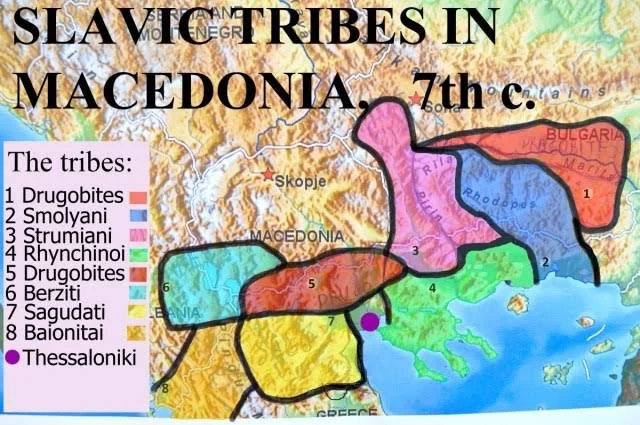
Slavic-speaking groups became established in different parts of the Balkans during this period. Their movement was not a single coordinated invasion carried out by one unified people. It involved different communities, changing alliances, settlement patterns, and interactions with existing populations.
The term “tribe” is often used in older historical writing, but it can imply a degree of unity that the evidence does not always support. Byzantine writers described groups using names that may have reflected political affiliations, regional identities, or the labels known to the authors themselves. The actual organization of these communities could change over time.
What Byzantine Sources Tell Us
One of the important bodies of evidence for the period is the collection of accounts known as the Miracles of Saint Demetrius. These texts concern Saint Demetrius, the patron saint of Thessaloniki, and describe threats to the city, including attacks involving Slavic groups.
The accounts are valuable because they preserve information about the relationship between Thessaloniki and surrounding communities. They describe periods when the city faced military pressure and when neighboring groups participated in raids, sieges, or other forms of conflict. They also reveal how the city’s Christian population interpreted these events through religious belief.
However, the Miracles are not neutral military reports. Their purpose was religious as well as historical. The authors presented Saint Demetrius as a protector of Thessaloniki, and events were framed in ways that emphasized divine assistance and the endurance of the Christian community.
This does not make the accounts useless. It means that historians must consider their purpose, language, chronology, and narrative conventions. The texts can provide evidence of conflict and contact, but they should not be treated as complete descriptions of every Slavic community in Macedonia.
Other Byzantine writings offer additional context, although their coverage is uneven. Authors frequently concentrated on imperial politics, warfare, religious disputes, and the fortunes of major cities. Rural populations and local communities appear less consistently unless they became involved in events that concerned the empire.
The result is an asymmetrical record: Byzantine authors preserved certain encounters in detail while leaving many aspects of local Slavic life undocumented.
Why the Chronicles Are “Lost”
The phrase “lost chronicles” raises a fundamental question about who produced written records in early medieval southeastern Europe.
Literary production in the Byzantine Empire took place within established institutions, including churches, monasteries, imperial administration, and educated urban circles. Written works were generally produced in languages associated with those institutions, particularly Greek. Communities outside these settings might preserve their histories through oral traditions, genealogies, songs, customary law, and memories of migration or conflict.
Oral traditions can be historically meaningful, but they are difficult to reconstruct for a specific seventh-century community without later records that preserve or discuss them. Stories can change as they pass between generations, and later writers may adapt older traditions to fit new religious or political circumstances.
It is possible that some local accounts or records were created and subsequently lost. The survival of medieval literature is highly uneven. Manuscripts could disappear through warfare, fire, abandonment, or the gradual deterioration of materials. Yet the general possibility that records were lost does not establish that a particular set of Slavic chronicles existed.
A responsible article must therefore distinguish between two claims: that the written record is incomplete, which is clear, and that identifiable chronicles of seventh-century Slavic tribes once existed in Macedonia, which would require specific evidence.
The absence of such chronicles does not mean that Slavic communities lacked history, political organization, or complex cultural traditions. It means that their experiences must often be reconstructed through indirect evidence.
Settlement and Everyday Life
Archaeology provides another perspective on early medieval Macedonia. Excavations and surveys can reveal settlement patterns, changes in material culture, agricultural practices, burial customs, and the reuse or abandonment of earlier structures.
The archaeological record must be interpreted carefully. A particular type of pottery or building does not automatically identify the ethnicity of the people who used it. Objects can travel through trade, imitation, migration, and cultural exchange. Communities may adopt new styles without replacing their entire population.
The settlement of Slavic-speaking groups occurred in a landscape that already contained populations shaped by Roman and Byzantine institutions. The region included rural agricultural communities, towns, fortified settlements, and ecclesiastical centers. Interactions between newcomers and existing residents could involve conflict, trade, intermarriage, adaptation, and the gradual formation of new local identities.
Agriculture likely played a major role in many rural communities. Access to cultivable land, water, livestock, and routes to market influenced settlement decisions. Villages could develop around productive land or near older settlements whose infrastructure remained useful.
Not every settlement experienced the same process. Some areas may have seen substantial disruption, while others experienced gradual demographic and cultural change. The evidence does not support reducing the history of Macedonia to a single, uniform event.
Thessaloniki and the Surrounding Communities
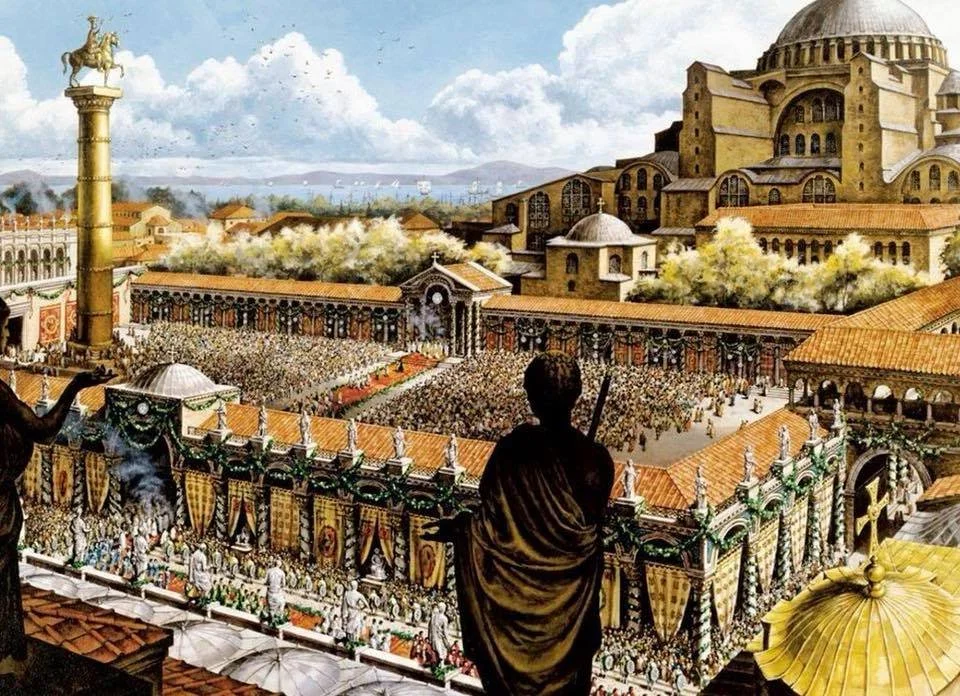
Thessaloniki was a major urban center and an important link between the Aegean and the Balkan interior. Its defensive position, religious institutions, and connections to maritime trade helped sustain its significance during periods of regional instability.
The city’s relationship with neighboring Slavic communities was complex. Byzantine accounts emphasize attacks and sieges, particularly because these events threatened the city and provided material for religious narratives. Yet warfare was only one dimension of regional interaction.
Communities living near Thessaloniki could participate in exchange, provide agricultural products, travel to urban markets, and develop relationships with local authorities. Even when political relations were hostile, trade and everyday contact might continue under some circumstances.
The city also served as a center through which Christianity, Greek-language administration, and imperial cultural practices could influence the surrounding region. Such influence did not necessarily produce immediate or uniform assimilation. Religious conversion, language change, political incorporation, and the development of new identities occurred over extended periods and differed from place to place.
The history of Macedonia is consequently better understood as a long process of interaction than as a simple division between a Byzantine city and a completely separate Slavic countryside.
Language, Identity, and Historical Change
Language provides important evidence for the history of Slavic settlement. The spread of Slavic languages across southeastern Europe is one of the major developments of the early medieval period. Yet language and identity should not be treated as interchangeable.
A person might speak a Slavic language while participating in local Christian institutions or serving within a political structure influenced by Byzantium. Another person might retain a different language while adopting cultural practices associated with neighboring communities. Multilingualism and cultural adaptation were possible, especially in regions where trade and political contact brought people together.
The term “Slavic” itself encompasses a broad range of communities rather than a single political entity. Groups could possess distinct leaders, local traditions, and relationships with neighboring populations. Their identities might change as alliances formed, settlements expanded, or political authority developed.
For this reason, the history of seventh-century Macedonia cannot be reconstructed simply by identifying a list of tribes and assigning each a fixed territory. Written sources may use particular group names, but those names need to be interpreted in their historical context.
Later medieval identities should also not be projected backward without qualification. The political and cultural communities that emerged in subsequent centuries developed through long processes of transformation and cannot be assumed to have existed in exactly the same form in the seventh century.
The Role of Oral Tradition
Oral tradition offers a useful way to think about the kinds of historical memory that written sources may fail to preserve. Communities can transmit stories about ancestors, migrations, wars, rulers, sacred places, and the origins of customary practices without maintaining written chronicles.
Such traditions may preserve genuine memories of earlier events, but historians must examine how they were recorded and transformed. A story documented centuries after the period it describes may contain older material, later reinterpretations, or elements shaped by the concerns of the time when it was written down.
Without a securely traceable chain of transmission, it is difficult to determine which details belong to the seventh century and which emerged later. Oral tradition should therefore be considered alongside archaeological, linguistic, and documentary evidence rather than used as a substitute for them.
The absence of surviving Slavic chronicles is not evidence that these communities had no historical consciousness. It is evidence of the limits of the surviving written archive.
Conclusion
The history of Slavic communities in seventh-century Macedonia is a history of migration, settlement, conflict, and cultural transformation. Byzantine texts, especially the Miracles of Saint Demetrius, provide important information about encounters around Thessaloniki, while archaeology and linguistic research help illuminate the wider changes taking place across the region.
The idea of “lost chronicles” captures a genuine problem: most surviving written narratives were produced by institutions outside the communities whose experiences they describe. Nevertheless, no specific body of seventh-century Slavic tribal chronicles from Macedonia can be treated as established historical fact without direct evidence.
A careful reconstruction must therefore combine sources while acknowledging their limitations. Rather than filling the gaps with invented rulers, manuscripts, or tribal histories, historians can examine settlement patterns, cultural exchange, regional conflict, and the gradual emergence of new identities. These approaches reveal a complex society whose history was larger than the surviving written record.