Introduction
Textiles can preserve history in ways that written documents often cannot. Embroidery, woven patterns, garment construction, and the materials used in clothing reveal information about technology, trade, social status, religious life, and family relationships. When textiles are kept as heirlooms, they can also become objects through which communities preserve memories of earlier generations.
Pontic Greek communities, historically associated with the southern and southeastern shores of the Black Sea, developed distinctive traditions of clothing, music, food, and domestic craft. Gold-colored thread and metallic embroidery have appeared in many regional textile traditions across the eastern Mediterranean and western Asia. Such decoration could communicate wealth, ceremonial importance, or aesthetic preference.
The idea of “esoteric gold embroidery” suggests that patterns on Pontic heirlooms encoded secret religious or philosophical meanings. Some motifs may indeed have symbolic significance, but not every embroidered design represents a hidden code. Patterns can serve decorative, social, religious, or practical purposes, and their meanings may change over time.
A historical study should therefore examine the materials, techniques, provenance, and documented meanings of particular textiles before assigning esoteric interpretations to them.
Pontic Greek Communities and Their Textile Traditions
Pontic Greek communities developed along the southern Black Sea coast in a region shaped by trade, agriculture, mountain settlements, and cultural contact. Their history included Byzantine political influence, the Empire of Trebizond, and later Ottoman rule.
Textile production formed part of the wider domestic and commercial economy. Clothing was made from materials whose availability varied by region and household resources. Wool, linen, cotton, silk, and metallic threads could be used in different combinations depending on the garment, its intended use, and the wealth of the owner.
Traditional clothing was not uniform throughout Pontus. Local styles could vary between towns, villages, social groups, and historical periods. Garments might also change through contact with neighboring communities or through access to new materials and fashions.
Embroidery could be used to decorate garments, household textiles, ceremonial clothing, and objects associated with marriage or religious life. The amount and quality of decoration often depended on the resources available to the maker or family.
The term “Pontic folk heirloom” should therefore refer to a specific object with a documented or credible regional connection, rather than to a single standardized textile tradition shared by all Pontic Greeks.
Gold Thread and Metallic Embroidery
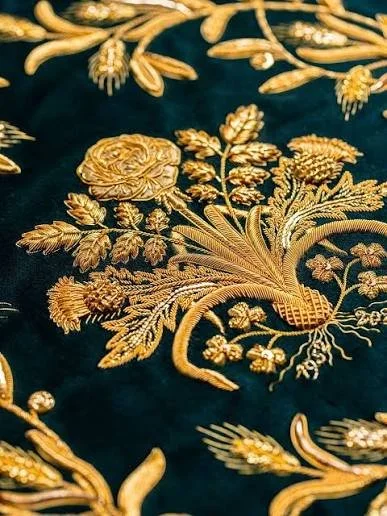
Gold embroidery can involve different techniques and materials. Some textiles use real gold in the form of fine metal strips or wire, while others use gilded materials, metallic thread, or modern substitutes designed to imitate the appearance of gold.
The production of metallic thread required specialized knowledge. Depending on the technique, a thin metal strip could be wrapped around a textile core or applied to a fabric surface. The finished material could then be stitched into decorative patterns.
The use of metallic decoration was not limited to Pontic communities. Gold and silver embroidery appeared in many parts of the Byzantine, Ottoman, Balkan, Caucasian, and eastern Mediterranean worlds. Techniques and motifs could move through trade, migration, workshops, and the circulation of garments.
A textile's metallic appearance therefore cannot establish a uniquely Pontic origin. Researchers must examine construction, materials, stylistic features, provenance, and comparable examples.
Scientific analysis can help determine whether the thread contains gold, silver, copper, or later metallic materials. Such analysis may also assist in distinguishing an older textile from a modern reproduction, although dating requires multiple lines of evidence.
The Symbolism of Embroidered Motifs
Textile patterns can communicate meaning, but their interpretation depends on historical context. Geometric designs, flowers, leaves, birds, stars, crosses, and other motifs appear in many regional traditions.
Some patterns may be associated with religious beliefs or local stories. Others may derive from workshop conventions, fashionable designs, or the practical requirements of embroidery. A repeated geometric motif can be visually striking without carrying a specific symbolic message.
Researchers should distinguish between three kinds of interpretation. The first is documented meaning, established through contemporary descriptions or reliable community testimony. The second is a plausible interpretation supported by comparisons with similar objects. The third is speculation based primarily on visual resemblance.
A star-like design, for example, might be interpreted as a celestial symbol, but it could also be a conventional decorative motif. A cross may have an explicit Christian meaning in one context while functioning as part of a broader decorative pattern in another.
The meaning of a textile should not be decided solely by the modern observer's response to its appearance.
Heirlooms and Family Memory
An heirloom acquires significance through its history within a family or community. A garment might be associated with a wedding, a religious celebration, a migration, or an important family event. Even an object of modest material value can carry strong emotional meaning.
Textiles can also preserve knowledge about the people who made them. Stitching methods, repairs, alterations, and wear patterns may reveal how an object was used and maintained. A garment that was repeatedly repaired might have been particularly valued, while a carefully preserved ceremonial piece may have been worn only on special occasions.
Family oral histories can help establish an heirloom's provenance. However, memories passed through several generations may contain uncertainty about dates, locations, or the identity of the maker. Researchers should record these accounts while comparing them with photographs, documents, and the physical object.
The heirloom's meaning may also change. A garment originally made for practical or ceremonial use can later become a symbol of ethnic identity, family heritage, or cultural survival.
This transformation is historically significant even when the object's original symbolism cannot be fully recovered.
Migration and the Preservation of Pontic Textiles
Pontic Greek communities experienced migration across several historical periods. Movement could occur for economic, educational, political, or personal reasons, while the upheavals of the late Ottoman period and the early twentieth century transformed many community histories.
Textiles could travel with families as useful possessions, valuable property, or objects associated with memory and identity. An embroidered garment might preserve a connection with a place of origin long after the family had settled elsewhere.
However, an object's presence in a diaspora household does not automatically establish where it was made. Textiles could be purchased in markets, received as gifts, altered after migration, or passed between families.
To identify an heirloom as Pontic, researchers should examine its documented history alongside its material and stylistic characteristics. The family's account is an important part of the evidence, but it may not be sufficient by itself to establish the workshop, date, or precise place of production.
The movement of textiles can also reveal wider networks of trade and cultural contact. An object may combine techniques or motifs associated with several regions, reflecting the interconnected nature of the eastern Mediterranean and Black Sea worlds.
Was the Embroidery Esoteric?
The term esoteric usually refers to knowledge or teachings restricted to a particular group. Applying it to embroidery requires evidence that the designs were intended to communicate information unavailable to outsiders.
A textile may contain symbols whose meaning was understood within a family, religious community, or workshop. Yet this does not automatically make the pattern esoteric. The design might communicate a familiar religious message or identify a garment's ceremonial purpose.
A stronger claim would require historical evidence showing that a particular motif was deliberately used as a restricted code. Such evidence might come from written descriptions, workshop records, ritual instructions, or consistent testimony from the community that produced the textile.
Without such evidence, it is more accurate to describe a motif as symbolic or culturally significant rather than secret.
The distinction matters because the language of hidden knowledge can romanticize ordinary craft traditions and obscure the skill, labor, and social relationships involved in textile production.
Documenting and Preserving Textile Heritage
Textiles are vulnerable to light, humidity, dust, pests, and mechanical damage. Metallic threads may corrode or become brittle, while natural fibers can weaken over time. Preservation therefore requires careful handling and suitable storage conditions.
Before conservation, researchers should document the object's dimensions, materials, construction, repairs, and visible damage. Photographs taken under consistent lighting can record the textile's condition and provide a reference for future study.
Material analysis may help identify fibers, dyes, and metallic components. Such analysis should be undertaken by qualified specialists, particularly when sampling could damage the object.
Provenance research is equally important. Family photographs, written records, oral histories, and earlier descriptions can help establish how the textile moved between generations.
Community participation should be central to this process. Heirlooms may carry personal or cultural significance beyond their value as museum objects, and families should have a role in determining how their history is recorded and shared.
Conclusion
Gold embroidery in Pontic folk heirlooms offers a valuable way to investigate craft knowledge, social identity, family memory, and cultural exchange around the Black Sea. Metallic threads and decorative patterns can reveal technical skill and the historical movement of materials and styles.
However, the presence of gold thread or a geometric motif does not establish an esoteric meaning. The interpretation of a textile depends on its provenance, construction, historical context, and the traditions of the people who made and preserved it.
A careful study combines material analysis, stylistic comparison, documentary research, and family testimony. It distinguishes documented symbolism from plausible interpretation and avoids treating every design as a hidden code.
The significance of Pontic heirlooms does not depend on proving that they contain secret messages. Their history lies in the skill of their makers, the lives of the people who used them, and the memories that allowed them to survive across generations and changing landscapes.