Introduction
Dodona, located in Epirus in northwestern Greece, was one of the ancient Greek world's most important oracular sanctuaries. Its oracle of Zeus attracted visitors seeking guidance about personal decisions, public affairs, and uncertain futures. The sanctuary's reputation rested on its distinctive methods of divination and its long history within the religious landscape of the region.
The idea of “oracle bones” at Dodona evokes the use of bones as instruments of prophecy. However, this phrase risks confusing different divinatory traditions. The best-known evidence for Dodona emphasizes Zeus's oracle, the sacred oak, and written questions submitted by visitors. It does not establish a general system of oracle bones used by a group of lesser prophets.
The sanctuary remains an important subject because its archaeological and epigraphic evidence reveals how ancient people sought divine advice. Inscribed lead tablets preserve questions posed to the oracle and provide rare insight into the concerns of ordinary individuals as well as communities.
A careful investigation should therefore focus on the evidence for divination at Dodona, the roles of its religious personnel, and the distinction between documented practices and later speculation about hidden prophetic objects.
Dodona and the Oracle of Zeus
Dodona was situated in a landscape of mountains and valleys in Epirus. Its sanctuary became famous for the worship of Zeus, whose oracle was associated with a sacred oak. Ancient accounts describe divination involving signs connected with the tree, including the interpretation of rustling leaves and other sounds or observations.
The precise procedures used at Dodona changed over time, and the evidence is not uniform across all periods. Ancient writers sometimes emphasized particular details that were important to their own explanations of the sanctuary.
Dodona's oracle served individuals and communities. Visitors could seek guidance about marriage, family matters, property, travel, religious obligations, and other practical concerns. Communities might also consult the oracle about public decisions.
This variety reveals an important feature of ancient divination: it was not restricted to grand political questions. People could use an oracle to address ordinary uncertainties that affected their lives.
The sanctuary's authority depended partly on its reputation, the interpretation of signs, and the religious traditions associated with Zeus.
The Lead Tablets of Dodona
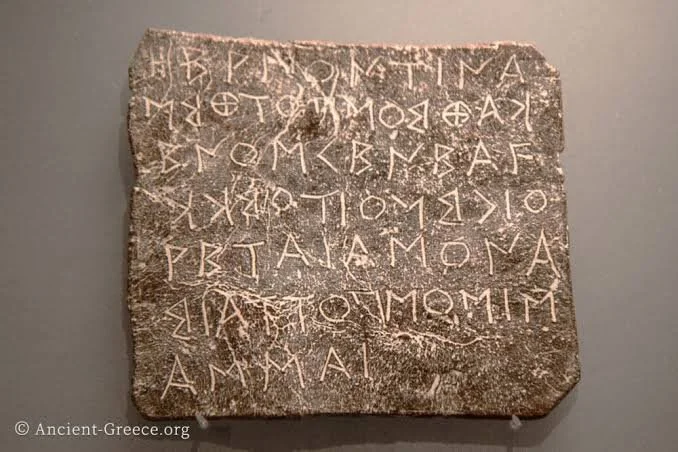
One of the most valuable sources for the history of Dodona is the collection of inscribed lead tablets discovered at the sanctuary. Many preserve questions addressed to the oracle.
The tablets record a wide range of concerns. Some ask whether a particular action would be beneficial, while others concern family relationships, property, marriage, or religious matters. The wording varies, and not every tablet is complete or easy to interpret.
These objects are important because they preserve the voices of people who might otherwise be absent from ancient literature. Instead of learning only about kings, generals, or famous philosophers, researchers can examine questions posed by individuals dealing with everyday decisions.
The tablets also reveal aspects of the sanctuary's practical operation. People traveled to Dodona, prepared questions, and submitted them within a recognized religious process. The oracle formed part of a broader network of belief and consultation.
The tablets are made of lead, but their function was not that of oracle bones in the sense associated with some other ancient divination traditions. The material used to record a question should not be confused with the method by which an oracle's response was obtained.
What Were “Oracle Bones”?
The term “oracle bones” is most famously associated with ancient Chinese divination, especially the late Shang dynasty. In that tradition, inscribed animal bones and turtle shells were used in divinatory procedures involving heat-induced cracks and questions addressed to ancestral or divine powers.
This is a distinct historical tradition from the oracle at Dodona. Similarities in the broad purpose of seeking supernatural guidance do not establish that the same objects or procedures were used.
Ancient societies developed many forms of divination, including the interpretation of animal behavior, dreams, celestial signs, lots, and other phenomena. These practices should be studied within their own cultural and historical contexts.
Calling Dodona's lead tablets “oracle bones” may be intended as a dramatic phrase, but it can mislead readers about the archaeological evidence. The known tablets are better described as inscribed questions associated with the sanctuary's oracle.
If researchers identify actual animal bones with evidence of a specific divinatory function at Dodona, those finds would require separate analysis. They should not be assumed to exist simply because the sanctuary was a center of prophecy.
The Personnel of the Sanctuary
Oracles required people who maintained sacred spaces, conducted rituals, received visitors, and interpreted or communicated divine guidance. Dodona's religious personnel changed over time, and ancient sources preserve different descriptions of those involved.
Some accounts refer to priests and other religious officials associated with Zeus. Ancient literary traditions also mention women connected with the oracle, although the details and chronology of these roles must be examined carefully.
The term “lesser prophets” suggests a defined group of subordinate diviners who used special objects to deliver predictions. Such a group should not be assumed without evidence. Religious personnel could have different responsibilities without belonging to a formal hierarchy of prophets.
Inscriptions, ancient descriptions, and the archaeological layout of the sanctuary can help reconstruct the organization of worship. However, the surviving record does not reveal every task performed by each participant.
A responsible account should describe the roles that can be supported by evidence and avoid inventing a secret class of prophetic specialists.
Divination and Everyday Decisions
Divination was one way ancient people managed uncertainty. In societies where outcomes depended on weather, health, political relationships, travel conditions, and the actions of others, the desire for guidance could be powerful.
An oracle's answer did not necessarily remove uncertainty. It might clarify a choice, reinforce a decision, or provide a framework for interpreting events. The process also connected an individual with a respected religious institution.
The questions preserved at Dodona demonstrate the practical range of concerns brought to the sanctuary. They show that religious consultation was integrated into ordinary life rather than limited to exceptional crises.
The wording of a question could be shaped by local conventions, and the form of the response might depend on the procedures used by the sanctuary. Unfortunately, not all tablets preserve the answers, and some contain only partial text.
The evidence nevertheless offers an unusually direct view of how people approached the divine in search of advice.
Archaeology and the Interpretation of Objects
Archaeological interpretation requires attention to the context in which an object was found. A bone, tablet, or small artifact may have several possible uses, and its function cannot be established from appearance alone.
Researchers examine the material, manufacturing marks, inscriptions, wear patterns, and relationship to nearby structures or deposits. Dating is also essential because an object found at a sanctuary might belong to a period long after its original religious function had ended.
For Dodona, the lead tablets are especially informative because many contain readable questions and are associated with the oracle. Their inscriptions provide evidence that is more direct than a general interpretation based on shape or material.
If an unusual object were proposed as a divinatory instrument, researchers would need to establish how it was used and whether comparable examples existed. The absence of a clear explanation should not be filled with an invented ritual.
Why the “Hidden Oracle Bones” Story Persists
The image of hidden prophetic objects is appealing because it suggests that an ancient sanctuary possessed secret technologies of divination. Yet the historical importance of Dodona does not depend on the existence of mysterious bones.
The sanctuary's known evidence is already remarkable. Its lead tablets preserve questions about personal and communal life, while ancient descriptions reveal how its oracle was understood by visitors and later writers.
The phrase “hidden” might refer to objects discovered during excavation or to aspects of ritual that were not fully described in ancient sources. These are different situations. An object buried in an archaeological deposit was not necessarily concealed deliberately, and an undocumented ritual cannot be reconstructed merely by imagining what might have occurred.
The most useful question is not whether Dodona concealed an unknown system of oracle bones, but how the sanctuary's documented divinatory practices worked and what they reveal about ancient religious life.
Conclusion
Dodona was a major center of divination associated with Zeus and the sacred oak. Its inscribed lead tablets are an exceptional source for understanding the questions ancient visitors brought to the oracle, including concerns about family, marriage, property, and practical decisions.
The phrase “oracle bones” should be used cautiously because the best-known evidence from Dodona consists of lead tablets bearing questions, not a documented system identical to the bone-based divination known from ancient China. Likewise, the existence of a distinct group of “lesser prophets” using hidden bones is not established by the general evidence for the sanctuary.
The history of Dodona is compelling precisely because its surviving evidence allows us to examine the interaction between religion and everyday life. Careful attention to inscriptions, archaeological context, and ancient accounts offers a clearer understanding of the sanctuary than unsupported claims about secret prophetic instruments.