Introduction
The Strymon River, known as the Struma in Bulgaria, flows southward through the Balkans before entering the Aegean Sea in northern Greece. Near its mouth, the river has created a deltaic landscape shaped by sediment deposition, coastal currents, river discharge, and changes in sea level. Wetlands, lagoons, sandy shores, and agricultural areas form part of this environment.
The title Rare Gypsum Dunes Along the Strymon Delta Shores suggests a coastal landscape where wind-blown gypsum crystals form unusual dunes. Gypsum is a real mineral, and gypsum-rich sediments can occur in environments where water evaporates and dissolved minerals precipitate. However, ordinary coastal dunes are usually dominated by quartz and other sand-sized grains, and a specific gypsum dune system at the Strymon Delta would require mineralogical confirmation.
The topic offers an opportunity to examine how dunes develop, how gypsum forms, and how researchers distinguish mineral-rich sediments from conventional coastal sand.
The Geological Nature of Gypsum
Gypsum is a hydrated calcium sulfate mineral with the chemical formula calcium sulfate dihydrate. It contains calcium, sulfate, and water molecules within its crystal structure.
Gypsum commonly forms when water containing dissolved calcium and sulfate becomes concentrated through evaporation. In suitable settings, including restricted basins, saline lakes, and evaporative environments, gypsum may precipitate and accumulate in sedimentary layers.
The mineral can also form through other geological processes, including reactions involving existing minerals and sulfate-bearing water. Its occurrence depends on local chemistry, temperature, water availability, and the movement of groundwater.
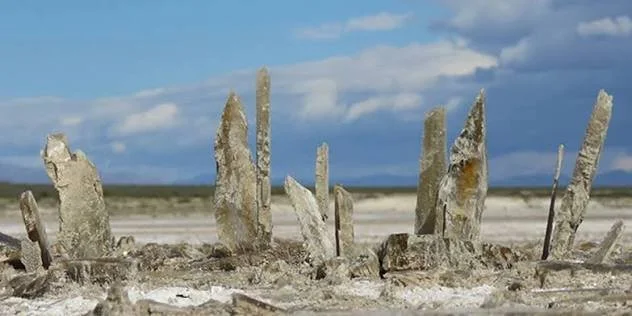
Gypsum is relatively soft compared with many common rock-forming minerals. It can occur as fine-grained material, fibrous crystals, or larger transparent crystals sometimes known as selenite. Its appearance varies according to crystal size, impurities, and the conditions under which it formed.
Although gypsum can occur in loose sediments, the existence of a gypsum deposit does not automatically mean that wind has formed dunes from it.
How Coastal Dunes Develop
Coastal dunes form when wind transports sand from beaches or other exposed sediment sources and deposits it where vegetation, obstacles, or changes in wind speed reduce the movement of grains.
The process depends on several factors, including grain size, wind direction, moisture, sediment availability, and vegetation. Fine, dry sand is generally easier for wind to transport than coarse or waterlogged sediment.
Dunes may form ridges parallel to the shoreline, isolated mounds, or larger systems that migrate inland. Vegetation can stabilize dunes by trapping sand and binding it with roots. Where vegetation is removed or damaged, dunes may become more mobile and vulnerable to erosion.
The mineral composition of dune sediment reflects the source material. Quartz is common because it is abundant and relatively resistant to weathering. Other minerals may occur in smaller amounts, depending on the geology of the surrounding watershed and coastline.
For a dune to be described as gypsum-rich, researchers would need to demonstrate that gypsum makes up a significant proportion of its sediment. The presence of a few gypsum crystals would not justify classifying an entire dune field as a gypsum dune system.
The Strymon Delta's Sedimentary Environment
The Strymon Delta developed through the interaction of river transport and coastal processes. The river carries sediment from inland areas, while waves and currents redistribute material near the coast. Seasonal variations in discharge and changes in the supply of sediment influence the shape and stability of the delta.
Geological research on the Strymon basin and nearby Strymonikos Gulf examines the region's sedimentary development and tectonic history. These studies provide context for understanding the landscape, but they do not by themselves establish the existence of gypsum dunes along the delta shores. <Cite refs={["turn478061search6"]} />
A gypsum dune claim would need to be investigated separately. Researchers would collect representative sediment samples from the beach, dune surface, and underlying layers. Laboratory analysis could determine whether gypsum is present and whether it occurs in sufficient quantities to influence the sediment's properties.
The source of the gypsum would also matter. It might originate from an evaporite deposit, be transported from inland areas, or occur as a minor component mixed with other minerals. Understanding the source would help explain whether the material could accumulate through coastal and wind-driven processes.
Can Gypsum Form Dunes?
Gypsum-rich sand can occur in certain dry environments, especially where local geological conditions provide abundant gypsum crystals or fragments. Wind can transport suitable particles, but their behavior depends on size, shape, density, and moisture.
In humid coastal environments, gypsum may dissolve or undergo changes when exposed to repeated wetting. This can limit its long-term preservation in loose surface deposits. The precise outcome depends on local rainfall, groundwater chemistry, drainage, and the amount of gypsum available.
Therefore, a proposed gypsum dune system near a river delta would require evidence of both a suitable mineral source and conditions that allow gypsum-rich material to accumulate. A landscape that appears pale or crystalline is not enough to establish its composition.
Ecological Importance of Delta Dunes
Coastal dunes can protect inland areas by absorbing wave energy and providing sediment that is redistributed during storms. They also create specialized habitats for plants and animals adapted to shifting sand, salt exposure, and limited freshwater.
Deltaic environments are particularly sensitive because river flow, sediment supply, and coastal erosion interact. Dams, channel modifications, sand extraction, construction, and changes in river discharge can alter the balance between sediment accumulation and erosion.
Dune conservation should therefore consider the entire coastal system. Protecting vegetation, limiting destructive vehicle access, and maintaining natural sediment processes can help preserve the stability of dune habitats.
Conclusion
The Strymon Delta provides a useful setting for studying coastal sedimentation, river-delta evolution, and dune formation. Gypsum is a well-understood mineral that can accumulate in evaporative environments and, under suitable conditions, become part of wind-transported sediments.
However, a distinctive field of rare gypsum dunes along the Strymon Delta should not be treated as a confirmed geological feature without mineralogical surveys. Sediment sampling and geological mapping would be necessary to establish the mineral composition, origin, and extent of any such deposit.
By separating the established geology of the delta from the unverified gypsum dune claim, researchers can investigate the possibility while maintaining a reliable account of the region's natural history.