Introduction
Amvrakikos Bay, located in northwestern Greece, is a semi-enclosed coastal basin connected to the Ionian Sea through a relatively narrow opening. The bay contains lagoons, shallow coastal waters, river-influenced environments, and habitats that support a diverse range of marine and bird life.
Like other coastal ecosystems, Amvrakikos experiences changes in water temperature, salinity, currents, and biological activity throughout the year. These conditions influence the distribution of plankton, jellyfish, fish, and other organisms.
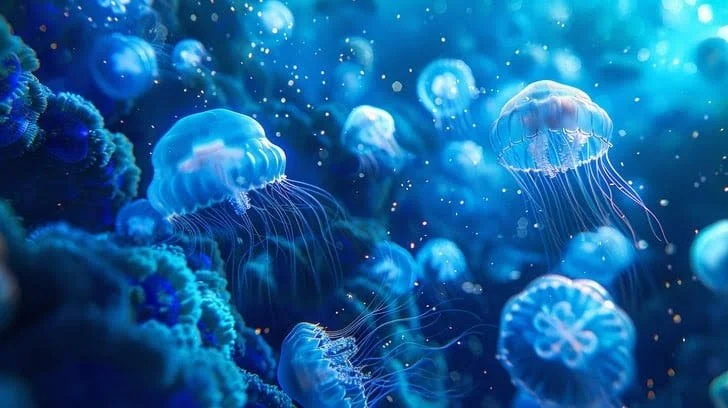
The idea of bioluminescent jellyfish swarms in the bay combines two genuine natural phenomena: jellyfish aggregations and biological light production. Some marine animals can produce light, and some jellyfish species are bioluminescent. However, the presence of recurring luminous jellyfish swarms in Amvrakikos Bay requires site-specific documentation. It should not be assumed merely because the bay supports marine life.
What Is Bioluminescence?
Bioluminescence is the production of light by a living organism through a chemical reaction. It occurs in a range of marine animals and microorganisms, including certain jellyfish, comb jellies, crustaceans, fishes, and planktonic organisms.
The chemical mechanisms vary among groups. Some organisms use a light-emitting molecule and an enzyme, while others rely on specialized proteins or chemical systems acquired through their food or symbiotic relationships.
Bioluminescence may serve several functions. It can help attract prey, confuse predators, provide camouflage, or facilitate communication. The role depends on the species and its ecological circumstances.
In dark water, the emitted light may appear blue or blue-green, although the color varies. A luminous animal can create a visible flash or glow, but the intensity depends on the organism, the surrounding darkness, and the observer's distance.
Not every jellyfish is bioluminescent, and not every luminous patch in the sea is caused by jellyfish. Microscopic plankton can also create flashes when the water is disturbed.
Jellyfish and the Formation of Swarms
Jellyfish are gelatinous animals belonging to several groups within the broader diversity of marine invertebrates. Their life cycles vary, but many species alternate between a free-swimming medusa stage and a smaller attached polyp stage.
Some jellyfish populations periodically increase in abundance or gather in particular areas. These aggregations are often called blooms or swarms. Their appearance can be influenced by water temperature, currents, food availability, reproduction, and the movement of water masses.
A visible aggregation does not necessarily mean that a population has permanently increased. Currents may concentrate animals in one location, creating a temporary swarm even when the wider population has not changed significantly.
Conversely, a true population increase may occur over a broader area and persist for longer. Distinguishing these situations requires repeated observations and, ideally, measurements of abundance and environmental conditions.
Why Semi-Enclosed Bays Matter
Semi-enclosed bays often have circulation patterns that differ from those of the open sea. Water exchange with the wider ocean may be restricted, and local winds, river discharge, and differences in water density can influence circulation.
Amvrakikos Bay receives freshwater and sediment from rivers, including the Louros and Arachthos. These inputs contribute to changes in salinity, nutrients, and water-column structure. The interaction between freshwater and seawater can create different habitats within the same bay.
These conditions influence marine food webs. Nutrient availability can affect plankton, which in turn supports organisms that feed on plankton. Jellyfish may benefit from particular combinations of prey availability and water circulation, although responses differ among species.
The bay's physical setting makes it relevant to marine ecological research, but it does not establish that bioluminescent jellyfish swarms occur there regularly.
How Researchers Would Investigate Luminous Swarms
A credible report of glowing jellyfish should identify the organisms responsible. Photographs and video can provide initial evidence, but researchers may need to examine specimens or use detailed imaging to distinguish jellyfish from similar gelatinous animals.
Observations should include the date, location, water temperature, salinity, weather, and approximate abundance of the organisms. Nighttime surveys can document visible light, while daytime observations can help identify the animals themselves.
Researchers may also sample plankton to determine whether luminous microorganisms are present. This is important because a glowing surface may result from dinoflagellates rather than from larger animals.
Repeated observations are essential for determining whether the phenomenon is seasonal, occasional, or associated with a particular current or environmental event. Without such records, a dramatic sighting should not be presented as a permanent natural attraction.
Ecological Implications of Jellyfish Blooms
Jellyfish are natural components of marine food webs. They consume a range of organisms, including plankton and, depending on the species, small fish or fish larvae. They are also eaten by some marine animals.
Large aggregations can affect fisheries, tourism, and coastal activities. Certain species sting humans, while others are relatively harmless to people. The risk cannot be judged reliably from the presence of a jellyfish swarm alone.
Environmental changes may influence the frequency or intensity of some jellyfish blooms, but there is no single explanation that applies to every location. Temperature, currents, food availability, predators, fishing pressure, and life-cycle characteristics may all contribute.
A claim that luminous jellyfish are increasing in Amvrakikos would therefore require long-term data rather than a few observations.
Protecting Amvrakikos Bay
The bay's lagoons and coastal habitats are important for biodiversity and are part of a broader wetland environment. Conservation requires attention to water quality, habitat alteration, fisheries, and the effects of human activity.
Responsible wildlife observation means avoiding unnecessary disturbance, not handling unfamiliar jellyfish, and following local guidance. Visitors should not enter the water simply to get closer to a luminous animal or assume that an organism is safe because it glows.
Conclusion
Bioluminescence and jellyfish aggregations are both genuine features of marine ecosystems. Their combination can produce remarkable nighttime displays, but establishing that such displays occur regularly in Amvrakikos Bay requires reliable observations and species identification.
The bay's semi-enclosed geography, freshwater inputs, and varied habitats make it a valuable setting for studying marine ecology. A careful investigation could determine whether luminous jellyfish occur there, how often they appear, and which environmental factors influence their distribution. Until such evidence is available, the title should be treated as an intriguing research topic rather than confirmation of a known recurring spectacle.