Introduction
In the ancient Greek world, healing was associated with several overlapping traditions. Medical practitioners observed symptoms and developed treatments, households used familiar remedies, and religious sanctuaries offered forms of healing connected with divine assistance. Among the most important healing deities was Asclepius, whose sanctuaries attracted visitors seeking relief from illness, pain, and uncertainty.
The region of Phthiotis, in central Greece, provides an interesting setting for exploring the relationship between natural springs, ancient settlement, religious practice, and medical care. The region's landscape includes mountains, valleys, and waterways, while its history connects it to the wider religious and political life of central Greece.
The idea of underground healing springs associated with Asclepius suggests a hidden network of sacred waters beneath the landscape. Such a network should not be assumed without archaeological or geological evidence. Natural springs were valued in many ancient communities, but not every spring was a healing sanctuary, and not every sanctuary associated with healing depended on underground water.
A historical investigation must distinguish between the documented cult of Asclepius, the ancient use of springs, and the modern interpretation of local geological features. This distinction allows the subject to be explored without confusing archaeological evidence, local tradition, and speculation.
Asclepius and Ancient Healing
Asclepius was the Greek god associated with healing and medicine. Ancient mythology described him as a skilled healer whose knowledge could restore health, although stories about his powers also raised questions about the limits of human and divine authority.
His cult became widespread across the Greek world. Sanctuaries dedicated to Asclepius, often called Asclepieia, served as religious centers where people sought healing through offerings, prayer, ritual activity, and other practices.
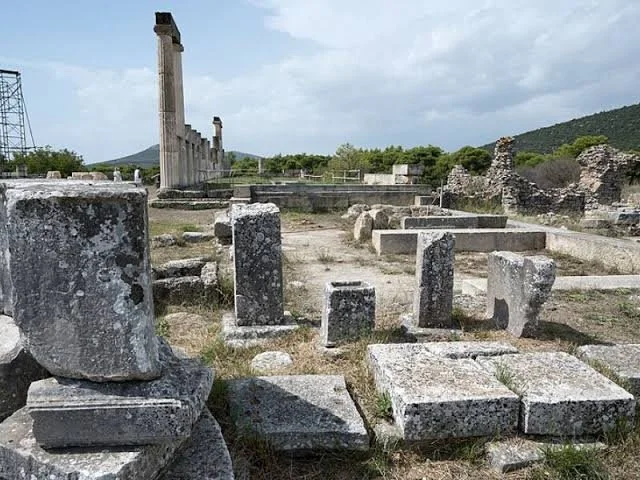
The sanctuary at Epidaurus is among the best-known examples. Other centers, including the sanctuary at the island of Cos, were associated with healing and the wider development of medical traditions. Their practices were not identical, and the relationship between religious healing and practical treatment varied over time.
Ancient healing should not be divided too rigidly into “religion” and “medicine” as though they were entirely separate systems. People could consult a physician, use herbal remedies, make offerings to a deity, and seek support from family members during the same illness.
The cult of Asclepius offered a framework in which suffering could be addressed through religious participation and the hope of divine assistance. Its popularity reflected both the importance of health and the uncertainty that surrounded many illnesses in antiquity.
The Role of Water in Ancient Sacred Landscapes
Water held practical and symbolic importance in ancient Greek communities. Springs supplied drinking water, supported agriculture, and helped sustain settlements. Their reliability could influence where people lived and how communities developed.
Water also featured in religious practices. Purification with water was common in various ancient Greek rituals, although the precise requirements differed according to the ceremony and sanctuary. Springs, rivers, and wells could acquire sacred associations through local stories, dedications, or the presence of a nearby sanctuary.
Some ancient sanctuaries incorporated water installations, including fountains, basins, wells, and channels. Their functions varied. A water feature might supply visitors, support ritual purification, serve the needs of a sanctuary, or form part of a larger architectural complex.
The association between water and healing is understandable in this context. Bathing, washing, drinking clean water, and resting near a spring could be perceived as beneficial. Certain mineral-rich waters may also have attracted attention because of their taste, temperature, or other noticeable characteristics.
However, the presence of water near a healing sanctuary does not prove that the water possessed medicinal properties, nor does it establish that the spring was used in a specific ritual.
Phthiotis and Its Historical Landscape
Phthiotis occupies part of central Greece and has connections with the historical region of Thessaly as well as routes leading toward southern Greece. Its geography includes fertile plains, upland areas, and access to the Malian Gulf.
The region's settlements developed in relation to agriculture, trade, transport, and the political circumstances of different historical periods. Ancient communities relied on local water sources for domestic use, livestock, irrigation, and other needs.
The region's natural springs and waterways would have been important to its inhabitants. Yet identifying a particular spring as an Asclepian healing site requires evidence beyond its location or reputation.
Researchers would need to examine local archaeological remains, inscriptions, ancient geographical descriptions, and the history of nearby settlements. A sanctuary might be identified through dedicatory inscriptions, cult objects, architectural remains, or references in ancient texts.
Without such evidence, a spring can be described as a potentially significant local water source, but it should not be assigned to the cult of Asclepius as an established fact.
What Would an Asclepieion Look Like?
Asclepieia varied in size and layout. Some developed into extensive sanctuary complexes, while others were smaller local institutions. Their architecture could include temples, altars, porticoes, sleeping areas, water installations, and spaces for offerings.
At some healing sanctuaries, visitors participated in a practice known as incubation. They slept in a designated sacred space, hoping to receive a healing dream or divine instruction. Inscriptions and later accounts describe experiences in which Asclepius appeared to a patient or prescribed an action associated with recovery.
These accounts are valuable for understanding ancient religious expectations, but they should not be read as modern clinical records. They often served commemorative or devotional purposes and could emphasize the deity's power.
Archaeological evidence can help identify the physical organization of a sanctuary. Inscriptions may name the deity, record dedications, or commemorate a healing. Objects associated with body parts have been found at some healing sanctuaries and are commonly interpreted as offerings expressing a request for or gratitude for recovery.
If a Phthiotian spring were associated with an Asclepieion, researchers would seek a comparable combination of evidence. A water source alone would not be sufficient.
The Meaning of “Underground” Springs
The phrase “underground spring” can refer to water that emerges from a subterranean aquifer, flows through a cave, or is accessed through a well. These are ordinary geological phenomena and can occur in limestone landscapes, where water moves through cracks and underground passages.
Such springs can be important to human settlement. Their temperature, mineral content, and reliability may differ from those of surface water sources. Some can produce distinctive deposits or leave geological traces that help researchers reconstruct their development.
However, the fact that water emerges from underground does not make it sacred. Ancient communities may have regarded particular springs as significant, but that interpretation must be established through local evidence.
The idea of a hidden network of underground healing springs connected to Asclepius is therefore a hypothesis, not an established feature of Phthiotian archaeology. To support it, researchers would need to identify the springs, document their geological characteristics, and demonstrate their historical association with healing practices.
Modern geological surveys can clarify where water flows underground. Archaeological investigation can determine whether ancient structures or artifacts are associated with a spring. Combining these methods would provide a stronger basis for interpretation than relying on a local legend alone.
Religious Healing and Practical Care
Ancient healing involved a range of practices. Physicians could observe symptoms, discuss a patient's history, recommend changes in diet, and use treatments available within their medical traditions. Families and local communities also relied on household remedies and caregiving.
Religious healing offered another approach. A visit to a sanctuary could provide hope, a sense of participation, and a framework for interpreting suffering. The ritual experience might be important even when the illness did not resolve.
Water could contribute to practical care through bathing, washing, and drinking. A spring might also provide a peaceful setting in which visitors rested during their journey. These benefits should be distinguished from claims that a particular water source could cure specific diseases.
Ancient accounts of miraculous healing reveal beliefs about divine power, but they do not establish the medical effectiveness of a treatment by modern standards. Similarly, archaeological evidence of a sanctuary cannot demonstrate that all patients recovered.
Understanding ancient healing requires attention to both its religious meaning and the limitations of historical medical knowledge.
How to Investigate a Local Healing-Spring Tradition
A study of a purported Asclepian spring in Phthiotis would begin with the identification of a specific location. Researchers would examine historical place names, local oral traditions, archaeological surveys, and any ancient references to the surrounding settlement.
Next, they would investigate the physical water source. Geological evidence could establish whether it emerges from an underground aquifer, passes through a cave, or is associated with mineral deposits. This would clarify the natural history of the spring without assuming a religious interpretation.
Archaeologists would then look for evidence of ancient use. Nearby buildings, altars, inscriptions, votive objects, and water-management installations could help establish whether the site had a ritual or practical function.
Finally, the evidence would need to be dated. A spring used in antiquity might have served different purposes during the Roman, Byzantine, Ottoman, and modern periods. Its current reputation may reflect a later tradition rather than an ancient cult.
This approach would make it possible to distinguish a documented healing sanctuary from a local water source whose historical significance remains uncertain.
Conclusion
Asclepius was one of the most important healing deities in ancient Greek religion, and his sanctuaries provide valuable evidence for the relationship between religious practice and the search for health. Water also played practical and ritual roles in ancient communities, making springs a plausible focus of local significance.
Phthiotis's landscape offers a setting in which to investigate these relationships. Nevertheless, the existence of a particular network of underground healing springs dedicated to Asclepius cannot be established without specific archaeological, textual, or epigraphic evidence.
A reliable investigation would combine geological study with archaeology and historical research. It would distinguish the natural characteristics of a spring from its religious interpretation and avoid treating ancient accounts of miraculous healing as modern medical evidence.
The subject remains compelling because it connects the physical landscape with ancient ideas about health, sacred power, and human vulnerability. The strongest account will emerge from the careful study of identifiable sites rather than assumptions about hidden underground sanctuaries.