Introduction
Thessaloniki, founded in the late fourth century BCE, became one of the most important cities of the ancient and medieval Balkans. Its strategic position at the northern end of the Aegean, together with its connections to major roads and maritime routes, made it an important center of trade, administration, and cultural exchange.
During the Roman imperial period, the city participated in the diverse religious life of the empire. Alongside traditional Greek and Roman cults, the wider Roman world included religious associations and initiatory traditions whose participants came from different social backgrounds.
One of the most distinctive of these traditions was the cult of Mithras, often called Roman Mithraism. Its worshippers gathered in specialized sanctuaries commonly known as mithraea. Because these spaces were often enclosed and sometimes built partly below ground, they have contributed to modern fascination with underground temples and secret initiation.
However, the existence of Mithraic sanctuaries elsewhere in the Roman Empire does not establish a network of hidden temples beneath Thessaloniki. Such a claim would require specific archaeological evidence from the city. The topic is best explored by examining the nature of Roman Mithraism, its architecture, and the evidence needed to identify a sanctuary.
Thessaloniki under Roman Rule
Thessaloniki became a major regional center after its foundation and continued to develop under Roman rule. The city stood near the Via Egnatia, the important road linking the Adriatic region with the eastern Mediterranean. Its harbor and commercial connections strengthened its role in the movement of goods, people, soldiers, and ideas.
Roman Thessaloniki contained public buildings, residential districts, religious spaces, and infrastructure associated with a major urban center. Its population included people with different languages, occupations, legal statuses, and religious affiliations.
The city was not culturally uniform. Religious life could include traditional civic worship, household rituals, imperial cult practices, and religious associations connected with particular communities or professions.
This diversity created conditions in which different religious traditions could circulate. However, the presence of a varied religious environment does not prove that every cult known from the Roman Empire had a sanctuary in Thessaloniki.
Each proposed cult site must be established through local evidence.
What Was Roman Mithraism?
Roman Mithraism was a religious tradition that flourished in the Roman Empire, particularly during the first to fourth centuries CE. It centered on Mithras, a deity whose name and some aspects of his imagery are connected with older Iranian religious traditions, but whose Roman cult developed within a distinctive imperial context.
The central image of Roman Mithraism is the tauroctony, which depicts Mithras killing a bull. The scene is commonly accompanied by other figures, including a dog, a serpent, a scorpion, and attendants carrying torches. Scholars continue to debate the image's full meaning and its relationship to ancient cosmology.
Mithraic worship was organized around initiation and participation in a community of worshippers. Inscriptions and other evidence indicate that members could be assigned grades or titles, although the precise meaning and practical significance of these grades remain subjects of study.
The cult was not identical to the older public religions of Greek and Roman cities. Its specialized imagery, restricted ritual practices, and distinctive meeting spaces gave it a recognizable character.
Nevertheless, Roman Mithraism should not be confused with modern ideas about a single secret society controlling political events. The evidence points to religious communities whose practices were shaped by the institutions and social relationships of the Roman world.
Why Mithraic Sanctuaries Were Often Enclosed
Mithraic sanctuaries are frequently described as caves or underground temples. Many were designed as enclosed spaces that resembled caves, even when they were constructed within buildings or adapted from existing structures.
The cave-like form was important to the cult's ritual environment. A long central space often contained benches along the sides, allowing participants to gather facing inward. At one end, a representation of the bull-slaying scene commonly occupied a prominent position.
The arrangement supported communal meals and other ritual activities. Archaeological evidence from Mithraea often includes dining equipment, lamps, inscriptions, and sculptural material associated with the cult.
Not every Mithraeum was literally underground. Some were located in basements, while others occupied buildings or artificially constructed spaces. Their defining characteristics were the ritual layout and associated evidence, not simply their position below ground level.
The cave-like setting has encouraged interpretations connecting the sanctuary with cosmic symbolism, but the exact meaning of every architectural feature remains debated.
Initiation and Religious Secrecy
Mithraic communities practiced initiation, and some elements of their ceremonies were not intended for outsiders. The cult's specialized spaces and imagery suggest that participants shared forms of ritual knowledge unavailable to the general public.
However, secrecy should not be confused with illegality. Many religious practices in the Roman Empire involved restricted ceremonies or knowledge reserved for members. The existence of initiation did not automatically place a cult outside the law.
The evidence for Mithraic ritual comes primarily from archaeological remains, inscriptions, and artistic representations. These sources reveal aspects of the cult's organization and imagery but do not provide a complete account of every ceremony.
Modern descriptions of Mithraic initiation sometimes go beyond the evidence by presenting detailed sequences of secret ordeals as though they were fully documented. Such reconstructions need to be evaluated according to the sources that support them.
A historically responsible account should distinguish between the secure evidence for initiation and more speculative attempts to reconstruct the exact experiences of participants.
Archaeological Evidence for a Mithraeum
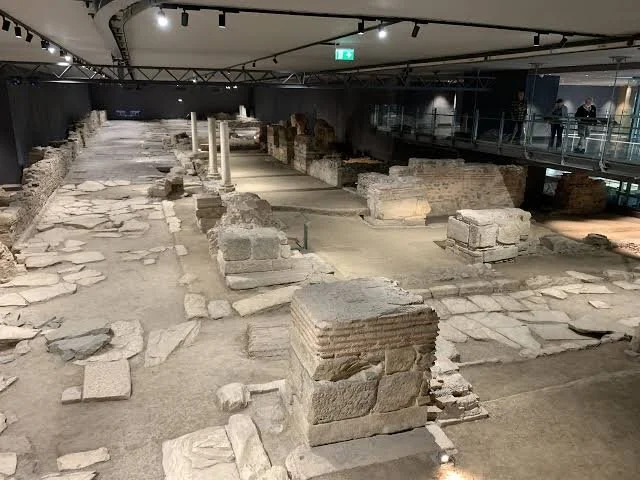
Identifying a Mithraeum requires more than discovering an underground chamber. Many subterranean spaces in ancient cities served as storage rooms, water installations, workshops, burial spaces, or parts of domestic buildings.
A convincing identification would normally depend on several forms of evidence. These could include a characteristic sanctuary layout, a tauroctony relief or associated imagery, inscriptions naming Mithras or worshippers, and artifacts consistent with the cult's ritual practices.
The archaeological context is equally important. Researchers need to know whether the objects were found in their original positions, whether the building can be dated securely, and whether the room underwent later alterations.
A relief depicting Mithras found in a city does not automatically prove that it came from a nearby underground sanctuary. Objects can be moved, reused in later buildings, or discovered far from their original location.
For Thessaloniki, any claim about an underground Mithraic temple must be supported by published archaeological evidence identifying a specific site. General knowledge of Roman Mithraism cannot substitute for that local evidence.
Did Thessaloniki Have a Mithraic Community?
Thessaloniki's position within the Roman Empire made it a plausible setting for a variety of religious associations. Soldiers, merchants, officials, travelers, and other residents moved through the city, bringing different practices and beliefs.
Roman Mithraism is known from numerous parts of the empire, including military and urban settings. Its participants were not exclusively soldiers, although military connections were important in some regions.
Yet the presence of Mithraism elsewhere does not establish the existence of a particular community in Thessaloniki. That question must be answered through inscriptions, reliefs, archaeological remains, or other evidence specifically associated with the city.
If evidence of a Mithraic community were identified, researchers would then examine its chronology, membership, relationship with the urban environment, and possible connections with other communities in the Balkans.
Until such evidence is established, it is more accurate to describe Mithraism as part of the wider Roman religious world that provides context for studying Thessaloniki, rather than claiming that hidden temples have been confirmed beneath the city.
The Fate of Mithraic Sanctuaries
Mithraic sanctuaries operated within the changing religious environment of the Roman Empire. During the later imperial period, Christianity became increasingly influential, and traditional cult institutions gradually lost public support and legal protection.
The transformation was not identical in every city. Religious sites could be abandoned, repurposed, dismantled, or incorporated into later structures. Some buildings survived because they were reused for other purposes, while others disappeared through urban redevelopment.
A subterranean room discovered beneath a later building may therefore have had several phases of use. Its earliest function cannot be determined solely from its final appearance.
Archaeologists must establish the chronology of the structure and examine the artifacts associated with each phase. This is particularly important in cities with long histories of continuous occupation, such as Thessaloniki.
The possibility of an ancient sanctuary beneath later urban layers is a legitimate archaeological question, but it must be answered through excavation and documented evidence.
Conclusion
Roman Mithraism was a distinctive initiatory cult with specialized sanctuaries, recognizable imagery, and communal rituals. Many Mithraea were enclosed or cave-like spaces, which helps explain the association between Mithraism and underground temples.
Thessaloniki's importance as a Roman city makes its religious history worth investigating. Nevertheless, the existence of a confirmed underground Mithraic temple beneath the city cannot be inferred from the cult's wider popularity.
A specific identification would require archaeological evidence such as a characteristic sanctuary layout, inscriptions, Mithraic imagery, and securely documented excavation context. A subterranean chamber alone is not enough.
The subject illustrates the importance of distinguishing an established feature of Roman religious history from a local archaeological claim that requires verification. By applying this distinction, researchers can investigate Thessaloniki's religious diversity without turning its underground spaces into imagined secret temples.