Introduction
Fertility was a major concern in ancient agricultural societies. The growth of crops, the health of livestock, the birth of children, and the continuation of family lines all influenced the stability of communities. Religious practices often addressed these concerns through offerings, festivals, prayers, and ceremonies associated with deities believed to protect agriculture, childbirth, or household prosperity.
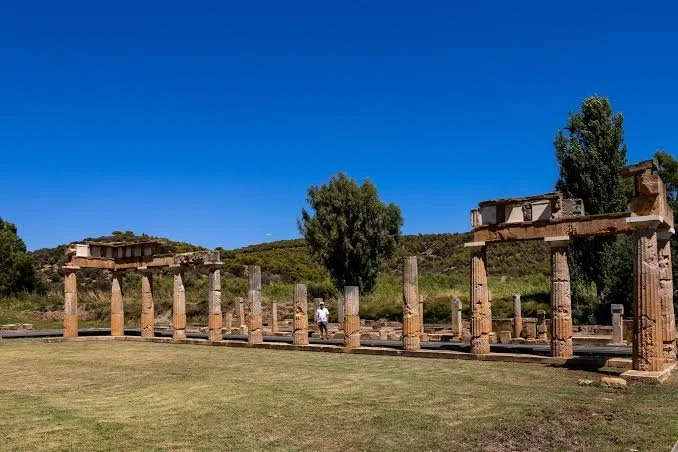
The Amarynthos area of Euboea, an island east of mainland Greece, provides an interesting setting for studying the relationship between local sanctuaries, agricultural life, and religious practice. The region is associated with the worship of Artemis, and archaeological research has contributed to a better understanding of its ancient sacred landscape.
The phrase “rare fertility rites” suggests distinctive ceremonies whose details may have been restricted or poorly documented. However, fertility-related religious practices were not necessarily rare or secret. They could form part of public festivals, household worship, and regular offerings.
A careful historical account must identify the specific evidence for a ritual before describing its purpose. The presence of a sanctuary associated with Artemis does not automatically establish that every ceremony performed there was a fertility rite.
Fertility in Ancient Greek Society
Ancient Greek communities depended on successful agriculture and the continuation of households. Crop failures, disease, infertility, and high infant mortality could create serious uncertainty. Religious practices offered ways to seek divine assistance and to mark important moments in the agricultural and human life cycles.
Fertility was not the domain of one deity alone. Demeter was strongly associated with grain and agricultural productivity, while Hera had connections with marriage and legitimate family relationships. Artemis possessed several roles, including associations with young people, childbirth, and the transition from childhood to adulthood in certain traditions.
These roles varied by location. A deity could have different local functions, and the same divine figure might be honored through distinct ceremonies in different sanctuaries.
Fertility rituals could include offerings, processions, songs, dedications, and communal meals. Some were public and integrated into the civic calendar; others took place within households or smaller social groups.
It is therefore misleading to imagine ancient fertility worship as a single secret system. The practices were diverse, and their meanings depended on the deity, community, and occasion.
Amarynthos and the Cult of Artemis
Amarynthos is associated with an important sanctuary of Artemis on Euboea. The identification and investigation of the sanctuary have helped clarify the relationship between the ancient settlement and its religious landscape.
Artemis was a widely worshipped goddess whose functions included hunting, wilderness, protection of young people, and aspects of childbirth. Her cults differed across the Greek world, reflecting local histories and traditions.
The sanctuary at Amarynthos belonged to this broader religious environment, but its precise ritual practices must be reconstructed from local evidence. Archaeological remains can establish the presence of a sanctuary and reveal aspects of its development, while inscriptions and votive objects may provide clues about the deity's local significance.
An offering associated with a human figure, for example, might be interpreted in relation to age, gender, health, or a request for divine protection. Yet the meaning of an individual object is rarely certain without supporting evidence.
The sanctuary's association with Artemis makes fertility and life-cycle rituals legitimate subjects of investigation. It does not justify inventing a particular ceremony simply because it fits the goddess's broader mythology.
Archaeology and the Reconstruction of Ritual
Archaeologists reconstruct ancient religious practices by examining the relationships between buildings, objects, inscriptions, and patterns of deposition. A sanctuary may contain altars, dedications, animal bones, pottery, figurines, or other materials associated with ritual activity.
The interpretation of these finds depends on context. Objects found near an altar may have been offerings, but they could also have entered the deposit through later disturbance. A figurine may represent a deity, a worshipper, an animal, or a symbolic object.
Repeated patterns are especially valuable. If a sanctuary contains large numbers of similar offerings associated with a particular life stage or concern, researchers may be able to identify recurring themes in the cult.
Even then, an offering does not necessarily reveal the precise wording of a prayer or the details of a ceremony. A figurine associated with a child, for example, might express gratitude, request protection, or commemorate a family event.
Archaeology can therefore reveal patterns of religious behavior without always providing a complete account of what worshippers believed or said.
Fertility and the Agricultural Calendar
Agricultural work followed seasonal cycles. Planting, harvesting, pruning, and animal breeding required attention to weather and the changing conditions of the year. Festivals could help organize these activities by marking transitions between seasons or expressing hopes for future abundance.
Religious observances connected with agriculture often combined practical and symbolic dimensions. Offerings might express gratitude for a successful harvest, while prayers could ask for favorable conditions in the coming season.
The same community might also celebrate marriage, childbirth, and household prosperity through religious practices. These concerns were connected in a broad sense because the survival of a household depended on food, labor, and the continuation of family relationships.
However, an agricultural festival should not automatically be labeled a fertility rite. Some festivals honored a deity for reasons that cannot be reduced to crop production or human reproduction.
For Amarynthos, the relationship between local religious practice and agricultural life must be investigated through the evidence for the sanctuary and its surrounding community.
Artemis and the Life Cycle
Artemis was associated with young people and transitions between stages of life in some Greek communities. Rituals involving girls and boys could mark social changes and express the community's expectations concerning adulthood.
Childbirth was dangerous in antiquity, and deities associated with protection could be invoked during pregnancy, labor, and the early life of children. Artemis's connection with childbirth reflects this broader concern, although her functions differed between local cults.
The religious significance of such practices should not be confused with a modern medical system. Worshippers could seek divine protection alongside practical assistance from relatives, attendants, and those with experience in childbirth.
Likewise, the presence of a sanctuary dedicated to Artemis does not establish that it served as a specialized center for fertility treatment. That conclusion would require more direct evidence.
A careful interpretation should consider the full range of Artemis's local functions rather than reducing the goddess to one aspect of her mythology.
Public Festivals and Restricted Ceremonies
Ancient Greek religion included both public and restricted practices. Public festivals could involve processions, sacrifices, athletic contests, music, and communal meals. Some ceremonies were limited by age, gender, civic status, or initiation.
These distinctions varied between sanctuaries. A ritual restricted to a particular group was not necessarily secret in the modern sense, and a ceremony whose details are poorly documented was not necessarily forbidden.
The term “rare” also requires evidence. A ritual may have been performed only during a specific festival or at a particular stage of life, but its limited frequency does not make it mysterious.
To establish that a distinctive fertility rite took place at Amarynthos, researchers would need a source describing the ceremony or archaeological evidence supporting the proposed interpretation. General knowledge of Artemis's associations is not enough.
The Importance of Local Context
The religious life of Amarynthos should be studied in relation to the wider history of Euboea. Settlements, sanctuaries, agricultural land, and maritime connections shaped the community's social and economic environment.
Local cults could reflect regional identity. A festival honoring Artemis might reinforce relationships between neighboring settlements or express the importance of the sanctuary to the wider community.
The scale of a sanctuary and the range of offerings found there can help researchers estimate its significance. Inscriptions may identify donors, officials, or groups associated with the cult. These records can reveal how religion connected local families with civic institutions.
However, evidence from another Artemis sanctuary cannot automatically be applied to Amarynthos. Even when two sites honored the same deity, their rituals and social roles could differ.
Local context is therefore essential to avoid turning a general description of Greek fertility religion into an unsupported account of one valley's ceremonies.
Conclusion
Fertility-related concerns shaped many aspects of ancient Greek religious life. Communities sought divine assistance for agricultural abundance, childbirth, family continuity, and the protection of young people. Artemis, Demeter, Hera, and other deities could be associated with these concerns in different local contexts.
The Amarynthos sanctuary of Artemis provides a valuable setting for studying regional religion and the relationship between sacred places and community life. Yet the existence of a sanctuary does not establish a specific set of rare or secret fertility rites.
The strongest interpretation must be based on local archaeological evidence, inscriptions, votive offerings, and reliable ancient descriptions. Researchers should distinguish a general association between a deity and fertility from evidence that a particular ceremony was performed at a particular place.
This approach allows the religious history of Amarynthos to be explored in depth while respecting the limits of the surviving record. Rather than inventing hidden ceremonies, historians can investigate how ancient people expressed hopes for health, abundance, and the continuity of their communities.