Introduction
The Chimaera is one of the most spectacular monsters of ancient Greek mythology.
Usually imagined as a hybrid creature combining lion, goat, and serpent characteristics, it became the legendary opponent of the hero Bellerophon.
The myth places the creature in Lycia, a region of southwestern Anatolia corresponding broadly to parts of modern Türkiye.
Ancient literary traditions connect Bellerophon with Lycia and describe his mission to defeat the Chimaera.
The title Rare Chimaera Fossils Tied to Bellerophon's Lycian Tales combines mythology with paleontology.
There are no known fossils scientifically demonstrating that a mythological Chimaera existed.
However, fossils can provide an interesting framework for understanding how unusual prehistoric remains might have contributed to ancient stories about monsters.
The Mythical Chimaera
The Chimaera was not an ordinary animal.
Its composite body challenged normal categories.
It combined features associated with different creatures:
lion,
goat,
serpent.
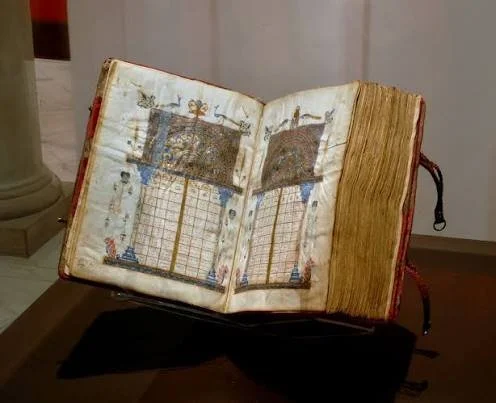
Hesiod and Homer provide early literary evidence for the creature, while later Greek and Roman writers expanded or rationalized its story. Modern scholarship continues to examine the development of the myth and its imagery.
The monster therefore represents an important example of mythological hybridity.
Bellerophon and Pegasus
Bellerophon was one of the great heroes of Greek mythology.
He became associated with Pegasus, the winged horse.
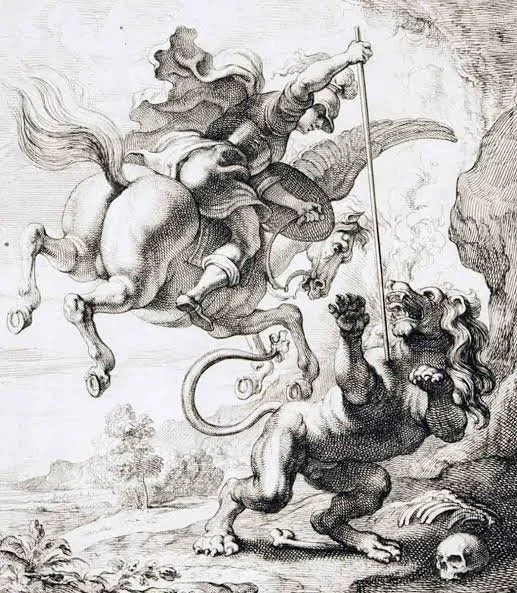
According to the mythology, Bellerophon was sent to Lycia and ordered to confront the Chimaera.
He ultimately succeeded, and the victory became one of the defining episodes of his heroic identity.
The story was represented extensively in ancient art.
Pottery, sculptures, and other artistic traditions show Bellerophon mounted on Pegasus confronting the monster.
Why Fossils Matter
The connection between fossils and mythology is more complicated than simply claiming that ancient people "found a dinosaur."
People have encountered unusual bones throughout human history.
Large fossilized bones can be difficult to identify without modern paleontology.
They may resemble the remains of enormous animals that no longer exist.
Such discoveries can encourage stories about giants, dragons, monsters, and ancient heroes.
This does not prove that a particular fossil inspired the Chimaera.
It simply demonstrates a plausible mechanism through which natural discoveries can become incorporated into folklore.
The Geological Landscape of Lycia
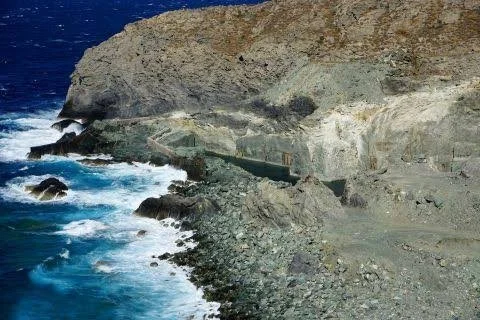
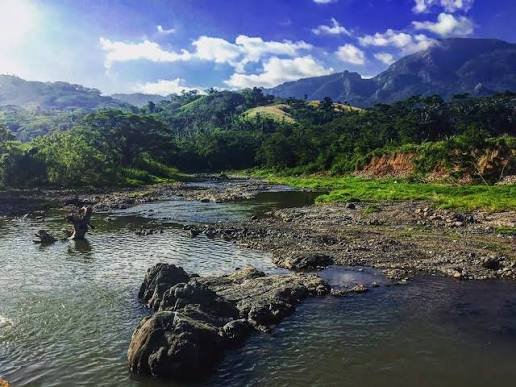
Lycia's landscape includes mountains, valleys, caves, rocky coastlines, and areas with unusual geological formations.
The region has also become famous in modern times for the naturally burning flames at Yanartaş, traditionally associated with the Chimaera in the broader regional landscape.
Ancient and later observers could encounter natural phenomena that seemed extraordinary.
Fire emerging from the earth, unusual rock formations, and strange fossil remains all provide powerful material for mythmaking.
Ancient Rationalization
One fascinating aspect of Greek intellectual history is that some ancient writers attempted to rationalize supernatural stories.
Rather than treating the Chimaera as a literal three-part animal, later interpreters could connect the story with geographical features or volcanic activity.
This demonstrates that ancient people themselves debated how myths should be understood.
Mythology was not always accepted as straightforward natural history.
What Would a "Chimaera Fossil" Actually Mean?
Scientifically, the phrase would need careful definition.
A fossil cannot prove the existence of a mythological hybrid.
At most, a fossil discovery could reveal the remains of an extinct animal whose unusual morphology might have influenced later imagination.
A scientifically interesting specimen might be a large mammal, marine reptile, or other prehistoric organism.
But linking it to Bellerophon's story would require evidence of cultural transmission, not simply geographical proximity.
Myth, Fossil, and Memory
This distinction is important.
Archaeology can establish that humans lived in a region.
Paleontology can establish that extinct organisms lived there.
Historical sources can establish that myths were told.
But proving that a specific fossil caused a particular myth requires another category of evidence.
Without such evidence, the relationship remains an interesting hypothesis.
Conclusion
The Rare Chimaera Fossils Tied to Bellerophon's Lycian Tales should therefore be treated as a speculative intersection of mythology and paleontology.
The Chimaera itself belongs to Greek mythology, while fossils belong to the geological record.
Their meeting point lies in the human tendency to interpret strange natural discoveries through stories.
The enduring power of Bellerophon's victory may ultimately tell us less about an extinct monster than about humanity's fascination with confronting the unknown.