Introduction
Few landscapes in Europe possess a stronger natural association with the underworld than the Phlegraean Fields near Naples in southern Italy.
Although the title refers to an underworld realm of Hades in the Phlegraean Fields, the geographical setting is important: this is not mainland Greece, but an ancient Greek-influenced volcanic landscape in Italy.
The area is famous for volcanic activity, fumaroles, hot springs, sulfurous gases, caves, and dramatic geological formations.
For ancient observers, such a landscape could easily appear like a boundary between the human world and the realm of the gods and the dead.
A Volcanic Landscape
The Phlegraean Fields are a vast volcanic region.
Unlike a single isolated mountain, the area consists of a complex volcanic system.
Its geological activity has produced craters, thermal areas, gases, and other unusual features.
These phenomena have made the region extraordinary for thousands of years.
Ancient inhabitants did not possess modern volcanology.
They experienced the landscape directly.
They could feel heat emerging from the ground, smell sulfur, observe steam, and encounter dangerous gases.
Such experiences naturally encouraged supernatural interpretations.
Hades and the Underworld
In Greek mythology, Hades was both the name of the god ruling the dead and a name associated with his realm.
The underworld was not simply equivalent to a Christian conception of hell.
It was a complex realm containing different regions and destinations for the dead.
Heroes such as Heracles, Orpheus, and Odysseus were associated with journeys or encounters involving the world of the dead.
Caves as Entrances
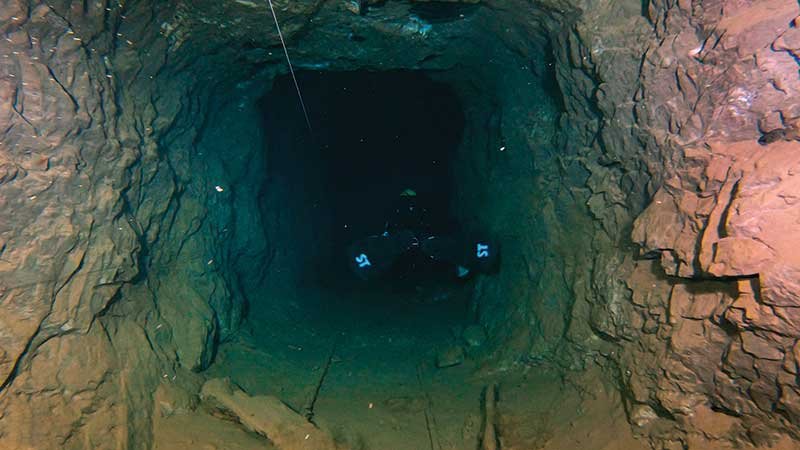
Caves were particularly powerful symbols.
A cave descends beneath the surface.
The entrance can appear as a threshold.
The interior may be dark, damp, and difficult to explore.
For ancient cultures, such places could naturally become associated with passages into hidden realms.
The Phlegraean volcanic landscape amplified this symbolism.
The Cumaean Connection
Nearby Cumae was an important Greek colony and later Roman religious center.
The Cumaean Sibyl became famous for prophetic traditions.
The area therefore accumulated multiple associations with prophecy, death, caves, and the supernatural.
This combination contributed to the region's reputation as a landscape where the human world and divine world seemed unusually close.
Natural Phenomena Behind the Myth
Modern science provides explanations for many features that once appeared supernatural.
Volcanic gases can accumulate in low areas.
Fumaroles release steam and gases.
Geothermal heat can emerge from underground.
Some gases can be dangerous or even fatal.
Ancient myths should therefore be understood within a landscape where real physical hazards were present.
A story about the underworld could have carried practical cultural significance as well as religious meaning.
The Underworld as Metaphor
The underground realm also represented transformation.
Death was imagined as a journey from one state of existence into another.
Caves, volcanic craters, and subterranean passages became natural symbols for this transition.
The underworld was therefore not simply a place beneath the ground.
It was a conceptual landscape of death, judgment, memory, punishment, and rebirth.
Conclusion
The Underground Realms of Hades in the Phlegraean Fields are best understood through the interaction of geology and mythology.
There is no archaeological proof of a literal underground kingdom inhabited by Hades.
But the landscape itself is extraordinary enough to explain why ancient cultures associated it with the supernatural.
The Phlegraean Fields demonstrate how geological activity can become transformed into religious geography and how volcanic landscapes can inspire some of humanity's oldest stories about the world beneath our feet.