Introduction
The story of Calypso is one of the most haunting episodes in the Odyssey.
Calypso, a mysterious divine woman, lives on the remote island of Ogygia, where Odysseus becomes stranded after his long journey.
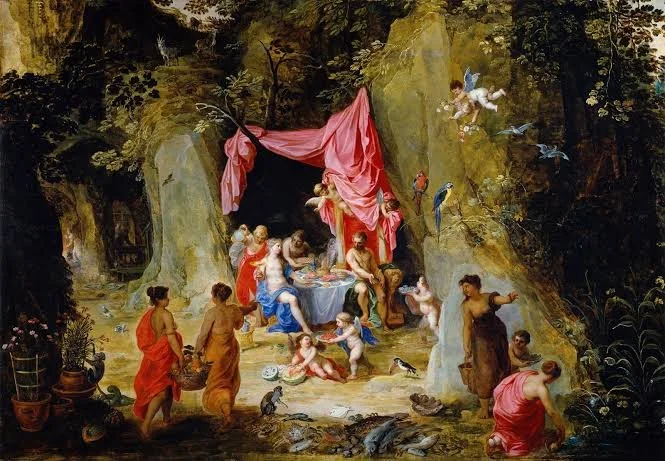
Her home is described as a beautiful and isolated environment filled with natural abundance.
The title The Unwritten Odyssey of Calypso's Immortal Garden draws attention to one of the most evocative aspects of the story: Calypso's extraordinary landscape.
There is no archaeological evidence establishing a literal immortal garden belonging to Calypso.
The concept instead belongs to the symbolic geography of Homer's epic.
Calypso and Ogygia
In Homer's Odyssey, Calypso lives on Ogygia.
Odysseus remains there for an extended period.
Calypso offers him an extraordinary form of existence.
Her world is beautiful, remote, and separated from ordinary human society.
Yet Odysseus ultimately longs to return home.
This tension is central to the story.
Paradise and Captivity
Calypso's island can initially appear like paradise.
It contains beauty, food, nature, and divine companionship.
But Homer complicates the idea of paradise.
Odysseus does not want immortality if it means abandoning his home and identity.
The garden can therefore be read simultaneously as paradise and prison.
The Idea of Immortality
Calypso is associated with immortality because she is divine.
Her offer to Odysseus is therefore profoundly significant.
He can potentially escape ordinary human mortality.
Yet he rejects the alternative.
The story suggests that human identity is connected with mortality, family, homeland, memory, and belonging.
The Garden as Symbol
The garden is not simply a botanical location.
It symbolizes a world outside ordinary time.
Plants grow abundantly.
The divine inhabitant does not experience life in the same way as mortals.
Odysseus, however, remains conscious of his own mortality.
The contrast creates one of the most emotionally powerful themes in the epic.
Searching for Ogygia
The location of Ogygia has fascinated readers for centuries.
Various geographical theories have attempted to identify it with real islands.
None can be demonstrated conclusively.
This uncertainty is part of the myth's appeal.
Ogygia exists partly as a literary landscape rather than a normal geographical coordinate.
The "Unwritten Odyssey"
The phrase "unwritten Odyssey" can be interpreted as everything that happens outside the main narrative.
What was Calypso's life before Odysseus arrived?
What did her island look like during ordinary seasons?
What happened after Odysseus left?
Homer does not provide complete answers.
This narrative silence allows later writers and readers to imagine the missing history.
Conclusion
The Unwritten Odyssey of Calypso's Immortal Garden belongs to the imaginative world created around Homer's epic.
There is no archaeological evidence proving the existence of a supernatural garden where immortals lived outside time.
Yet Calypso's garden remains powerful because it asks a profound question.
If a person were offered endless life in a perfect paradise but had to abandon everything they loved, would immortality truly be happiness?
Odysseus' answer is one of the defining ideas of the Odyssey: home can matter more than paradise.