He Defied Death for Love—But One Glance Destroyed Everything: The Tragic Story of Orpheus and Eurydice
Introduction: Love That Challenged the Boundaries of Life and Death
Among the most haunting narratives in Greek mythology, the story of Orpheus and Eurydice stands as a timeless meditation on love, loss, and the limits of human defiance. Unlike heroic epics filled with conquest and glory, this myth is profoundly intimate—centered not on war or power, but on devotion so powerful it dares to challenge death itself.
Yet, despite its extraordinary premise, the tale ends not in triumph but in irreversible tragedy. The myth explores themes of trust, human weakness, and the fragility of hope, making it one of the most emotionally resonant stories in classical literature.
The Divine Musician: Who Was Orpheus?
Orpheus was no ordinary mortal. According to ancient sources such as Ovid and Virgil, he was the son of the muse Calliope—patron of epic poetry—and either the Thracian king Oeagrus or the god Apollo. This divine lineage granted him extraordinary musical abilities.
His lyre, often said to be gifted by Apollo himself, possessed supernatural qualities. When Orpheus played, nature responded:
Trees bent toward him
Rivers altered their courses
Wild animals grew calm and gathered peacefully
Music, in Orpheus’s hands, became more than art—it was a force capable of harmonizing the natural and supernatural worlds.
Eurydice: The Beloved Bride
Eurydice, a nymph of exceptional beauty and grace, became Orpheus’s wife. Their union symbolized harmony and mutual devotion, often interpreted by scholars as an idealized representation of marital love in ancient Greek culture.
However, their happiness was short-lived.
Shortly after their wedding, Eurydice was bitten by a venomous snake while fleeing from unwanted advances—often attributed to the shepherd Aristaeus in some versions of the myth. The bite proved fatal, and she descended into the realm of the dead, known as the Underworld.
A Journey Beyond Death: Orpheus Descends into the Underworld
Overwhelmed by grief, Orpheus resolved to do the unthinkable: retrieve Eurydice from the Underworld. This act alone sets him apart from other mythological figures—he does not seek conquest, but reunion.
To reach the realm of the dead, he traveled to the domain ruled by Hades and his queen Persephone.
Armed only with his lyre, Orpheus confronted the guardians of death:
Cerberus, the monstrous three-headed dog, was lulled into submission by his music
The tormented souls paused their suffering
Even the implacable rulers of the Underworld were moved
In a rare display of compassion, Hades and Persephone agreed to release Eurydice—but under one strict condition.
The Condition: A Test of Faith
Orpheus was allowed to lead Eurydice back to the world of the living, with one crucial rule:
He must not look back at her until they had both fully reached the surface.
This condition has been widely interpreted in academic discourse as a symbolic test of trust, patience, and faith. It reflects a recurring theme in mythological narratives: the idea that divine gifts come with burdens or constraints that mortals struggle to uphold.
The Fatal Glance: A Moment of Human Weakness
As Orpheus ascended the dark path toward the living world, Eurydice followed silently behind him. The journey was long and filled with uncertainty.
Doubt began to creep in:
Was she truly there?
Had the gods deceived him?
Was he walking alone?
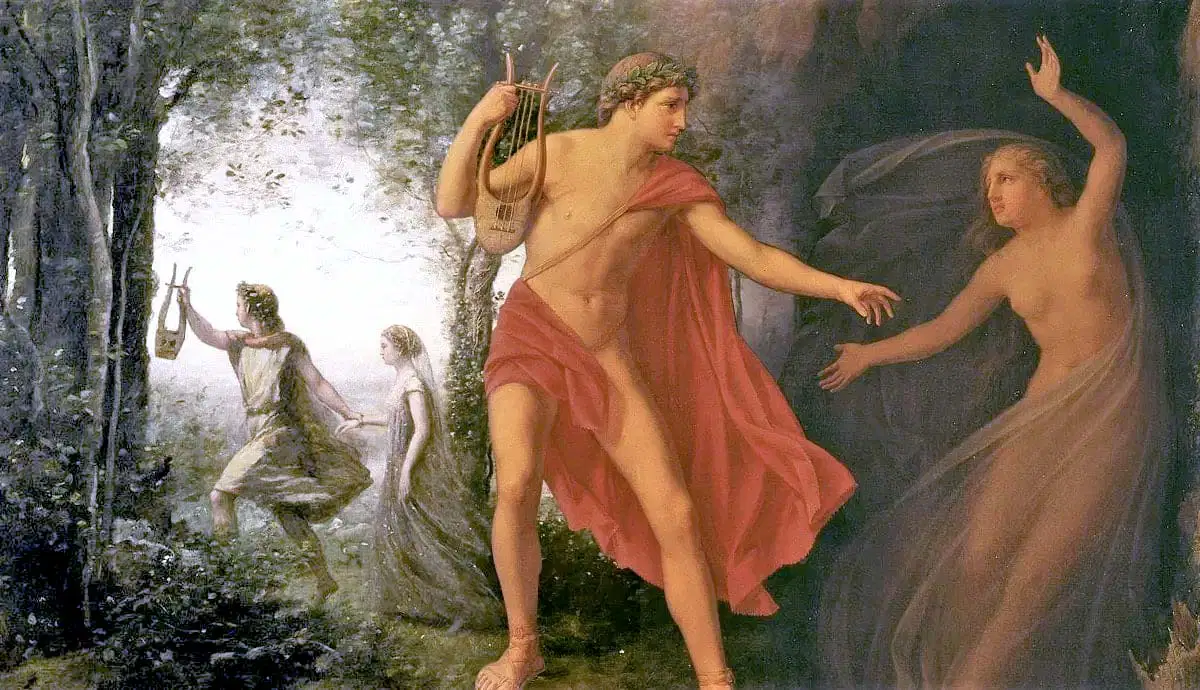
Just as he reached the threshold of the upper world, unable to resist any longer, Orpheus turned back.
In that instant, Eurydice vanished.
This moment is the emotional climax of the myth—a single, irreversible act that transforms hope into despair. Eurydice’s final words, often described in literary retellings, express not anger but sorrowful resignation as she is pulled back into the Underworld forever.
Themes and Interpretations
1. The Fragility of Trust
Orpheus’s failure is not due to lack of love, but lack of trust. His inability to believe in the unseen underscores a deeply human vulnerability.
2. Love Versus Death
While love drives Orpheus to defy death, the myth ultimately suggests that mortality is an unbreakable boundary. Even divine intervention cannot fully overturn it.
3. The Power and Limits of Art
Orpheus’s music can move gods and alter reality—but it cannot correct a human mistake. This duality highlights both the transcendence and limitation of artistic expression.
4. Human Imperfection
The story resonates because Orpheus’s failure is relatable. His doubt reflects the universal struggle between faith and fear.
Aftermath: A Life Marked by Loss
Following Eurydice’s second death, Orpheus was inconsolable. Different versions of the myth describe his fate:
In one account, he rejects all human companionship and wanders in grief
In another, he is ultimately killed by the Maenads—followers of Dionysus—who tear him apart in a violent frenzy
Even in death, however, his legend endures. His severed head, still singing, is said to have floated down a river, symbolizing the immortality of art and memory.
Cultural Legacy and Influence
The myth of Orpheus and Eurydice has had a profound impact across centuries:
In literature, it inspired works by poets like Rainer Maria Rilke
In music, it influenced operas such as Orfeo ed Euridice by Christoph Willibald Gluck
In modern storytelling, it continues to shape narratives about love, loss, and second chances
Its enduring appeal lies in its emotional universality—everyone understands the fear of losing someone and the longing to bring them back.
Conclusion: A Love That Echoes Through Time
The tragedy of Orpheus and Eurydice is not merely a story of loss—it is a reflection of the human condition. It captures the tension between hope and doubt, the desire to defy fate, and the painful consequences of our imperfections.
In the end, Orpheus did achieve something remarkable: he proved that love can reach even into the depths of death. But the myth reminds us that love alone cannot always overcome the limits of mortality.
And perhaps that is what makes this story unforgettable—not its triumph, but its heartbreaking truth.