Themis, a daughter of Uranus and Gaia, is one of the most significant figures in Greek mythology, though she is often overshadowed by the Olympians she preceded. As a Titaness of the second generation, she represents the foundational concepts of law, order, and social custom—principles that were essential for the transition from a primal, chaotic world to a structured one.
The Embodiment of Justice
Unlike Dike, who represented human or legal justice, Themis embodied divine justice (Themis literally means "that which is put in place" or "divine law"). She was the architect of the cosmic order, ensuring that everything in the universe, from the movement of the stars to the conduct of the gods, remained within its proper sphere.
The Oracle of Delphi: Before it was associated with Apollo, the Oracle at Delphi was believed to be the domain of Themis. She was seen as a source of primordial wisdom, capable of interpreting the will of the gods and upholding the "customs" that governed both gods and mortals.
Counselor to Zeus: Themis was one of the few beings whom Zeus trusted implicitly. She acted as his primary advisor, sitting beside him on Olympus to ensure his decrees were balanced and aligned with the laws of the universe. She was instrumental in the division of the spoils after the Titanomachy (the war between the Titans and the Olympians).
Divine Lineage and Roles
Themis is perhaps best known for the roles and children she brought into the world, which helped organize existence:
The Horae (The Seasons): With Zeus, she bore the Horae (Eunomia/Good Order, Dike/Justice, and Eirene/Peace). Together, these goddesses maintained the stability of human society.
The Moirai (The Fates): In many traditions, she is also the mother of the Fates (Clotho, Lachesis, and Atropos), who spun, measured, and cut the threads of human destiny, ensuring that every mortal met the fate they were assigned.
The Custodian of Rites: Themis was responsible for presiding over the sacred rites and hospitality laws (xenia). In this role, she ensured that the social fabric of humanity was maintained through proper conduct, respecting guests, and honoring the dead.
The Evolution of the Iconography
While ancient depictions of Themis were abstract, the later Greek and Roman conceptualization of her evolved into the image we recognize today:
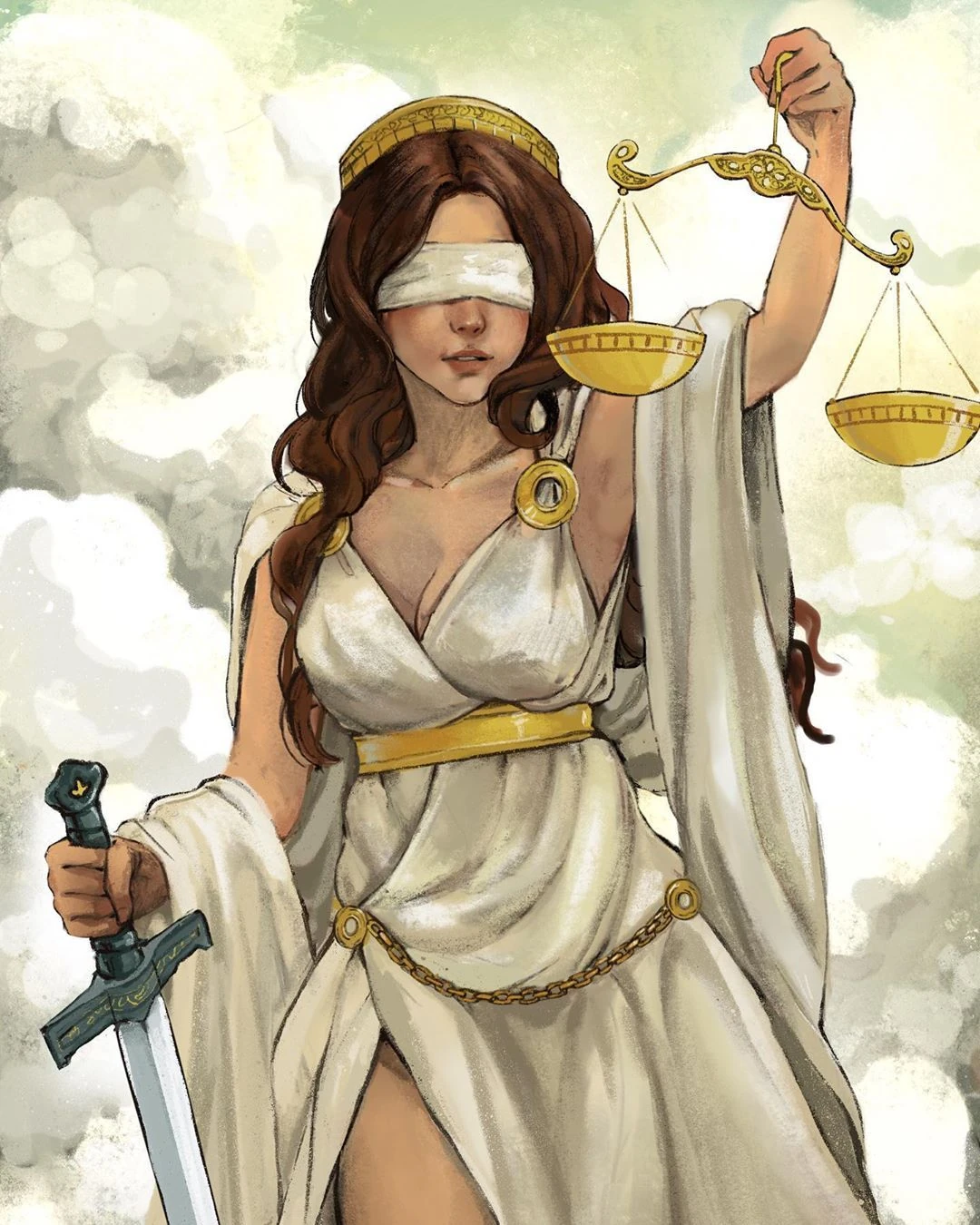
The Scales: She is frequently depicted holding a balance scale, representing the weighing of evidence and the impartiality required for justice.
The Blindfold: Interestingly, the "blindfold of justice"—the idea that justice should be impartial and ignore the status or identity of those involved—was a later development, primarily associated with the Roman interpretation of her as Justitia. The original Themis was often depicted with her eyes wide open, signifying her divine, all-seeing foresight.
The Sword: Her association with a sword signifies the power of authority—the ability to execute decisions and punish those who violate the divine order.
Significance in Mythological Order
Themis represents the bridge between the chaotic, raw power of the Titans and the organized, legalistic rule of the Olympian gods. Her presence on Olympus provided the necessary framework of rules that kept the volatile Olympians from destroying themselves—and humanity—through their own excesses.
By establishing the customs and laws that governed both the heavens and the earth, Themis ensured that even in a world ruled by powerful and sometimes capricious deities, there remained an underlying, immutable structure that kept the universe from descending back into the original chaos of the void.
Since we've discussed the origins of law and the divine order through Themis, would you be interested in exploring how these concepts were challenged by the more chaotic forces in mythology, such as the goddess Eris (Discord), or perhaps how the Fates (Themis's daughters) influenced the lives of mortal heroes?