The story of Orion, the great giant hunter, is one of the most enduring figures in Greek mythology. Because no single poet standardized his tale, there are several conflicting versions of his life, his death, and his eventual placement among the stars.
The Hunter’s Origins
In most accounts, Orion is described as a giant of immense stature and singular beauty, the son of Poseidon (god of the sea) and Euryale. His divine heritage granted him the extraordinary ability to walk across the surface of the sea as easily as he walked on land.
The Shepherd's Son: In an alternative, more whimsical account, Orion is born from the hide of an ox sacrificed by a poor shepherd named Hyrieus to Zeus, Hermes, and Poseidon. The gods, moved by his generosity, instructed him to bury the hide and urinate on it, resulting in the birth of Orion nine months later.
Life and Conflict
Orion’s life was defined by both his prowess as a hunter and his turbulent temper.
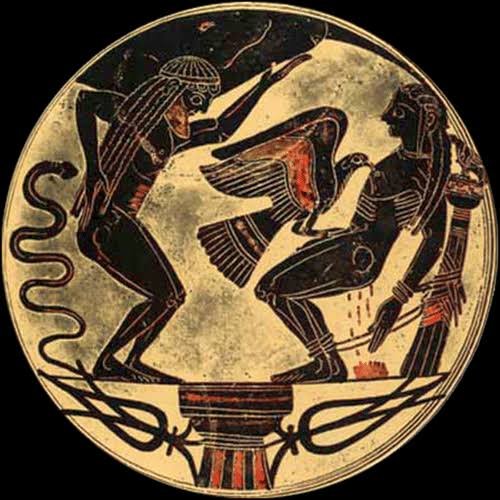
The Chios Incident: While in the service of King Oenopion of Chios, Orion fell in love with the king's daughter, Merope. Driven by wine and desire, he assaulted her. As punishment, Oenopion blinded him and cast him out.
The Journey to Light: A sympathetic Hephaestus provided Orion with a guide named Cedalion. Carrying the boy on his shoulders, Orion journeyed to the East, where the rising sun (Helios) miraculously restored his sight.
The Death of the Giant
Orion’s death is the most debated part of his myth, with several distinct traditions:
The Giant Scorpion: The most famous version states that Orion grew boastful, claiming he would kill every animal on Earth. Gaia, the Earth goddess, offended by this threat to her creations, sent a giant scorpion to sting him to death.
The Tragic Accident: In a version involving his companion, Artemis, the goddess of the hunt, Orion was swimming far out at sea. Her brother, Apollo, jealous of Artemis's affection for the hunter, wagered that she could not hit the "dark spot" (Orion's head) bobbing in the water. Artemis, unaware of her target, fired her arrow and killed him.
Divine Vengeance: Other versions depict Artemis killing him directly because he violated one of her sacred nymphs or because he dared to challenge her to an archery/discus contest.
Immortalization in the Stars
The transition of Orion into the sky is generally portrayed as an act of pity or memorialization.
Placement: Whether killed by the scorpion or by Artemis, the gods—often at the request of Artemis and Leto—placed Orion among the stars to honor his strength and hunting skill.
The Eternal Chase: In the heavens, the Scorpion (the constellation Scorpius) and Orion are placed at opposite sides of the celestial sphere. They are never visible in the night sky at the same time, symbolizing their eternal conflict: as the Scorpion rises in the East, the Hunter sets in the West, forever fleeing his killer.
The Pleiades: In some variations, Orion’s pursuit of the Seven Sisters (the Pleiades) is what led Zeus to transform both the giant and the sisters into constellations, ensuring that while the hunter continues to chase them across the sky, he can never truly catch them.
Orion remains a fixture in the night sky not just as a cluster of stars, but as a "fossilized" narrative of the ancient world—a reminder of the hubris of man and the volatile, often tragic relationship between mortals and the divine.