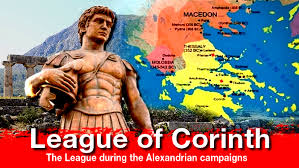
The League of Corinth (338/337 BCE) was the political "seal" on the Macedonian conquest of Greece. Following his decisive victory at the Battle of Chaeronea, Philip II of Macedon did not treat the defeated Greek city-states as occupied territories. Instead, he organized them into a sophisticated confederation that maintained the illusion of Greek liberty while ensuring absolute Macedonian control.
It was a masterstroke of diplomacy that turned a group of bitter enemies into a unified military machine directed toward one goal: the invasion of the Persian Empire.
1. The Architecture of "Freedom"
Philip was a student of Greek politics and knew that the Greeks hated nothing more than a foreign master. To avoid constant revolts, he framed the League as a Common Peace (Koine Eirene).
The Member States: Every major Greek city-state joined—except for Sparta, which stubbornly refused. Philip famously left them alone, reportedly saying that a "tamed" Sparta served as a better warning to the others than a destroyed one.
Autonomy and Independence: On paper, every member was "free and independent." They were allowed to keep their own laws and forms of government. However, they were strictly forbidden from making war on one another or attempting to overthrow their current regimes.
2. The Synedrion: The Federal Council
The League was governed by a Synedrion (council) that met at Corinth. Each city-state had a number of votes proportional to its military strength.
The Role of the Council: The Synedrion acted as a supreme court for disputes between member states and had the power to declare war.
The Hegemon: This was the crucial "catch." Philip was appointed the Hegemon (commander-in-chief) and Strategos Autokrator (supreme general) of the League for life. While the Council made the laws, Philip controlled the army.
3. The "Covenant" of Peace
The League’s charter included specific clauses designed to prevent the kind of internal chaos that had defined the 4th century BCE.
No Confiscation of Land: Members were forbidden from seizing property, canceling debts, or freeing slaves. This appealed to the wealthy elites of the Greek cities, who saw Philip as a protector against social revolution.
The Prohibition of Piracy: The League guaranteed the safety of the seas, a move that won the support of the merchant classes in cities like Athens and Corinth.
4. The Panhellenic Crusade
The stroke of genius in the League of Corinth was its ideological mission. Philip needed a way to redirect Greek aggression away from Macedon and toward a common enemy.
Avenge the Persian Wars: Philip proposed a "War of Retribution" against the Persian Empire to punish them for the desecration of Greek temples during the invasion of Xerxes 150 years earlier.
The Tool of Unity: By framing the invasion as a Panhellenic crusade, Philip turned his Greek "subjects" into "allies" and "liberators." It gave the Greeks a sense of purpose and the promise of Persian spoils.
5. Macedonian Garrisons: The "Fetters" of Greece
Despite the talk of autonomy, Philip ensured his control was backed by iron. He placed Macedonian garrisons in three strategic locations, known as the "Fetters of Greece":
Acrocorinth: The citadel overlooking the Isthmus, controlling the land route to the Peloponnese.
Chalcis: Controlling the Euboean Gulf.
The Cadmea (Thebes): Ensuring the silence of Athens’ most dangerous neighbor.
6. The Legacy: A Bridge for Alexander
When Philip was assassinated in 336 BCE, the League of Corinth initially wavered. However, his son Alexander quickly marched south, forced the Synedrion to re-elect him as Hegemon, and used the League’s legal framework to raise the troops that would conquer Asia.
The League proved that the Greeks could be unified, but only when a "superior" power provided a centralized military command and a shared external enemy.