The myth of Cronus (or Kronos) is one of the most visceral and dark chapters in Greek cosmogony. It represents the generational struggle for power, the paralyzing fear of being replaced, and the transition from the primordial chaos of the Titans to the structured reign of the Olympian gods.
1. The Prophecy of Doom
Cronus was the youngest of the first-generation Titans, the children of Uranus (Sky) and Gaia (Earth). After Cronus castrated his father to seize the throne, Uranus issued a chilling prophecy: As Cronus had overthrown his own father, he too would be deposed by one of his children.
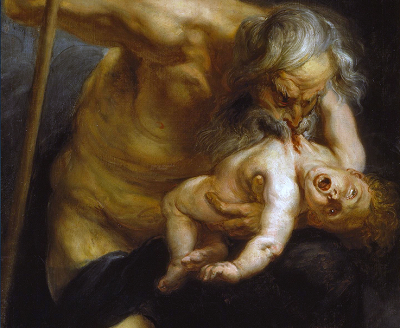
The Paranoia of Power: Unlike Uranus, who imprisoned his children, Cronus decided on a more "permanent" solution. To ensure the prophecy could never come true, he chose to consume his offspring the moment they were born.
2. The Devouring of the Olympians
Cronus married his sister Rhea, but their union was defined by tragedy. One by one, as Rhea gave birth, Cronus took the infants and swallowed them whole.
The Victims: These were the future pillars of the Greek pantheon: Hestia, Demeter, Hera, Hades, and Poseidon.
The Living Prison: Because they were immortal gods, they did not die inside him. Instead, they remained trapped and growing within his stomach—a physical manifestation of a father’s refusal to let the next generation take their place in the world.
3. The Deception of Rhea
By the time her sixth child, Zeus, was born, Rhea could no longer endure the loss. She sought the counsel of her mother, Gaia, to devise a plan to save her son and punish Cronus.
The Omphalos Stone: Rhea wrapped a large stone in swaddling clothes and presented it to Cronus. Blinded by his own arrogance and haste, Cronus swallowed the stone (the Omphalos) without realizing it wasn't the infant.
The Secret Upbringing: Zeus was hidden away in a cave on Mount Ida in Crete, where he was raised by the goat-nymph Amalthea and protected by the Kouretes—warriors who clashed their shields to drown out the sound of the baby's crying so Cronus wouldn't hear him.
4. The Regurgitation and the Titanomachy
Once Zeus reached adulthood, he returned to challenge his father. With the help of the Oceanid Metis, he fed Cronus a poisoned draught (an emetic) that forced him to vomit.
The Rebirth: Cronus first spat out the Omphalos stone, followed by Poseidon, Hades, Hera, Demeter, and Hestia—all fully grown and ready for war.
The War of the Titans: This led to the Titanomachy, a ten-year cosmic war between the Titans and the Olympians. With the help of the Hundred-Handed Giants (Hekatonkheires) and the Cyclopes, Zeus eventually defeated Cronus and imprisoned the Titans in the deep abyss of Tartarus.
5. Symbolism: Time as the Devourer
In later antiquity and the Renaissance, Cronus became synonymous with Chronos (the personification of Time). This linguistic blurring added a philosophical layer to the myth.
Father Time: Just as Cronus devoured his children, Time is seen as a force that "consumes" everything it creates. Every second that is born is immediately swallowed by the past.
The Scythe: Cronus is often depicted carrying a scythe—originally the tool he used to castrate Uranus, but later reimagined as the "Grim Reaper's" tool, representing the harvest of life and the inevitable end brought by Time.
6. The "Golden Age" Paradox
Paradoxically, while Cronus was a tyrant to his children, his reign was known in myth as the Golden Age of Mankind. It was a time of perpetual spring, where humans lived like gods without labor or sorrow. Some versions of the myth suggest that after his defeat, Zeus eventually released Cronus from Tartarus to rule over the Elysian Fields, the paradise of the afterlife.
The myth of Cronus serves as a grim reminder that when leaders (or parents) try to stop the "clock" of progress to preserve their own status, they often create the very rebellion they fear.