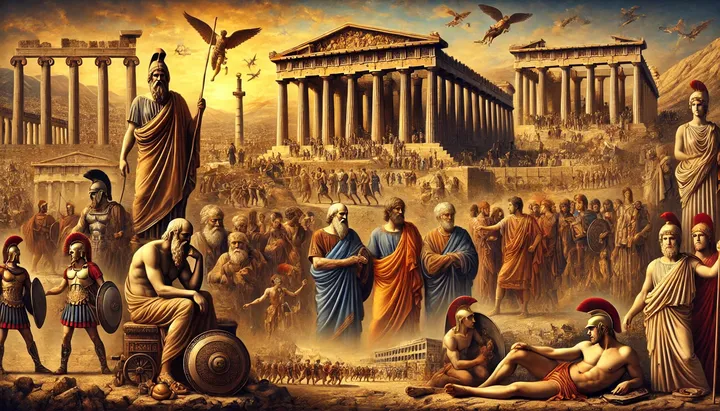
o understand the world that produced the myths of Atalanta and Cecrops, we have to look at the daily realities of the Polis (the city-state). Greek society was a complex hierarchy where status was defined by citizenship, gender, and the distinction between "civilized" urban life and the "wild" rural interior.
1. The Oikos: The Heart of the Home
The Oikos was the fundamental unit of Greek society, encompassing the family, their property, and their enslaved workers.
Physical Layout: Houses were typically inward-facing, built around a central open-air courtyard. This allowed for privacy from the street and provided light and ventilation.
Gendered Spaces:
The Andron: A formal dining room used exclusively by men for the symposium (drinking parties). It was usually located near the entrance so male guests didn't have to pass through the rest of the house.
The Gynaikon: The women's quarters, often located on the upper floor or in the rear. This was where women managed the household, spun wool, and wove textiles.
The Hearth: Dedicated to the goddess Hestia, the hearth was the spiritual center of the home, where fire was kept burning and offerings were made.
2. Social Hierarchy: Citizens and Outsiders
Society was strictly stratified, particularly in democratic Athens, where "equality" was a privilege reserved for a specific minority.
Citizens (Astoi): Free-born adult males whose parents were both citizens. They had the right to vote, hold office, and own land.
Metics (Metoikoi): Resident aliens (foreigners). They were often wealthy merchants or skilled craftsmen. While they paid taxes and served in the military, they could not own land or vote.
Enslaved People: The economy was heavily dependent on enslaved labor. They worked in mines, on farms, and in households. While some "privileged" enslaved people (like bankers or tutors) lived independently, most were considered property (douloi).
3. The Agora: The Pulse of the City
If the Oikos was the private heart, the Agora was the public soul of the city.
The Market: In the morning, the Agora was a bustling marketplace where vendors sold everything from Attic olive oil to Scythian slaves and Egyptian papyrus.
The Stoas: These were long, roofed colonnades that provided shade. They served as the "offices" for magistrates and the "classrooms" for philosophers like Socrates and Zeno.
Political Life: Men spent the majority of their day here, debating politics, discussing news, and participating in the legal system. For a Greek citizen, "leisure" (schole) wasn't about rest; it was the freedom to engage in the intellectual and political life of the city.
4. Education and the Ephebeia
Education was focused on creating the "Ideal Citizen"—someone balanced in both mind and body.
Paidagogos: A trusted enslaved person who accompanied boys to school, supervised their behavior, and ensured they learned their lessons.
The Curriculum: Boys studied "Grammata" (reading, writing, and poetry), "Mousike" (music and lyric poetry), and "Gymnastike" (athletics).
The Ephebeia: Upon turning 18, young men entered a period of state-sponsored military and civic training. They guarded the borders and participated in religious festivals before becoming full voting citizens.
5. Diet and the "Mediterranean Triad"
Greek cuisine was governed by the Mediterranean Triad: Grain, Grapes, and Olives.
Sitos (The Base): Barley or wheat bread and porridge made up the bulk of every meal.
Opson (The Flavor): Anything eaten with the bread. This included olives, onions, garlic, cheese, and legumes.
Meat and Fish: Meat was rare and usually only eaten after a religious sacrifice. Fish was more common, especially for those living near the coast.
Wine: Greeks almost always diluted their wine with water (usually 3 parts water to 1 part wine). Drinking undiluted wine was considered a mark of "barbarism" and drunkenness.
6. Clothing: The Art of the Drape
Greek clothing was remarkably simple in construction—essentially rectangular pieces of wool or linen—but complex in how it was draped and pinned.
The Chiton: A basic tunic worn by both men and women.
The Peplos: A heavier woolen garment worn by women, pinned at the shoulders and belted at the waist.
The Himation: A heavy cloak worn over the chiton during cold weather or for formal public appearances.
The Chlamys: A short cloak worn by soldiers and travelers, pinned at one shoulder to keep the sword arm free.
Greek daily life was a constant tension between the desire for private family honor and the duty of public civic participation. While we often focus on their wars and statues, it was the rhythm of the olive harvest, the debates in the Stoas, and the rituals of the family hearth that truly built the world of the ancient Greeks.