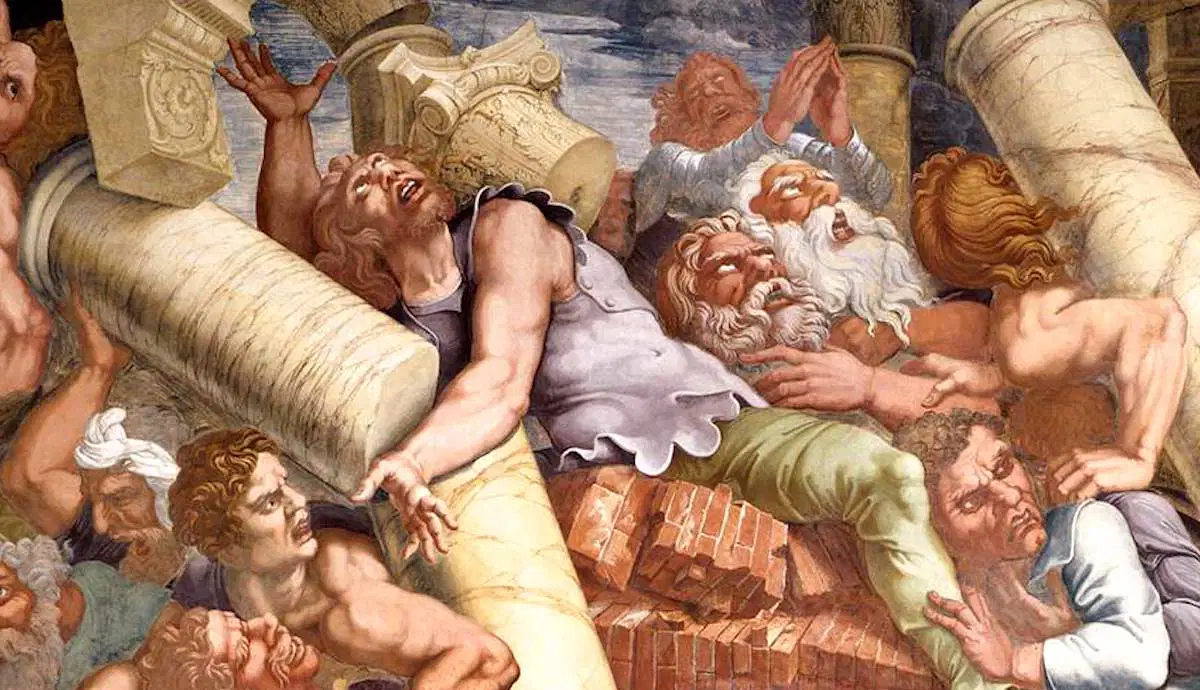
The Gigantomachy was the ultimate test of the Olympian gods' right to rule the universe. Unlike the Titanomachy (the war against the Titans), which was a struggle for succession, the Gigantomachy was a chaotic, apocalyptic rebellion launched by the Gegenēis ("Earth-born"), a race of monstrous giants.
It represents the mythological struggle between Cosmos (order/civilization) and Chaos (wild/untamed nature).
1. The Origin of the Giants
The Giants were born from a literal act of vengeance. After Zeus imprisoned the Titans in Tartarus, their mother, Gaia (the Earth), was furious.
Blood of Uranus: When the Titan Cronus castrated his father Uranus, the blood fell upon Gaia. From this divine blood, the Giants were conceived.
Their Form: In early Greek art, they appeared as heavily armed hoplite warriors. In later Hellenistic and Roman art, they became more monstrous, often depicted with serpent-like tails instead of legs, symbolizing their deep connection to the primitive earth.
2. The Prophecy and the Hero
The Olympians faced a terrifying problem: a prophecy stated that the Giants could not be killed by gods alone. They could only be defeated if the gods fought alongside a mortal hero.
Heracles' Recruitment: Zeus fathered Heracles specifically for this purpose. The greatest mortal warrior was summoned to Olympus to bridge the gap between divine power and mortal lethality.
The Magic Herb: Gaia, knowing the prophecy, sought a magical herb that would make her children invulnerable even to mortals. However, Zeus forbade the Sun (Helios) and Moon (Selene) to shine, and in the darkness, he harvested the herb himself, depriving the Giants of their protection.
3. The Key Battles and the Fallen Giants
The war was fought on the volcanic plains of Phlegra ("The Burning Land"). Each major Olympian was paired against a specific Giant "counterpart."
Zeus vs. Porphyrion: The king of the Giants attempted to distract Zeus by attacking Hera. Zeus struck him with a thunderbolt, and Heracles finished him with an arrow.
Athena vs. Enceladus: As Enceladus fled, Athena crushed him by throwing the entire island of Sicily on top of him. Myth says his fiery breath still causes the eruptions of Mount Etna.
Poseidon vs. Polybotes: Poseidon chased Polybotes across the sea. He broke off a piece of the island of Kos and threw it at the Giant, creating the island of Nisyros.
Hermes vs. Hippolytus: Wearing the Cap of Invisibility (the Helmet of Hades), Hermes managed to slay the giant Hippolytus.
4. The Symbolism of the Struggle
To the ancient Greeks, especially the Athenians, the Gigantomachy was the supreme metaphor for their own history.
Victory of Reason: The Olympians represented the triumph of intellect, law, and beauty over the mindless, overwhelming strength of the "earth-born" monsters.
Political Allegory: After the Greeks defeated the "barbarian" Persians, they used the Gigantomachy in their architecture (such as on the Parthenon metopes) to symbolize the victory of Greek civilization over foreign invasion.
5. The Great Altar of Pergamon
The most spectacular physical record of this myth is the Pergamon Altar (2nd century BCE).
The Frieze: It features a 113-meter-long masterpiece of sculpture showing the gods and giants locked in a swirling, violent struggle.
Dynamic Realism: Unlike earlier, static art, the Pergamon frieze shows the Giants in agony, with straining muscles and desperate expressions, marking the pinnacle of Hellenistic "Baroque" style.
The Gigantomachy concludes the "Age of Rebellions." With the Giants defeated and buried under volcanoes and islands, Zeus’s reign was finally secure, and the world was shaped into the geographic and political order known to the ancients.