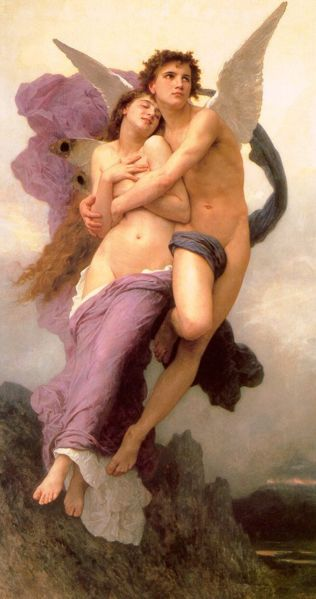
The myth of Eros and Psyche is one of the few tales from Greek mythology that concludes with a "happily ever after." It is a profound allegory for the journey of the human soul (Psyche) as it overcomes trials and suffering to find divine love (Eros).
Unlike many myths that serve as warnings, this story celebrates the necessity of trust and the transformative power of perseverance.
1. The Beauty That Rivaled a Goddess
Psyche was a mortal princess so breathtakingly beautiful that men began to worship her instead of Aphrodite. Enraged, the goddess of love commanded her son, Eros, to use his golden arrows to make Psyche fall in love with the most hideous creature on earth.
The Accidental Wound: When Eros saw Psyche, he was so startled by her beauty that he accidentally grazed himself with his own arrow. He fell deeply in love with her and, defying his mother, spiritied her away to a hidden palace.
2. The Invisible Husband
Psyche was brought to a magnificent enchanted castle where she was served by invisible voices. Eros visited her only at night, in total darkness, insisting that she must never see his face.
The Test of Faith: For a time, Psyche was happy. However, her jealous sisters visited and convinced her that her husband was a monstrous serpent who was fattening her up to be eaten.
The Lamp and the Oil: Driven by doubt, Psyche waited for Eros to sleep. She lit a lamp and, instead of a monster, saw the most beautiful of the gods. In her trembling excitement, a drop of hot oil fell from her lamp onto Eros's shoulder, waking him.
The Betrayal: Feeling his trust shattered, Eros flew away, leaving Psyche with his final, famous words: "Love cannot live without trust."
3. The Labors of Psyche
Desperate to win Eros back, Psyche appealed to Aphrodite. The goddess, still vengeful, set four "impossible" tasks for the mortal girl to prove her worth.
The Sorting of the Seeds: Psyche was told to sort a massive mound of mixed grains by dawn. A colony of ants, pitying her, performed the task for her.
The Golden Fleece: She had to gather wool from dangerous, sun-maddened sheep. A reed whispered to her, advising her to wait until dusk and collect the wool caught on the briars.
The Water of the Styx: She had to fill a flask from the deadly River Styx. Zeus's eagle flew down and filled the flask for her.
The Box of Beauty: Finally, she was sent to the Underworld to ask Persephone for a fragment of her beauty in a box.
4. The Final Temptation and Apotheosis
Psyche successfully retrieved the box, but on her way back, her curiosity (and vanity) got the better of her. She hoped that a little of the divine beauty would help her win Eros back.
The Eternal Sleep: Upon opening the box, she found not beauty, but a "deadly sleep" (stygian sleep) that overwhelmed her.
The Rescue: Eros, now healed from his burn and unable to bear their separation, flew to her. He wiped the sleep from her face and returned it to the box.
The Marriage: Eros appealed to Zeus, who granted Psyche ambrosia, making her immortal. The gods celebrated their wedding, and the couple eventually had a daughter named Hedone (Pleasure/Joy).
5. Philosophical Meaning: The Soul and Love
The names in this story are highly symbolic. In Greek, Psyche means "Soul" and is often depicted with butterfly wings (representing transformation), while Eros represents "Desire" or "Love."
The Allegory: The myth suggests that the Soul must undergo hardship and "darkness" to achieve true, divine union. It argues that love is not just a feeling, but a process of growth—moving from blind physical attraction to a spiritual connection based on trust and shared experience.
The story of Eros and Psyche reminds us that while doubt can burn, the soul's capacity for resilience can bridge the gap between the mortal and the divine.