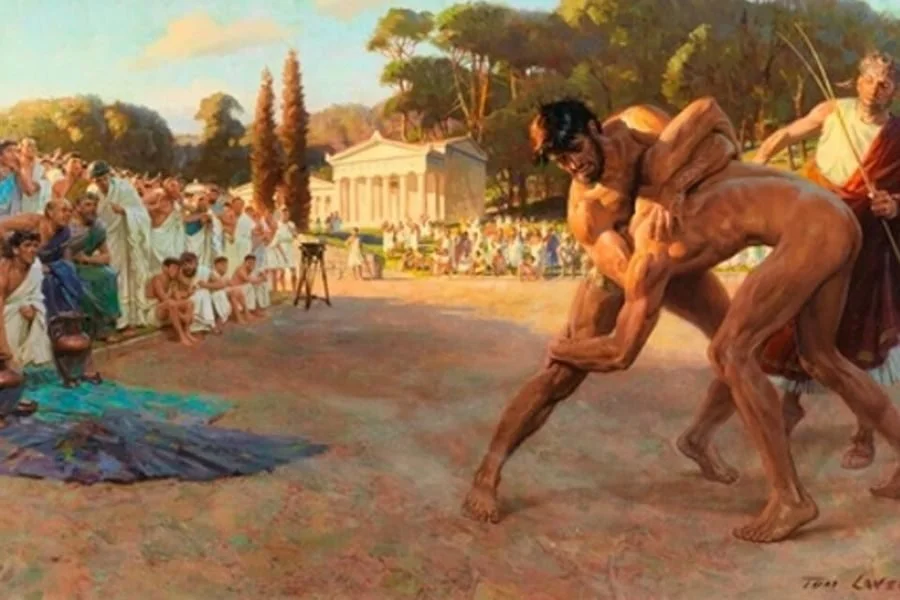
In the Greek mind, athletics were not an "extracurricular" activity; they were the very foundation of a young man's development. This was driven by the concept of Gymnastike, the physical half of the educational duo that, along with Mousike (the arts and intellect), aimed to produce the perfect citizen.
1. The Paidotribēs: The Master of the Body
Just as a boy had a teacher for literacy, he had a paidotribēs (literally "boy-rubber" or "trainer") for athletics.
The Early Years: Starting around age seven, boys attended the palaestra, a private wrestling school. Unlike the public gymnasia for adults, the palaestra was a controlled environment for children.
Technique over Strength: Early education focused on form, posture, and rhythm. The Greeks believed that physical training taught a child sophrosyne (self-control) and how to endure hardship without complaint.
Music and Motion: Training often took place to the sound of an aulos (a double-piped flute). The music helped the boys develop a sense of timing and grace, ensuring that their movements were not just powerful, but beautiful.
2. The Pentathlon: The Balanced Athlete
Greek education discouraged specialization. They didn't want a boy to be just a fast runner or just a strong wrestler; they wanted a "balanced" man. The Pentathlon was the ultimate educational tool because it tested five distinct areas of physical excellence:
Stadion (Running): For speed and lung capacity.
Halma (Long Jump): For explosive power. Athletes used lead or stone weights called halteres to propel themselves further.
Diskos (Discus): For rhythm and coordination.
Akontion (Javelin): For precision and upper-body strength.
Pale (Wrestling): For tactical thinking and raw power.
3. Preparation for the Phalanx
The ultimate "practical" goal of athletic education was to prepare the youth for hoplite warfare.
The Shield and Spear: The strength required to hold a heavy bronze shield in a packed formation for hours was built in the wrestling pits.
Endurance: Cross-country running and the Hoplitodromos (a race run in full armor) taught young men how to manage their breath and energy while carrying 50–70 pounds of gear.
The Agonistic Spirit: By competing against their peers daily, boys learned the "warrior's heart"—the refusal to quit and the desire to win honor (timē) for their family and city.
4. Moral and Social Development
Athletics served as a laboratory for social behavior.
Aidos (Shame/Modesty): Competing naked in front of one's peers and elders forced a young man to be comfortable with his body while maintaining a sense of respect and "proper" shame regarding his performance.
Fair Play: Violating the rules of a sport was seen as a moral failing. A boy who cheated in a race was seen as someone who would likely cheat in business or politics later in life.
The Ephebeia: At age 18, the athletic training became state-mandated. The ephebes lived and trained together, forming the social bonds that would make them a cohesive unit in the citizen-army.
5. The "Beautiful" Body
The Greeks believed that the state of the body reflected the state of the soul. A neglected, "soft" body was seen as a sign of a lazy, undisciplined mind.
Kalos (Beauty): Through athletics, the young man achieved the physical "beauty" praised in Greek sculpture. This wasn't about vanity; it was about achieving the harmonious proportions that the Greeks believed were part of the natural order.
By the time a young man completed his education, his body was a well-tuned instrument ready for the demands of the battlefield, while his mind was (ideally) sharpened by the discipline and strategy he had learned on the wrestling mat.
Since the Greeks viewed physical weakness as a civic failure, do you think our modern education system—which often treats "Gym" as a secondary or optional class—is neglecting a vital part of what it means to be a disciplined and capable citizen?