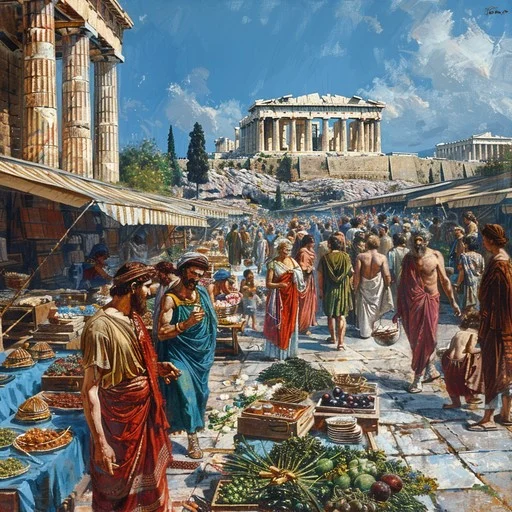
Ancient Greek commerce was the lifeblood of the Mediterranean, connecting disparate city-states and far-flung colonies through maritime networks, bustling marketplaces, and sophisticated financial systems. Rather than relying on simple barter, the Greek economy was highly monetized and relied on specialized infrastructure, standardized currency, and a robust maritime economy.
1. The Agora: The Heart of Trade and Civic Life
In every Greek city-state (polis), the agora served as the primary public space, functioning as both a market and the center of social and political life.
Vendor Stalls: Merchants set up temporary wooden stalls or used permanent stone benches to sell a variety of goods, ranging from fresh produce and livestock to textiles and household items.
Specialized Quarters: The market was often divided into distinct sections, such as the kyklos (the circle where slaves were sold), areas for fish, and stalls for pottery and perfume.
Inspectors of the Market (Agoranomoi): Magistrates were appointed to ensure that weights and measures were accurate and that goods were not defective or falsely advertised.
2. The Piraeus and Maritime Networks
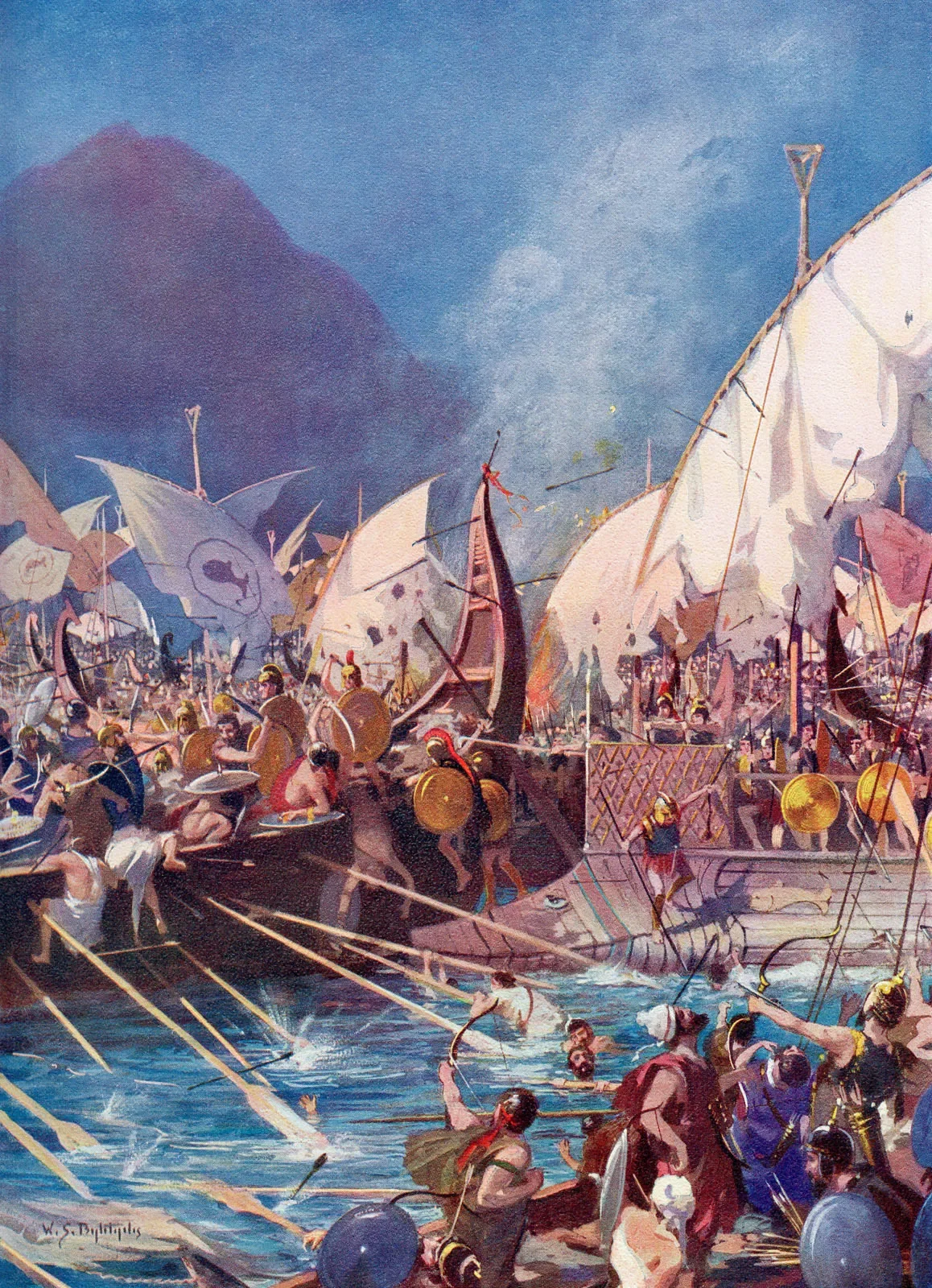
Maritime trade was the engine of the Greek economy, with the Aegean Sea acting as a highway connecting regions that lacked certain resources.
The Port of Piraeus: As the harbor of Athens, Piraeus was the busiest port in the Greek world. It was fortified by the Long Walls to ensure a secure supply route to the city.
Merchant Vessels (Holkades): These broad, deep-hulled wooden ships were built for cargo capacity rather than speed, transporting grain, wine, and pottery across the Mediterranean and Black Seas.
Emporion: Designated trading quarters, or emporia, were established in coastal cities to facilitate exchange between local and foreign merchants without granting full civic rights.
3. Standardized Currency and Banking
The development of coinage around the 7th century BCE revolutionized trade, moving the Greek world away from a reliance on bullion and barter.
The Athenian Owl: The silver tetradrachm of Athens, widely known as the "Owl," became a universally trusted currency across the Mediterranean due to its consistent purity and weight.
Banking and Money Changers (Trapezai): Money changers set up tables (trapezai) in the agora to exchange different city-state currencies and assess the purity of foreign bullion, laying the groundwork for modern banking.
Maritime Loans (Bottomry): Wealthy individuals provided loans to merchants at high-interest rates to fund voyages. If the ship sank, the lender absorbed the loss, which mitigated the high risks of ancient shipping.
4. Key Commodities of Exchange
Greek trade was defined by a triad of staple agricultural products and the exchange of manufactured goods or raw materials.
The Olive and the Vine: Olive oil and wine were the most important Greek exports, transported in large ceramic containers known as amphorae.
Attic Pottery: The distinctive black-figure and red-figure pottery of Athens was highly prized throughout the Mediterranean and Etruria.
Silver and Grain: Athens relied heavily on grain imports from Egypt, Sicily, and the Black Sea region to feed its population, paying for them using the silver mined at Laurium.
5. Weights and Measures
Accurate measurement was vital for fair commerce across the diverse city-states of Greece.
Standardized Amphorae: Storage vessels were regulated to ensure consistent volumes for liquid and dry commodities.
The Aeginetan and Euboic Standards: Different city-states used different weight systems for currency and metal. For instance, the Aeginetan standard was used in the Peloponnese, while the Euboic-Attic standard became dominant in Athens and Ionia.