In ancient Greece, the arrival of a child and their subsequent growth were celebrated with a mixture of religious devotion, protective rituals, and deep social significance. The survival and naming of a child were milestones marked by distinct ceremonies designed to welcome the new life into the family and the polis (city-state).
1. The First Days: Acceptance and Protection
In ancient Greece, a newborn did not immediately become a member of the family. The first few days of life were highly precarious.
The Father's Decision: Immediately following birth, the infant was placed on the floor before the father. The father had the legal right to either accept or reject the child. If accepted, the child was bathed and welcomed into the oikos (household). If rejected, the child could be exposed (ekthesis), left outside to die or be taken by others.
Amulets and Protection: The Greeks feared the "evil eye" and malevolent spirits, especially for vulnerable infants. Babies were immediately given protective amulets called periapta, which were hung around their necks to ward off danger and illness.
2. The Amphidromia and the Dekate
Once the child was accepted, two major celebratory ceremonies took place to mark the transition into the family and community.
The Amphidromia (The 5th or 7th Day): * Held on the fifth or seventh day after birth, this private, domestic ritual was centered around the family hearth (hestia).
The midwife or nurse carried the baby running in a circle around the hearth, symbolizing the child's purification and integration into the household.
During this ceremony, gifts were given to the mother and the baby, and the home was decorated with an olive branch (for a boy) or a woolen ribbon (for a girl) on the doorway.
The Dekate (The 10th Day): * This was the public celebration and naming ceremony.
Friends and relatives gathered for a feast and offered sacrifices to the gods, particularly to the goddess Eileithyia (the goddess of childbirth).
The father officially named the child, and the guests brought gifts, including amulets and children's toys.
3. Childhood and Games
Childhood was recognized as a distinct, formative stage of life. It was a time for play, storytelling, and preparation for adult roles.
Toys and Play: Greek children played with a variety of toys made from terracotta, wood, and cloth. Common toys included rattles (platage) to soothe the baby and ward off spirits, spinning tops, hoops, and wheeled carts. Girls played with terracotta dolls (plangones) with articulated limbs.
Games: Children engaged in active outdoor games. One popular game was chytinda (similar to blind man's buff), as well as games involving knucklebones (astragaloi), which were used for both games of skill and fortune-telling.
4. Education and Coming of Age
As children grew, their upbringing diverged significantly by gender, and specific festivals celebrated their development.
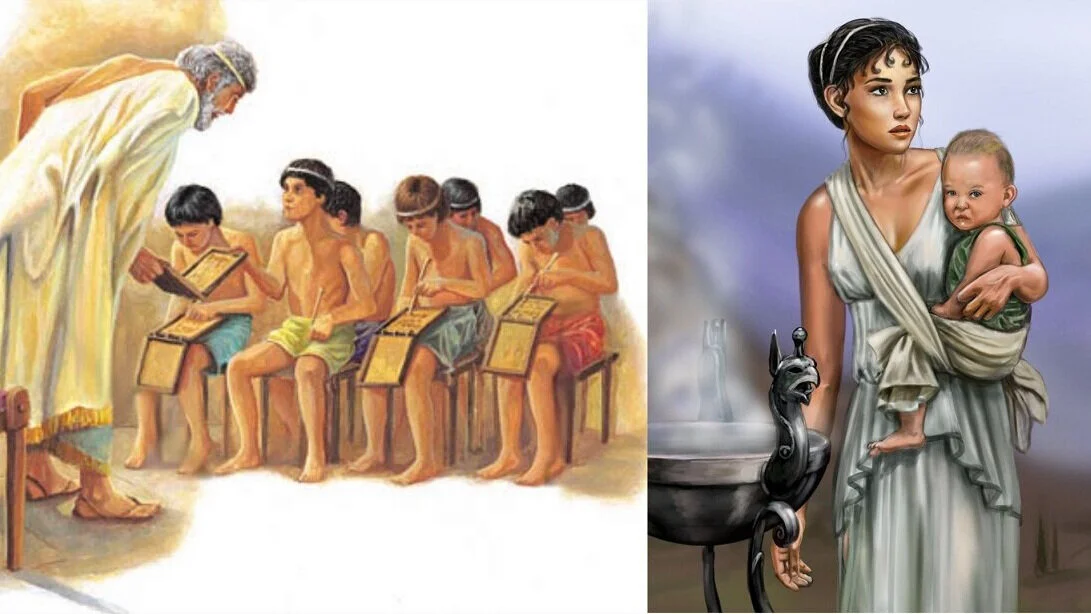
Gender Roles: Boys were educated outside the home, learning reading, writing, physical training (palaestra), and music. Girls remained largely inside the home, learning spinning, weaving, and household management.
The Apatouria Festival: For boys, reaching adolescence was celebrated during the Apatouria festival, where the father introduced his son to the members of his brotherhood (phratry), marking his entry into the civic community.
The Cutting of Hair: Both boys and girls often participated in rituals where locks of their hair were dedicated to the gods (such as Artemis or Apollo) as a rite of passage from infancy to childhood.