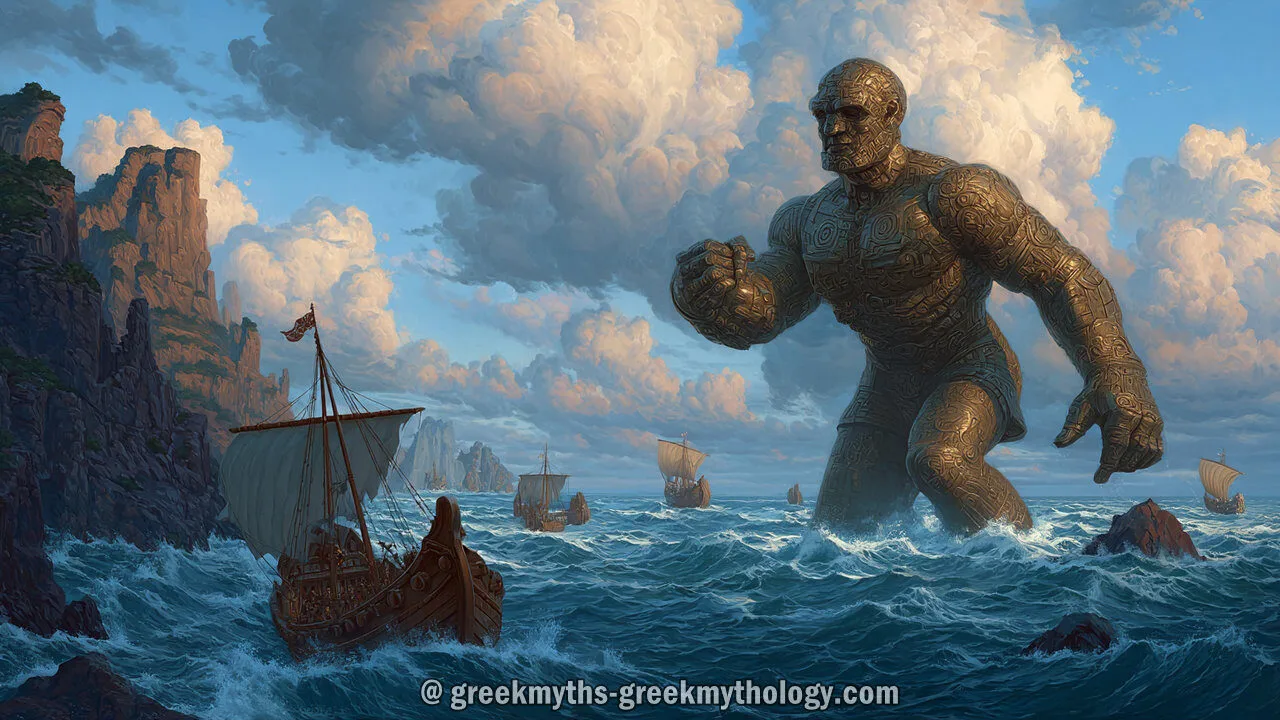
The legend of Talos provides a fascinating look at what many consider the "first robot" in Western literature. Long before the advent of modern technology, the Greeks imagined a sentient machine made of bronze, programmed to protect the borders of a kingdom with tireless efficiency.
1. The Divine Origin and Purpose
Talos was a giant automaton crafted specifically to protect the island of Crete. There are two primary versions of his creation:
The Gift of Hephaestus: Most myths state he was forged by the god-smith Hephaestus and given to King Minos to guard his realm.
The Last of the Bronze Age: Other accounts suggest he was a survivor from the "Age of Bronze," a generation of metallic humans who preceded the current race of men.
His primary directive was simple: Patrol and Protect. Talos would march around the entire perimeter of Crete three times every single day. If he spotted a foreign ship approaching the shore, he would hurl massive boulders to sink them.
2. The Internal "Hardware"
What makes Talos unique among mythological creatures is the specific description of his anatomy, which mirrors a mechanical cooling or hydraulic system.
The Ichor: Instead of blood, Talos was filled with ichor, the golden fluid of the gods.
The Single Vein: He had only one vein that ran from his neck down to his ankle.
The Bronze Bolt: This vein was held shut at the ankle by a single bronze nail or bolt. This was his "off switch"—and his only vulnerability.
3. Defensive Tactics
Talos didn't just rely on throwing rocks. If an enemy managed to land on the island, he had a secondary, more gruesome method of defense:
The Red-Hot Embrace: He would walk into a fire until his bronze body glowed red-hot. He would then seize the invaders in a bear hug, burning them to death while he "laughed" (the sound of the bronze grinding together).
4. The Fall of the Giant
The downfall of Talos occurred during the voyage of Jason and the Argonauts. As they attempted to land on Crete for supplies, Talos began his usual bombardment of stones.
The Argonauts were saved not by strength, but by the sorceress Medea. She used her powers of persuasion and magic to defeat the machine:
Psychological Warfare: Medea telepathically convinced Talos that she could make him immortal (ironic for a machine) if he removed the bolt.
The Mechanical Failure: In another version, she cast a spell that caused him to graze his ankle against a sharp rock, dislodging the bolt.
The Result: The ichor drained out of his body "like melted lead," and the great bronze guardian lost its life-force, toppling into the sea.
The story of Talos bridges the gap between myth and science fiction, showing that the human imagination has been grappling with the idea of "artificial life" for thousands of years.