Agriculture was the foundation of the Ancient Greek economy, employing roughly 80% of the population. However, farming in Greece was a relentless struggle against a landscape that was "mountainous, rugged, and thin-soiled." To survive, the Greeks developed a sophisticated "Old Style" of dry-land farming that maximized every inch of available terrain.
1. The Mediterranean Triad
The Greek agricultural year was dictated by three essential crops that were perfectly suited to the climate’s hot, dry summers and mild, wet winters.
Grain (Sitos): Barley was the primary crop because it was more resilient to poor soil and drought than wheat. It provided the "daily bread" (maza) for the masses.
Olives (Elaia): Often called "liquid gold," olives were the most versatile crop. They provided food, lamp fuel, and the base for soaps and medicines. Olive trees were so sacred that cutting one down in Athens was a capital offense.
Grapes (Ampelos): Vineyards were planted on hillsides where other crops couldn't grow. Wine was a caloric staple, always consumed diluted with water to maintain the social order.
2. Terracing: Farming the Mountains
Because only about 20% of the Greek land was flat and arable, farmers had to "create" land on steep slopes using stone retaining walls.
Soil Conservation: These terraces prevented the thin topsoil from washing away during heavy winter rains.
Micro-climates: By changing the angle of the land, farmers could capture more sunlight or shield sensitive plants from the wind, allowing for diverse crops even in mountainous regions.
3. The Agricultural Calendar and Fallowing
Greek farmers practiced a two-field system to prevent soil exhaustion. Each year, half the land was planted while the other half lay fallow to recover nutrients.
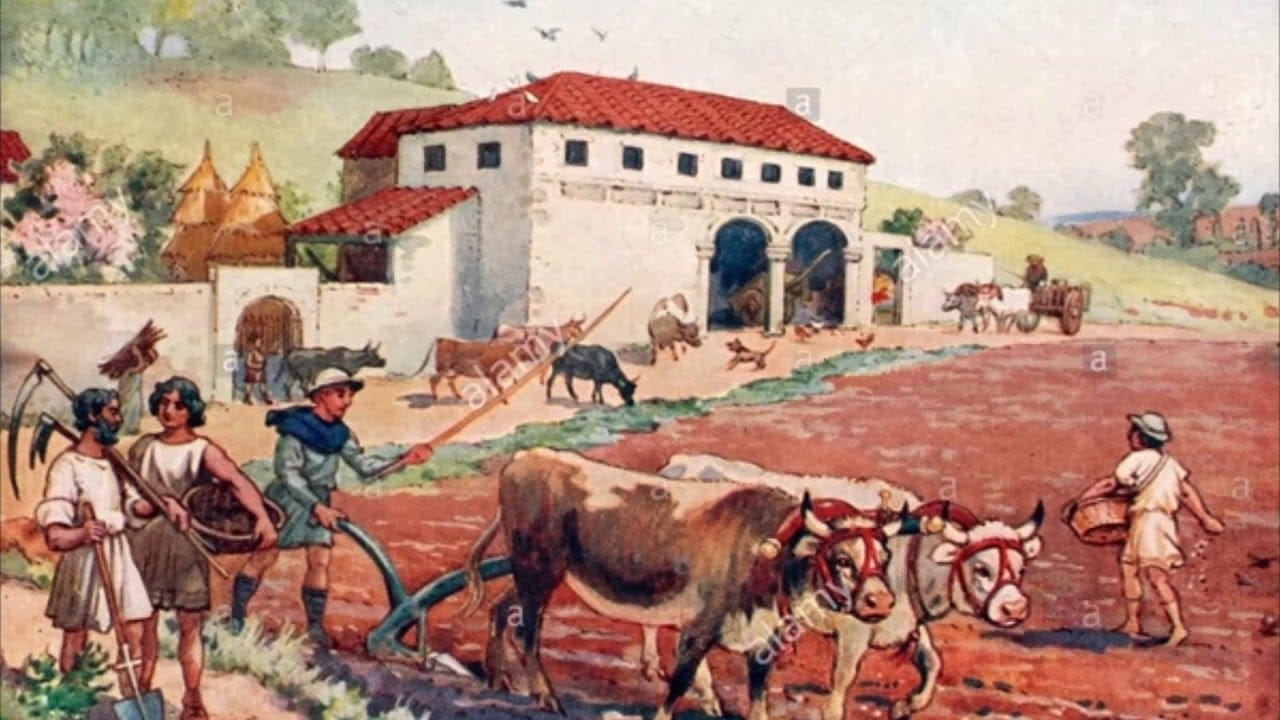
The Autumn Plow: After the first rains in October, farmers used a light wooden scratch-plow (aratron) pulled by oxen. Unlike the heavy plows of northern Europe, this tool was designed to break the crust without turning the soil too deep, which would have caused it to dry out.
The Spring Weeding: Manual labor was intense; farmers used heavy hoes and mattocks to break up clods of earth and remove weeds that competed for precious water.
4. Livestock and Transhumance
Large-scale cattle ranching was rare due to a lack of lush pasture. Instead, the Greeks relied on "small wealth"—sheep and goats.
The Manure Cycle: Animals were grazed on fallow fields, where their manure served as the primary fertilizer.
Transhumance: To keep livestock fed year-round, shepherds practiced transhumance—moving flocks to high mountain pastures in the summer and back to the coastal plains in the winter.
5. Irrigation and Water Management
In the driest regions, such as Attica, farmers became masters of hydraulic engineering to stretch their water supply.
Cisterns and Trenches: Every drop of rainwater was captured in stone-lined cisterns. Farmers dug intricate networks of small trenches to direct water precisely to the roots of trees and vines.
The Shaduf: Borrowed from Egypt, this counterweighted lever was used to lift water from deep wells or rivers into irrigation channels with minimal effort.
6. The "Ideal" of the Independent Farmer
In the Greek social hierarchy, the independent farmer (autourgos) was seen as the moral backbone of the state.
The Citizen-Soldier: Because farmers owned their land, they were the ones most motivated to fight as hoplites to defend the territory.
Hesiod’s Works and Days: This 8th-century BC poem served as the ultimate manual for the "Old Style" farmer, blending practical advice on when to sow and reap with moral lessons on the value of hard work (ergon) and justice.