Blacksmithing was the industrial backbone of Ancient Greece, bridging the gap between the legendary craftsmanship of the god Hephaestus and the practical needs of the hoplite soldier and the farmer. Operating in the "Old Style" of the charcoal-fired forge, Greek smiths mastered the transition from the Bronze Age to the Iron Age, creating tools that were both functional and enduring.
1. The Smelting Process and Materials
The journey of a Greek weapon began at the mines, such as the famous silver and iron mines at Laurion.
The Transition to Iron: By the Archaic period (c. 800 BC), iron had largely replaced bronze for cutting tools and weapons because it was more abundant and could hold a sharper edge if treated correctly.
Bloomery Furnaces: Smiths used "bloomery" furnaces—conical structures made of clay. Layers of iron ore and charcoal were heated while air was pumped in via hand-operated bellows. The result was a "bloom," a spongy mass of iron and slag that had to be hammered repeatedly to remove impurities.
2. The Forge: Heat and Hammer
The Greek forge (chalkeion) was a place of intense physical labor and precise temperature control.
Charcoal Fuel: Because wood burns too quickly and at too low a temperature, smiths used charcoal, which provided the consistent $1,200$°C to $1,500$°C heat required to make the iron malleable.
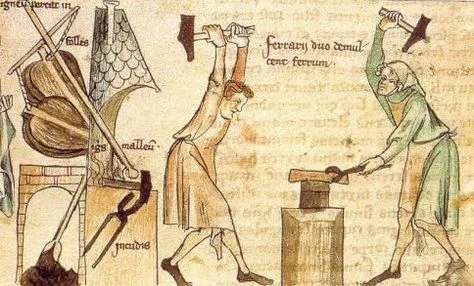
Anvil and Tools: The smith used heavy iron anvils, various sized hammers, and tongs (pyragra). To shape a sword or a plowshare, the iron was heated until it glowed "cherry red," then hammered into shape—a process known as forging.
3. Case Hardening and Steel
Ancient Greek smiths did not have "steel" in the modern sense, but they accidentally discovered a process called carburization.
Adding Carbon: By heating iron in a charcoal fire for long periods, the outer layer of the metal absorbed carbon from the fuel, effectively turning the surface into high-carbon steel.
Quenching: To lock in this hardness, the smith would "quench" the red-hot blade by plunging it into cold water or oil. This made the weapon brittle, so they would often "temper" it by reheating it at a lower temperature to regain toughness.
4. Weaponry: The Xiphos and the Kopis
The blacksmith’s primary goal for the military was to create a blade that would not snap or bend in the heat of a phalanx charge.
The Xiphos: This was the standard double-edged shortsword. Smiths forged it with a "leaf-shaped" blade, which shifted the weight toward the tip to allow for effective cutting and thrusting.
The Kopis: A curved, single-edged sword. Forging this required complex hammering to ensure the weight was concentrated on the "belly" of the blade, allowing it to strike with the force of an axe.
5. Defensive Armor: The Art of Bronze
While weapons shifted to iron, defensive armor—like helmets and cuirasses—remained primarily bronze (an alloy of copper and tin) because it was easier to cast and hammer into complex, anatomical shapes.
The Corinthian Helmet: Smiths would start with a single thick sheet of bronze and hammer it over a shaped "stake" or form. This required incredible skill to ensure the metal didn't thin out too much or crack at the edges of the eye slits.
Bronze Casting: For decorative elements or heavy greaves (shin guards), smiths used the "lost-wax" casting method, pouring molten bronze into clay molds.
6. Tools for the Oikos and the Field
The blacksmith was the local "handyman" for the civilian population, providing the essential iron tools that allowed Greek civilization to function.
Agricultural Tools: Smiths forged iron plowshares, sickles for the grain harvest, and heavy mattocks for breaking the rocky Greek soil.
Construction Tools: The building of temples like the Parthenon required thousands of iron chisels, saws, and "lewis bolts"—iron clamps used to lift and secure massive marble blocks. These tools had to be constantly resharpened at the forge, keeping the local smith in high demand.