For the Ancient Greeks, storytelling was not just entertainment; it was the primary vehicle for education, religion, and cultural identity. Long before literacy became widespread, the "Old Style" of communication relied on the spoken word, creating a culture where the ear was as important as the eye.
1. The Role of the Rhapsode
In the centuries before the Iliad and Odyssey were written down, professional storytellers known as Rhapsodes traveled from city to city.
The Staff: The word "Rhapsode" literally means "stitcher of songs." These performers would hold a wooden staff (rhabdos) to signal their authority and rhythmically "stitch" together thousands of lines of verse from memory.
Performance Art: They didn't just recite; they acted. A skilled Rhapsode could move an entire crowd to tears or fury, using vocal inflection and gestures to bring characters like Achilles or Odysseus to life.
2. Homer and the Epic Cycle
The foundation of Greek culture rested on the Epic Cycle, a series of poems detailing the Trojan War and its aftermath.
Mnemonic Devices: Because these stories were oral, they utilized "formulaic composition." Phrases like "rosy-fingered Dawn" or "swift-footed Achilles" were not just poetic; they were memory anchors that helped the storyteller maintain the meter of the poem while thinking of the next line.
The Shared "Text": Even after these were committed to writing, every Greek child was expected to memorize large portions of Homer. It provided a common language of metaphors and moral lessons that unified the Greek world.
3. Myth as Living History
To the Greeks, myths were not "fairy tales" but a record of their distant past.
Genealogy: Nobility often traced their family trees back to the heroes of myth. A king in Argos might claim descent from Perseus, using the oral tradition to legitimize his current political power.
Explaining the World: Storytelling was used to explain everything from the change of seasons (the myth of Persephone) to the naming of a local spring. By weaving the landscape into the story, the Greeks made their history tangible.
4. The Dionysia and the Birth of Drama
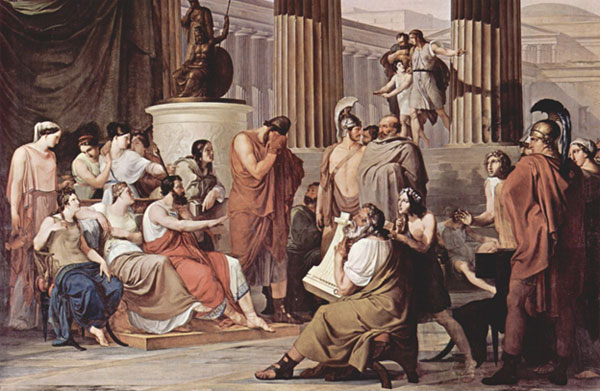
The transition from a single storyteller to a group of actors occurred during religious festivals, most notably the City Dionysia in Athens.
The Chorus: Originally, a group of people (the Chorus) sang and danced in honor of Dionysus. Eventually, an individual "stepped out" from the Chorus to engage in dialogue, leading to the birth of tragedy and comedy.
Civic Engagement: These plays were oral stories performed for the entire city. They allowed the polis to debate complex issues—like the conflict between state law and family duty in Antigone—through the safe lens of ancient legend.
5. Aesop and the Fable
While the nobility enjoyed epics and tragedies, the common people shared a tradition of fables, most famously attributed to Aesop.
Moral Instruction: Unlike the grand epics of gods and kings, fables used animals with human traits to deliver practical, "street-smart" advice.
Universal Reach: Because these stories were short and relied on simple imagery (like a tortoise and a hare), they were the most portable form of Greek storytelling, spreading through markets and docks to the farthest reaches of the Mediterranean.
6. The Symposium as a Storytelling Hub
The private banquets of the elite were the "intellectual workshops" for oral tradition.
Riddles and Wit: A popular pastime at a symposium was the ainigma (riddle). Guests would compete to see who could create the most clever or deceptive story-puzzle.
Preserving the Past: It was in these intimate settings that elders passed down local legends and family histories to the younger generation, ensuring that the "Old Style" of oral history remained vibrant even as the written word began to take hold of the Greek world.