Imagine undergoing surgery without general anesthesia, sterile operating rooms, or modern synthetic antibiotics. For an ancient Greek patient, this wasn't a nightmare scenario—it was the baseline reality of healthcare.
Yet, despite lacking modern technology, ancient Greek surgeons (cheirourgoi, meaning "hand-workers") achieved remarkable survival rates for complex procedures. They managed this by combining rigorous empirical observation, specialized metallurgy, and an accidental understanding of antiseptics. They treated surgery not as mysticism, but as a highly disciplined craft.
1. The Battlefield as a Classroom
The foundational manual for Greek surgery was forged in the blood and mud of warfare. As the Greek physician Hippocrates famously noted:
"He who desires to practice surgery must go to war."
Treating battlefield puncture wounds, arrow extractions, and shattered bones forced Greek medicine to abandon abstract theory and adopt brutal, practical efficiency.
Through thousands of hours treating soldiers, surgeons mapped the human vascular system, learning which arteries caused instant, fatal blood loss if nicked and which areas of the body could safely withstand deep incisions.
2. The Toolkit: Specialized Metallurgy
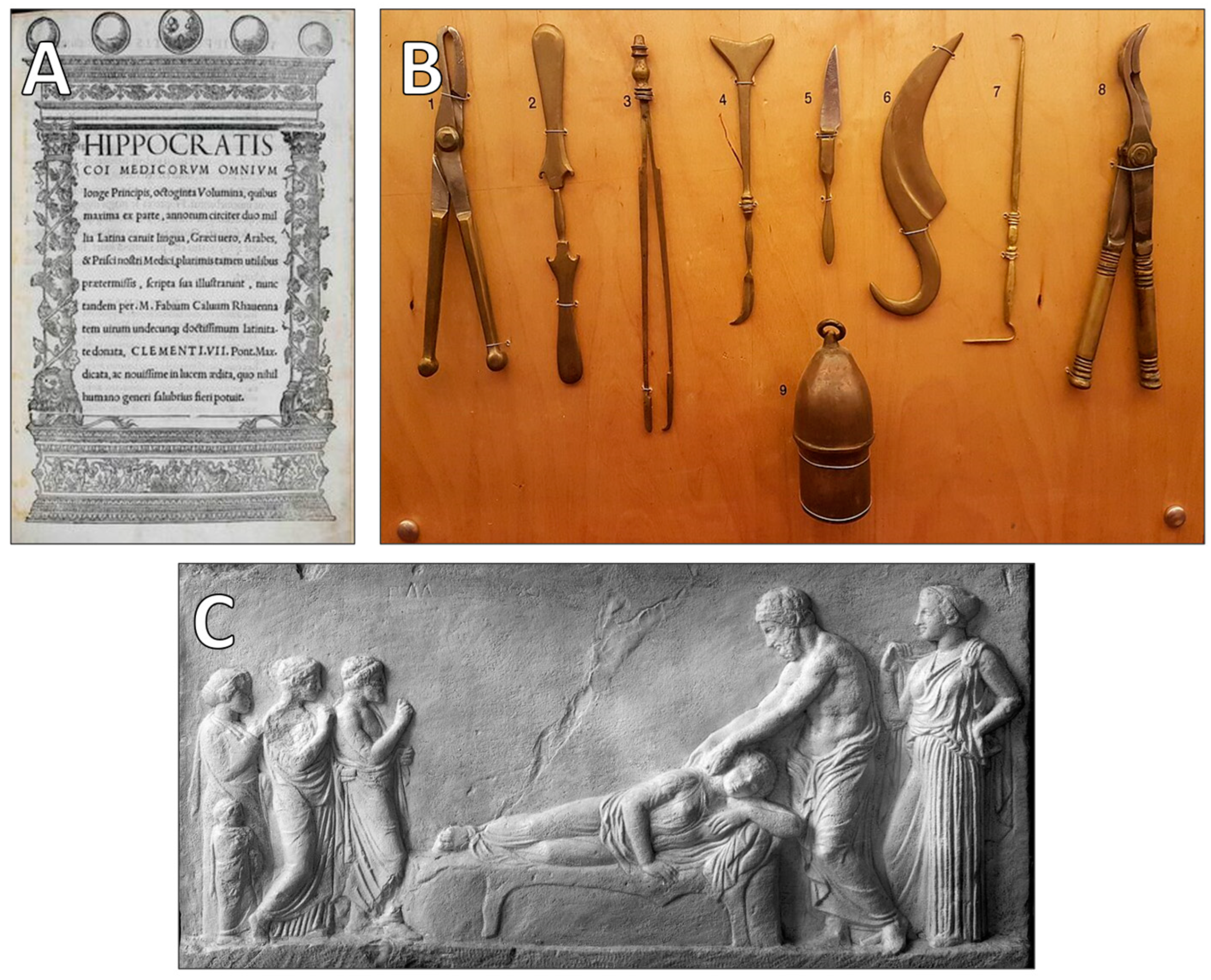
By the Hellenistic era, Greek surgical instruments had evolved into highly specialized tools made of high-quality bronze, iron, and steel. Surgeons carried dedicated leather tool rolls containing implements that are surprisingly recognizable to modern medical professionals.
Scalpels (Smilai): Usually featured a double-sided steel blade attached to a bronze handle. The handles were often shaped like a leaf or spatula, allowing the surgeon to blunt-dissect tissue or pull back skin with the blunt end while cutting with the other.
Bone Levers and Forceps: Used to pry fragmented bones back into position or extract deeply embedded arrowheads and sling bullets without tearing adjacent muscle fibers.
Trephines (Trypana): Hand-cranked, circular crown saws used to drill directly into the human skull. This was done to relieve intracranial pressure caused by traumatic head wounds or skull fractures—and archaeological findings show that a high percentage of patients actually survived the bone healing process afterward.
3. Pain Management Without Anesthesia
The lack of modern gaseous anesthesia meant that speed and psychological management were paramount. Greek surgeons could not keep a patient unconscious for hours, so operations had to be executed in minutes.
To dull the agonizing pain, surgeons turned to a sophisticated botanical pharmacopeia:
When herbal sedatives weren't enough, physical restraint was the final line of defense. The surgical theatre was heavily staffed with strong assistants whose sole job was to hold the patient completely immobile to ensure the surgeon’s blade never slipped.
4. Accidental Antisepsis: The War on Infection
The Greeks had absolutely no concept of germ theory; they believed infection was a corruption of the humors or an imbalance of heat. However, their strict hygiene protocols accidentally mimicked modern aseptic techniques.
1.Pre-Surgical Washing:Boiled Water & Wine.
The Hippocratic text On the Physician demanded that surgeons thoroughly wash their hands and clean the patient's skin using only boiled water or clean, high-proof wine. The alcohol in the wine acted as a potent, unintended topical antiseptic.
2.Hemostasis:Controlling Blood Loss.
Before sealing a wound, bleeding had to be stopped. Surgeons used tight compression bandages, linen ligatures to tie off severed blood vessels, or cautery irons (hot iron tools) to sear flesh and instantly seal open vessels.
3.Wound Dressing:Antimicrobial Poultices.
Wounds were rarely left open to the air. Surgeons dressed incisions with clean linen soaked in wine, vinegar, honey, or copper oxide rosin. Honey creates a natural osmotic barrier that prevents bacterial growth, while copper oxide possesses intense antimicrobial properties.
5. Orthopedics and Mechanical Traction
For complex compound fractures and joint dislocations, the Greeks relied on heavy mechanical engineering. Hippocrates designed a specialized wooden apparatus known as the Hippocratic Bench (Bathron).
Using a system of wooden levers, winches, and axles, the surgeon could apply immense, steady, and precise mechanical traction to a patient's leg, arm, or spine. This powerful pulling force overcame the natural resistance of large muscle groups, allowing the physician to safely slip dislocated joints back into their sockets or perfectly realign fractured bone shafts before applying a rigid splint.
Through this marriage of simple machinery, botanical chemistry, and meticulous anatomical knowledge, ancient Greek surgeons transformed a terrifying, chaotic ordeal into an organized, highly successful medical art form.