Introduction: The Balanced Body
For over two thousand years, Western medicine was dominated by a single, comprehensive theory: if you fell ill, it was not because of bacteria, viruses, or genetic quirks. It was because your body was physically out of balance. This system of thought is known as Humorism, or the theory of the Four Humors.
Formulated in the 5th century BCE within the Hippocratic Corpus and later systematized by the imperial physician Galen of Pergamum, this theory sought to explain the entire spectrum of human health, pathology, and temperament using a few simple, natural mechanics. Just as the Pre-Socratic philosophers argued that the universe was made of a balance of cosmic elements, the Greek medical establishment claimed that the human body was a mini-cosmos, kept alive by four vital metabolic fluids.
1. The Matrix of Health: The Four Fluids
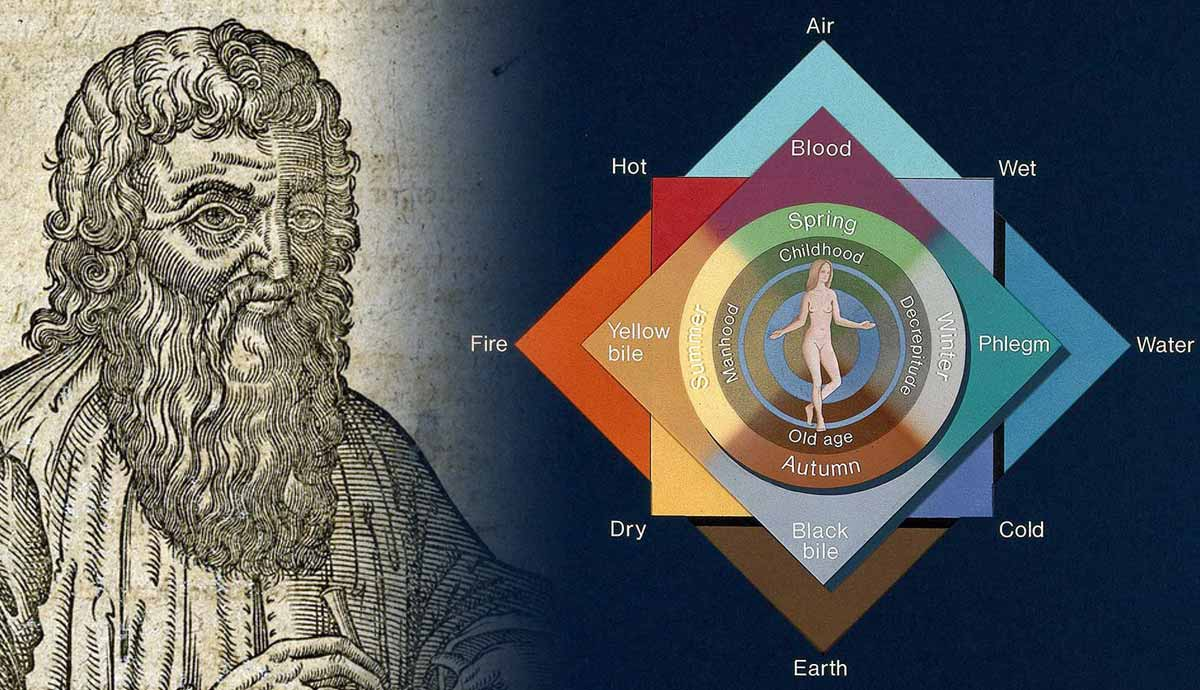
The word humor stems from the Greek word chymos ($\chi\upsilon\mu\omicron\varsigma$), which literally translates to "juice" or "fluid." The Greeks argued that the liver, spleen, brain, and lungs constantly manufactured and processed four specific juices.
To make sense of these fluids, physicians mapped them directly to the four foundational elements of the universe and the four primary physical states of matter:
2. The Humoral Typology: Health, Sickness, and Personality
In a perfectly healthy body, all four juices existed in a state of harmonious, proportional equilibrium known as eukrasia. Sickness occurred the exact moment one fluid became excessively dominant or depleted, a state of disharmony known as dyskrasia.
Crucially, the humors did not just control your physical organs; they dictated your baseline personality, mood, and mental health. This psychological offshoot, perfected by Galen, created four distinct human temperaments that still echo in our modern vocabulary:
1. Blood (Sanguis)
Attributes: Hot and Wet (Associated with Fire/Spring)
The Sanguine Temperament: An individual with a natural abundance of blood was thought to be cheerful, optimistic, courageous, and full of vitality. However, an extreme excess (plethora) of blood caused fever, high blood pressure, manic episodes, and facial flushing.
2. Phlegm (Phlegma)
Attributes: Cold and Wet (Associated with Water/Winter)
The Phlegmatic Temperament: Dominated by a thick, clear fluid produced by the brain and lungs. These individuals were calm, steady, rational, and slow to anger. An excess of phlegm led to lethargy, respiratory issues, cognitive dullness, and emotional detachment.
3. Yellow Bile (Cholé)
Attributes: Hot and Dry (Associated with Air/Summer)
The Choleric Temperament: Manufactured in the liver and stored in the gallbladder. Choleric people were highly driven, passionate, and decisive, but easily tipped into intense anger, impatience, and aggression. Physical symptoms of excess included jaundice, ulcers, and inflammatory fevers.
4. Black Bile (Melancholia)
Attributes: Cold and Dry (Associated with Earth/Autumn)
The Melancholic Temperament: A thick, dark fluid attributed to the spleen. A slight dominance made an individual analytical, artistic, and deeply reflective. A massive excess led to what the Greeks called melancholy—the ancient medical term for profound, clinical depression, often accompanied by paranoia and insomnia.
3. Therapeutics: The Law of Opposites
If a patient walked into a Greek clinic suffering from a burning, inflammatory fever, a Galenic doctor would diagnose the issue as an excess of a Hot and Dry humor (Yellow Bile). To bring the body back into eukrasia, the doctor applied the foundational rule of ancient therapeutics: The Law of Opposites.
    [ Patient State ]  ────────► [ Medical Intervention ]  ────────► [ Desired Outcome ]
    Hot & Dry Fever               Prescribe Cold & Wet                 Restored Balance
   (Excess Yellow Bile)          (Cucumbers, Barley Water)              (Eukrasia)
Treatment rarely involved complex chemical drugs. Instead, physicians manipulated the body’s inputs and outputs using four distinct strategies:
Dietetics: Food was viewed as medicine. If a patient was cold and sluggish, they were fed "hot" spices like garlic and pepper. If they were overheated, they were restricted to a diet of "cooling" foods like cucumbers, melons, and boiled barley water.
Environmental Shifts: Doctors routinely prescribed changes in climate. A patient suffering from chronic respiratory phlegm (Cold/Wet) might be ordered to move up to a dry, sun-drenched mountain village.
Evacuation: If a humor was dangerously concentrated, it had to be physically removed. Physicians used plant-based emetics to induce vomiting, or purgatives like hellebore to clear out the digestive tract.
Venesection (Bloodletting): Because blood was considered the easiest humor for the body to overproduce, opening a vein to let out a measured amount of blood became the most common medical procedure in the Western world, used to treat everything from headaches to broken bones.
4. The Scientific Verdict: The Legacy of a Closed Loop
It is easy to mock humorism today as primitive superstition, but to the ancient Greeks, it represented a monumental leap toward secular, rational science. By insisting that disease was caused by physical fluids reacting to physical environments, Hippocrates and Galen effectively stripped demons, curses, and divine punishment out of the hospital room.
   [ Ancient Humorism ]                   [ Modern Medicine ]
   • Balance of 4 internal fluids         • Germ theory and cellular biology
   • Focused on overall systemic state    • Isolated pathogens and specific targets
   • Qualitative observation              • Quantitative metrics (Lab data, scans)
The true weakness of the humoral model was its complete lack of diagnostic tools. Because they could not see cells, bacteria, or chemical hormones, the Greeks built a closed, unfalsifiable logical loop. If a treatment worked, the balance had been restored; if the patient died, the fluid imbalance was simply too severe to correct.
Despite its flaws, humorism stood as a deeply compassionate, holistic philosophy of medicine. It treated each patient as a highly unique individual whose mind and body were completely intertwined, establishing a standard of clinical observation that guided the medical profession for over two millennia.