Introduction: The Geometric Cosmos
To the ancient Greeks, the night sky was not an unfathomable void of chaotic cosmic dust. It was the ultimate expression of divine geometry, order, and harmony. While earlier civilizations like the Babylonians and Egyptians were master observers who compiled incredibly precise, centuries-long logs of astronomical data, they viewed the stars primarily through the lenses of omen-reading and calendar-keeping.
The Greeks took a radically different approach. They paired Babylonian empirical data with their own obsession with mathematics to ask a fundamental question: What is the physical, geometric model that explains these movements? This intellectual leap gave birth to mathematical astronomy, transforming the "wanderers" of the night sky—the planets (planētes)—into a complex playground for pioneering mathematicians.
1. The Tools of Observation: Naked-Eye Precision
Without telescopes, which would not be invented for another two millennia, Greek astronomers relied on sophisticated mechanical instruments to measure angles, track celestial coordinates, and predict eclipses with astonishing accuracy.
The Gnomon: Borrowed from the Babylonians, this was a simple vertical rod that cast a shadow on a flat surface. By measuring the length and changing direction of the shadow, astronomers like Thales and Anaximander could precisely determine the dates of the solstices and equinoxes.
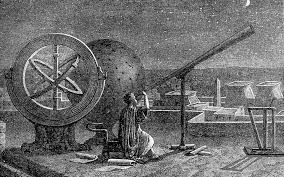
The Astrolabe and Armillary Sphere: These nested metallic rings allowed astronomers to align a sighting plane with a star or planet. By reading the degree markings carved into the brass rings, observers could map out a celestial body's exact latitude and longitude along the ecliptic (the path the Sun appears to follow across the sky).
The Dioptra: A long sighting tube mounted on a tripod equipped with precision cogwheels and water levels. It was used to measure the angular diameters of the Sun and Moon, as well as the exact distance between cosmic bodies.
2. Cosmic Scale: Calculating the Size of the Earth and Moon
Armed with nothing but basic geometry, trigonometry, and shadows, Greek astronomers calculated sizes and distances within our solar system that remarkably approximate modern values.
Eratosthenes Measures the Earth
Around 240 BCE, Eratosthenes, the head librarian at Alexandria, noticed a fascinating phenomenon. On the summer solstice in Syene (modern Aswan), the sun shone directly down a deep well, casting no shadow. At the exact same day and time in Alexandria, a vertical gnomon cast a distinct shadow showing an angle of 7.2 degrees.
       Alexandria (Shadow angle: 7.2°)
          /│
         / │
        /  │   Distance: ~5,000 stadia
       /   │
      /____│_________________
     /                       \
    /                         \
   /                           \
  /                             \
 /                               \
 \             (Center)          /
  \             /    \          /
   \           /7.2°  \        /
    \_________/________\______/
              Syene (No shadow)
Knowing that a full circle is 360 degrees, Eratosthenes calculated that 7.2 degrees was exactly $1/50\text{th}$ of the Earth's total circumference. By multiplying the physical distance between the two cities (measured by professional pacers to be roughly 5,000 stadia) by 50, he concluded the Earth's circumference was 250,000 stadia. Depending on the exact length of the stadion he used, his calculation was accurate to within 1% to 15% of modern satellite measurements.
Aristarchus and the Heliocentric Heresy
Aristarchus of Samos (c. 310–230 BCE) used the geometry of lunar eclipses to estimate that the Sun was vastly larger than the Earth. Based on this, he proposed a radical, lone theory: it made no sense for a massive body like the Sun to orbit a smaller body like the Earth. He argued that the Earth and planets actually rotated around a stationary Sun at the center—the first heliocentric model.
The theory was overwhelmingly rejected by his contemporaries because it violated basic common-sense physics (they argued that if the Earth was hurtling through space, humans would feel a constant wind and objects dropped from towers would fly backward).
3. Saving the Appearances: The Geocentric Epicycles
Because heliocentrism was discarded, astronomers had to figure out a way to map the movements of the universe while keeping a stationary Earth dead-center. This was known as the Geocentric Model, later formalized by Claudius Ptolemy in his massive astronomical encyclopedia, the Almagest (c. 150 CE).
The geocentric astronomers faced a massive mathematical headache: retrograde motion. Occasionally, planets like Mars appear to slow down, stop, move backward across the night sky for a few weeks, stop again, and then resume their forward journey.
To explain this loop-de-loop behavior mathematically without changing the Earth's central position, Apollonius of Perga and Hipparchus engineered a highly complex system of circles-within-circles:
The Deferent: The large, main circular orbit centered around the Earth.
The Epicycle: A smaller, secondary wheel that the planet was affixed to. As the center of the epicycle traveled smoothly along the large deferent pathway, the planet spun along the smaller circle.
When the planet spun along the inner side of its epicycle closest to Earth, it briefly moved opposite to the overall direction of the deferent, creating the optical illusion of retrograde motion. Ptolemy eventually added dozens of these overlapping epicycles, creating a clunky but highly functional mathematical calculator that successfully predicted planetary positions for over 1,400 years.
4. The Antikythera Mechanism: An Ancient Analog Computer
For centuries, modern historians assumed that these complex, multi-layered geometric formulas existed only on flat papyrus scrolls. That assumption was shattered in 1901 when divers exploring an ancient Roman shipwreck off the coast of Greece recovered a calcified, corroded lump of bronze that became known as the Antikythera Mechanism.
Dated to the late 2nd century BCE, this device is the world's oldest known analog computer. Using a complex array of more than 30 interlocking bronze gearwheels, a user could turn a single hand-crank to track the calendar, simulate the highly irregular orbit of the Moon (incorporating Hipparchus's theories of lunar anomaly), model the paths of the five known planets, and countdown the exact day and hour of upcoming solar and lunar eclipses.
The mechanism proves that Greek astronomy was not merely a collection of abstract philosophical musings. It was a highly advanced engineering tradition capable of translating complex, multi-layered geometric laws into precise, mechanical hardware.