Introduction: The Birth of the Peripatetic Tradition
In 335 BCE, after spending years traveling the Mediterranean and tutoring a young Alexander the Great, Aristotle returned to Athens. Instead of joining Plato’s Academy—where he had studied for two decades—he established his own institutional center of learning just outside the city walls: the Lyceum.
Named after its location in a grove dedicated to Apollo Lyceus (the wolf-god), the Lyceum was not simply a schoolhouse. It was a sprawling gymnasium, a public park, and a religious sanctuary wrapped into one. Under Aristotle’s guidance, it transformed into the ancient world’s premier research institution, introducing a revolutionary, scientific approach to Greek education (paideia) that fundamentally redefined how human beings systematically investigate the natural world.
                  =================================
                            THE LYCEUM
                  =================================
                    /             |             \
                   /              |              \
           [The Peripatos]   [The Library]   [The Museum]
           Shaded walkways    First massive   Collection of
           for lectures       book archive    zoological specs
1. The Peripatetic Method: Education in Motion
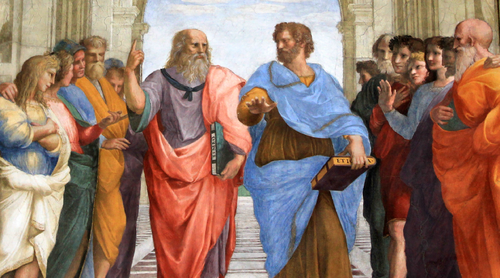
The most iconic characteristic of the Lyceum was its unique pedagogical style. Aristotle did not lecture from a static podium or a raised throne. Instead, he delivered his most profound philosophical and scientific insights while walking under the shaded porticoes (peripatoi) of the grounds.
Because of this habit, his students and colleagues earned the permanent nickname the Peripatetics (the "Walkers" or "Strollers"). This style of education was highly intentional:
The Morning Walk (Eothinos): Reserved for Aristotle’s advanced, inner-circle students (esoteric). These intimate, highly technical sessions covered advanced logic, physics, metaphysics, and theology while navigating the quiet morning gardens.
The Afternoon Walk (Deilinos): Geared toward the general public and younger students (exoteric). These open lectures focused on accessible, practical subjects like rhetoric, politics, poetry, and ethics.
This dynamic environment fostered collaborative debate over passive listening, ensuring education was an active, shared intellectual pursuit.
2. The Curriculum: Empirical Science and the First Archive
While Plato's Academy focused heavily on abstract geometry, pure mathematics, and the detached realm of metaphysical Forms, the Lyceum’s educational curriculum was deeply rooted in empiricism—the belief that knowledge is derived from rigorous sensory observation and data collection.
To support this radical new approach to learning, the Lyceum assembled two historic tools:
The First Great Library
Aristotle recognized that systematic research required access to existing knowledge. The Lyceum gathered hundreds of papyrus scrolls, maps, and historical manuscripts, creating the first organized, comprehensive research library in Europe. This collection later served as the direct structural blueprint for the legendary Great Library of Alexandria.
The Natural History Collection
Supposedly aided by funding and specimens sent back from Asia by his former pupil Alexander the Great, Aristotle established a massive collection of botanical and zoological samples at the Lyceum. Students did not just read about nature; they dissected marine life, cataloged rare plants, and analyzed animal anatomy firsthand.
3. The Organization: A Democratic Republic of Scholars
The Lyceum pioneered a highly structured, egalitarian system of institutional governance that mirrors modern university departments.
Institutional RoleFunctional Responsibility in the LyceumThe Scholar-ArchonThe administrative head of the school (first Aristotle, followed by his brilliant successor Theophrastus). Chosen democratically by the community.The Archon of the MonthA student elected by their peers every ten days to manage the daily mechanics of the school, including organizing meals, maintaining equipment, and enforcing academic discipline.The Symposium MasterOverseer of the monthly academic banquets, ensuring that communal dining remained an orderly, sober space for intellectual presentations and peer review.
By treating students as active administrators and citizens of the school, the Lyceum taught civic responsibility alongside philosophy, preparing young men to step directly into the political structures of the Greek polis.
4. The Legacy: A Blueprint for the Modern University
The Lyceum's approach to education permanently altered the trajectory of Western thought. When Aristotle passed away, leadership fell to Theophrastus (c. 371–287 BCE), who expanded the campus, formalized the botanical research curriculum, and secured the school's legal status in Athens.
   [Aristotle's Lyceum]
         │
         ▼
   [Library of Alexandria] ──► [Preservation of Texts] ──► [The Modern University]
Ultimately, the Lyceum moved education away from localized master-disciple relationships and toward a permanent, multi-disciplinary research institution. Its commitment to categorical division—breaking knowledge down into distinct fields like biology, physics, ethics, politics, and logic—remains the literal bedrock upon which modern high school and university curriculums are built today.