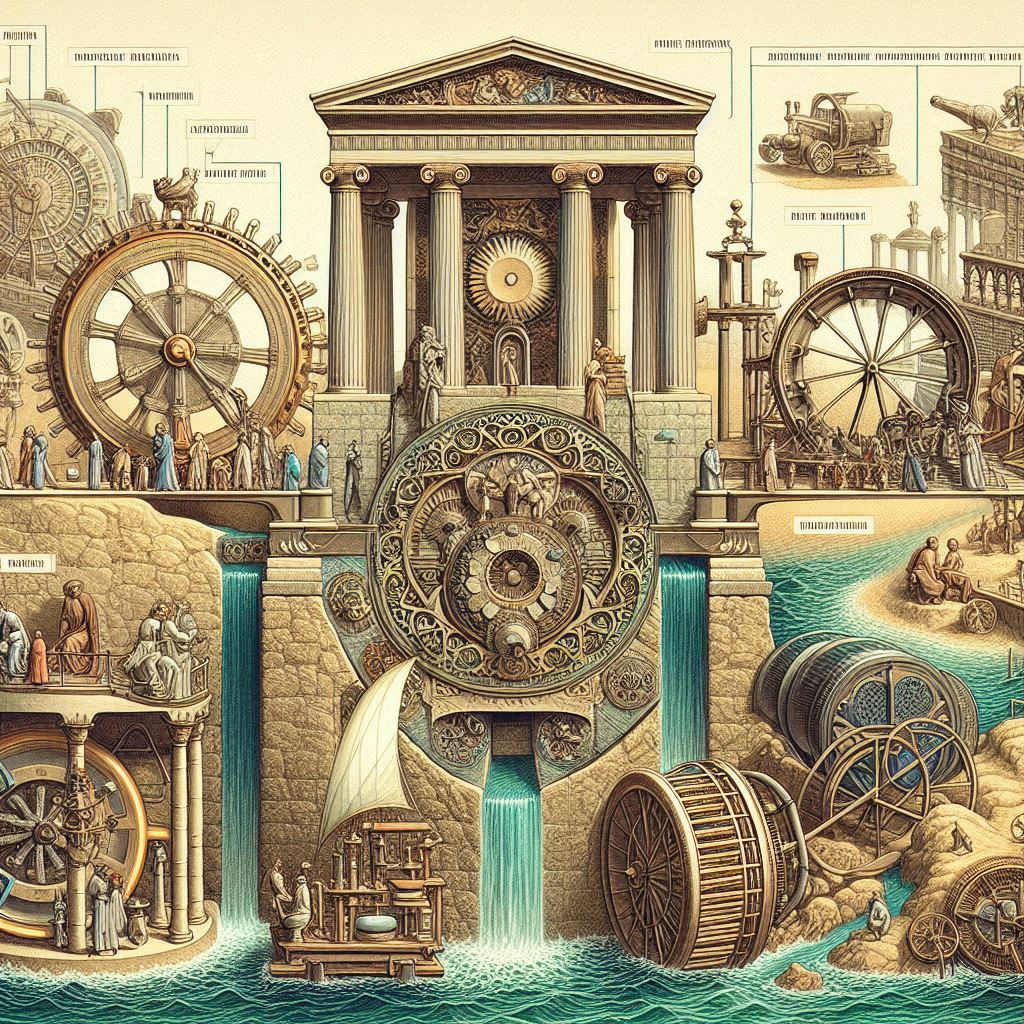
When we think of massive ancient waterworks, our minds naturally drift to the sprawling stone aqueducts of the Roman Empire. However, the Romans did not invent urban fluid mechanics—they inherited them. Centuries earlier, classical Greek engineers were already masterfully manipulating fluid dynamics, topography, and geometry to build complex, hidden water networks.
Faced with a notoriously dry Mediterranean climate, highly fractured rocky terrain, and vulnerable city centers, the Greeks pioneered urban hydraulic engineering. Rather than staging massive, elevated stone monuments above ground, they hid their sophisticated networks completely underground to safeguard their water supplies from both evaporation and invading armies.
1. The Tunnel of Eupalinos: A Mathematical Masterpiece
The crowning achievement of Greek hydraulic engineering is the Tunnel of Eupalinos, constructed in the 6th century BCE on the island of Samos. The tyrant Polycrates faced a critical defensive problem: the city's main fresh water source sat on the opposite side of the towering, solid-limestone Mount Kastro.
To resolve this, the engineer Eupalinos of Megara proposed an unprecedented gambit. He would tunnel over half a mile directly through the center of the mountain, digging from both sides simultaneously to meet in the middle.
Lacking magnetic compasses, topographic maps, or GPS, Eupalinos relied entirely on pure Euclidean geometry and basic surveying rods.
1.Tracing the Mountain Rim:Surveying the Profile.
Eupalinos mapped a leveling line over the rocky summit of the mountain to calculate the exact elevation difference between the northern spring and the southern city gates.
2.Sighting Straight Lines:Maintaining a Constant Vector.
Both digging teams used strings, level rods, and primitive sighting tools to maintain a perfectly straight horizontal line as they blasted into the solid rock from opposite faces.
3.Ensuring the Intersect:The Strategic Deflection.
To prevent the two teams from accidentally passing each other in the dark due to a minor mathematical drift, Eupalinos deliberately changed the path of both tunnels to an intentional zigzag near the center. This wide, deliberate sweep guaranteed the two teams would cross paths.
The two teams met in the absolute pitch black of the mountain interior with an error margin of less than 10 feet horizontally and mere inches vertically. To ensure the water flowed naturally via gravity, Eupalinos then dug a separate, precisely graded sloping trench along the floor of the main tunnel to house clay aqueduct conduits.
2. Inverted Siphons: Bending Water to Defy Gravity
Standard aqueducts rely on continuous, gentle downward slopes to keep water moving. But what happens when an engineer needs to move water across a massive, deep valley?
While the Romans chose to bridge these chasms by erecting multi-tiered stone arcades, the Greeks took a radically different path. They mastered the physics of the inverted siphon, utilizing the principle of communicating vessels to push water down into valleys and force it right back up the opposite side.
       [ Source Reservoir ]                                [ City Cistern ]
                │                                                 ▲
                ▼                                                 │ (Water rises back up
         (Water drops down)                                       │  to its original level)
                │                                                 │
                └──────────────► [ Deep Valley ] ─────────────────┘
                               (High-Pressure Pipeline)
The physics were elegant: as water plunged down the closed pipeline from the high source reservoir, it built massive hydrostatic pressure. This kinetic energy forced the liquid through the valley floor and pushed it up the far side, rising nearly to the elevation of its point of origin.
Managing this required incredible metallurgy and structural engineering. The valley floors experienced intense, bursting pressures. To prevent catastrophic leaks, Greek engineers manufactured thick, interlocking blocks of solid stone or heavy terracotta pipes bound tight with lead jackets to preserve a pressurized, hermetic seal.
3. The Public Fountain House: The Heart of the Agora
Once fresh spring water arrived safely inside a city’s defensive walls, it was funneled directly into the civic center (agora) to supply a fountain house (krene). These structures were not merely decorative water displays; they served as critical, high-volume public utility centers.
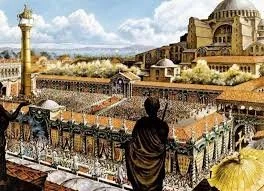
As shown in the architectural reconstruction above, a typical fountain house featured a beautiful shaded colonnade protecting a series of large stone basins.
Water flowed continuously from hidden, underground pressurized pipes through decorative bronze spouts—frequently cast in the shape of lion heads or theater masks. Citizens and enslaved workers gathered here daily to fill heavy ceramic jars (hydriai) for household cooking, cleaning, and drinking.
4. Sanitation and Flood Control: The Great Drains
The Greeks understood that bringing water into a crowded city was only half the battle; managing wastewater and flash flooding was equally vital for public health.
Cities like Athens and Priene featured incredibly advanced, integrated subterranean drainage grids. Beneath the main stone avenues sat the Great Drains—large, stone-lined canals covered with heavy slabs.
Greywater Processing: Individual homes and public latrines hooked directly into these underground channels via stone conduits.
Self-Cleaning Mechanics: The main channels were intentionally built with steep grades. When seasonal Mediterranean rainstorms battered the city, storm runoff quickly cascaded into the grid, creating a high-velocity flash that naturally scoured the sewers clean of household sludge and debris, flushing it safely outside the city limits into agricultural fields.
Through this invisible, subterranean infrastructure of tunnels, high-pressure siphons, and self-cleaning sewers, ancient Greek urban planners turned water management into an art form—proving that great civic engineering isn't always about what you can see on the horizon, but what you can mathematically hide beneath your feet.