For the ancient Greeks, happiness was not an emotion. It wasn’t a fleeting mood, a hit of dopamine, or a temporary feeling of joy. They didn't view it as something you could "feel" on a Tuesday morning and lose by Tuesday afternoon.
Instead, they called it Eudaimonia ($ \epsilon \upsilon \delta \alpha \iota \mu \mu o \nu \iota \alpha $), a word that translates literally to being guided by a "good divine spirit," but functionally means human flourishing, optimal functioning, or a life well-lived. To the Greeks, happiness was an objective achievement—the ultimate product of a lifetime of deliberate, rational practice.
Here is how the giant schools of Greek philosophy defined the ultimate goal of human existence.
1. Socrates and Plato: Happiness as Soul-Harmony
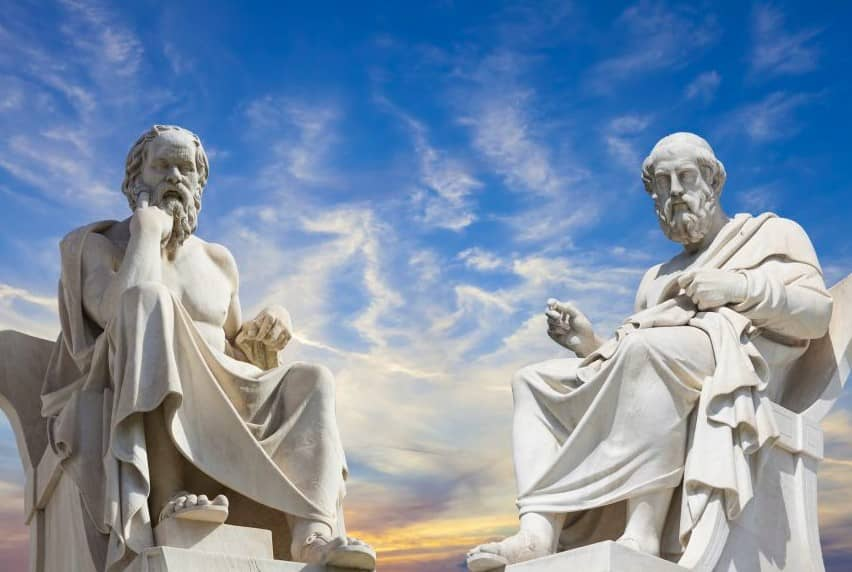
For Socrates and his student Plato, Eudaimonia was an entirely internal state. They revolutionized philosophy by arguing that happiness does not depend on physical luck, wealth, fame, or political power. Instead, it is a direct consequence of the health and moral order of your soul (psyche).
Plato argued that the human mind is divided into three competing parts:
Reason (Logistikon): The rational helmsman that seeks truth and logic.
Spirit (Thymoeides): The emotional drive that seeks honor, courage, and recognition.
Appetite (Epithymetikon): The physical urges that seek food, sex, comfort, and material wealth.
       [ CONFLICT ]                                  [ HARMONY (EUDAIMONIA) ]
     ┌──────────────┐                                    ┌──────────────┐
     │   Appetite   │ ◄── Gives orders to...             │    Reason    │ (Rules with wisdom)
     └──────┬───────┘                                    └──────┬───────┘
            ▼                                                   ▼
     ┌──────────────┐                                    ┌──────────────┐
     │    Reason    │ (Enslaved by desires)              │    Spirit    │ (Enforces order)
     └──────────────┘                                    └──────┬───────┘
                                                                ▼
                                                         ┌──────────────┐
                                                         │   Appetite   │ (Moderated and calm)
                                                         └──────────────┘
Unhappiness, or psychic disease, occurs when your physical Appetites or erratic Spirit hijack the ship, forcing your Reason to serve them. Happiness is achieved only when Reason rules supreme, organizing the other two components into a state of beautiful, harmonious balance. For Plato, a just and virtuous person is inherently happy because their internal house is in perfect structural order.
2. Aristotle: Happiness as an Activity
While Plato focused on the soul's abstract structure, Aristotle brought the concept down to earth in his Nicomachean Ethics. Aristotle famously claimed that happiness is not a static state of being, nor is it a possession.
"One swallow does not make a summer, neither does one fine day; and so too one day or a brief space of time does not make a man blessed and happy."
Aristotle defined Eudaimonia as "an activity of the soul in accordance with virtue (arete)." Key word: activity. You cannot simply possess good character traits; you must actively exercise them in the real world.
To explain this, he used the Telos Principle—the idea that everything in nature has an ultimate purpose or unique function:
Object/EntityUnique Function (Ergon)Excellent Execution (Arete)A KnifeCutting cleanlyBeing sharp and balancedAn EyeSeeing clearlyPossessing perfect, 20/20 visionA Human BeingUsing Reason to guide choicesLiving a life of rational, moral excellence
To find happiness, Aristotle argued you must apply the Golden Mean—the mathematical sweet spot between two behavioral extremes. For example, courage is the perfect, virtuous middle ground between the deficiency of cowardice (too little confidence) and the excess of rashness (reckless overconfidence).
Crucially, Aristotle was a realist. Unlike the philosophers who came after him, he admitted that true Eudaimonia requires a few external goods: you need basic health, enough resources to not starve, and good friends. For Aristotle, happiness is a lifelong project evaluated only at the very end of your journey.
3. Epicureanism: Happiness as Tranquility
In the turbulent Hellenistic era, Epicurus founded a school of thought that shifted the goalposts of happiness toward radical peace of mind. While Epicurus is often misunderstood today as an advocate for luxurious indulgence ("epicurean delights"), his actual philosophy was remarkably minimalist.
Epicurus defined happiness through two specific negative states—the absence of pain:
Aponia: The absence of physical pain in the body.
Ataraxia: The absence of mental anxiety and fear in the soul (unshakeable tranquility).
   [ Kinetic Pleasures ]  ────────► Short-lived spikes (Eating rich food, drinking wine)
                                    Can lead to future pain (Hangovers, addiction).

   [ Static Pleasures ]   ────────► The stable baseline of having zero pain or anxiety.
                                    This is the true peak of Epicurean happiness.
To achieve ataraxia, Epicurus advised dividing your desires into three categories:
Natural and Necessary: Food, water, shelter, safety, and deep friendship. (Easy to get, vital for happiness).
Natural but Unnecessary: Expensive gourmet meals, fine wine, or sexual intimacy. (Nice to have, but you shouldn't rely on them).
Unnatural and Unnecessary: Wealth, political power, fame, and luxury items. (Impossible to satisfy, highly toxic, and the primary source of human anxiety).
By limiting your desires strictly to what is natural and necessary, spending your days philosophizing with close friends, and realizing that the gods are indifferent to human affairs, you become entirely self-sufficient and immune to the chaotic shifts of the outside world.
4. Stoicism: Happiness as Radical Resilience
The Stoics, founded by Zeno of Citium, agreed that the ultimate goal of life was Ataraxia, but they reached it through a path of radical psychological discipline. They argued that happiness is achieved by living in accordance with Nature (Reason) and cultivating absolute mastery over your judgments.
The core engine of Stoic happiness is the Dichotomy of Control:
                  ┌────────────────────────────────────────┐
                  │       THE DICHOTOMY OF CONTROL         │
                  └───────────────────┬────────────────────┘
                                      │
           ┌──────────────────────────┴──────────────────────────┐
           ▼                                                     ▼
  [ WITHIN YOUR CONTROL ]                               [ OUTSIDE YOUR CONTROL ]
  • Your thoughts and judgments                        • The weather and climate
  • Your intentions and choices                        • Other people's opinions/actions
  • Your personal actions                              • Sickness, wealth, and mortality
           │                                                     │
           ▼                                                     ▼
   Invest 100% of your                                   Practice Apatheia (Radical
   identity and effort here.                             acceptance and indifference).
The Stoics claimed that things outside your control are fundamentally "indifferent"—they are neither morally good nor bad. Sickness, poverty, or a sudden storm cannot make you unhappy. Only your internal judgment about those events can ruin your happiness.
As the Stoic philosopher Epictetus famously put it: "Men are disturbed not by things, but by the view which they take of them." By withdrawing your emotional dependence from external outcomes and investing your entire sense of self-worth into your own moral choices, you achieve a state of Apatheia—freedom from destructive, irrational passions. For a Stoic, virtue is not just the path to happiness; virtue is happiness.