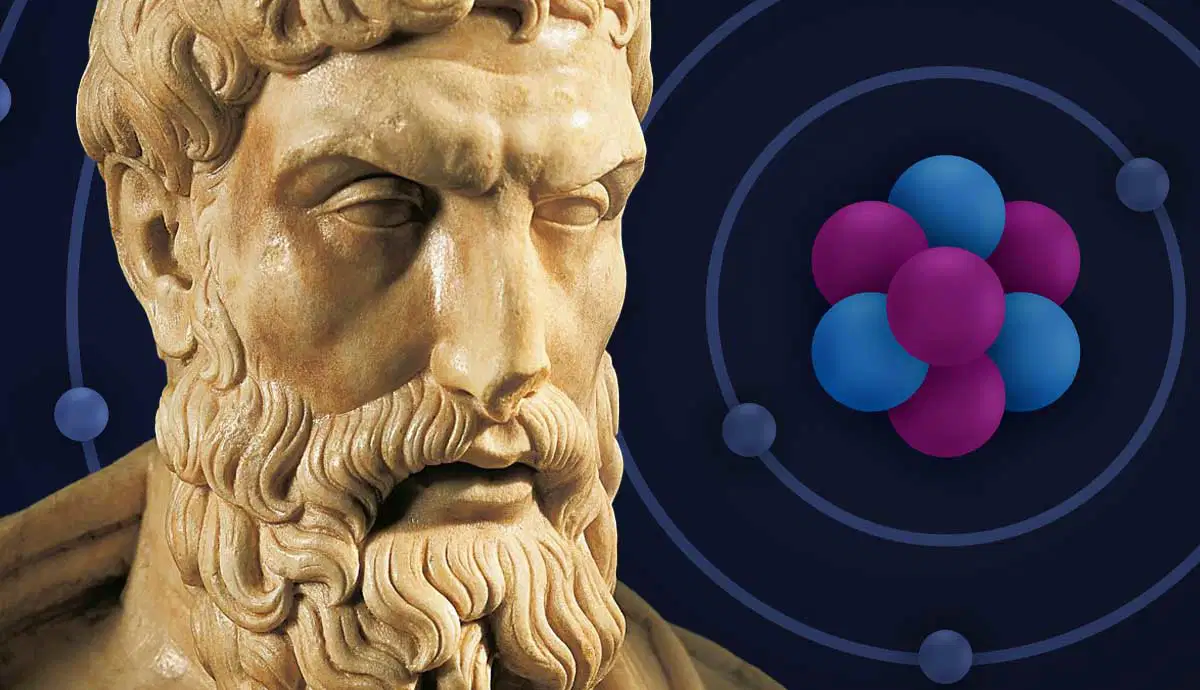
Introduction: The Birth of the Indivisible
Imagine taking an apple and cutting it in half. Then, you cut that half in half again. If you kept repeating this process down to the microscopic level, could you keep dividing that piece of apple forever? Or would you eventually hit a hard, fundamental wall—a particle so small that it is physically impossible to divide any further?
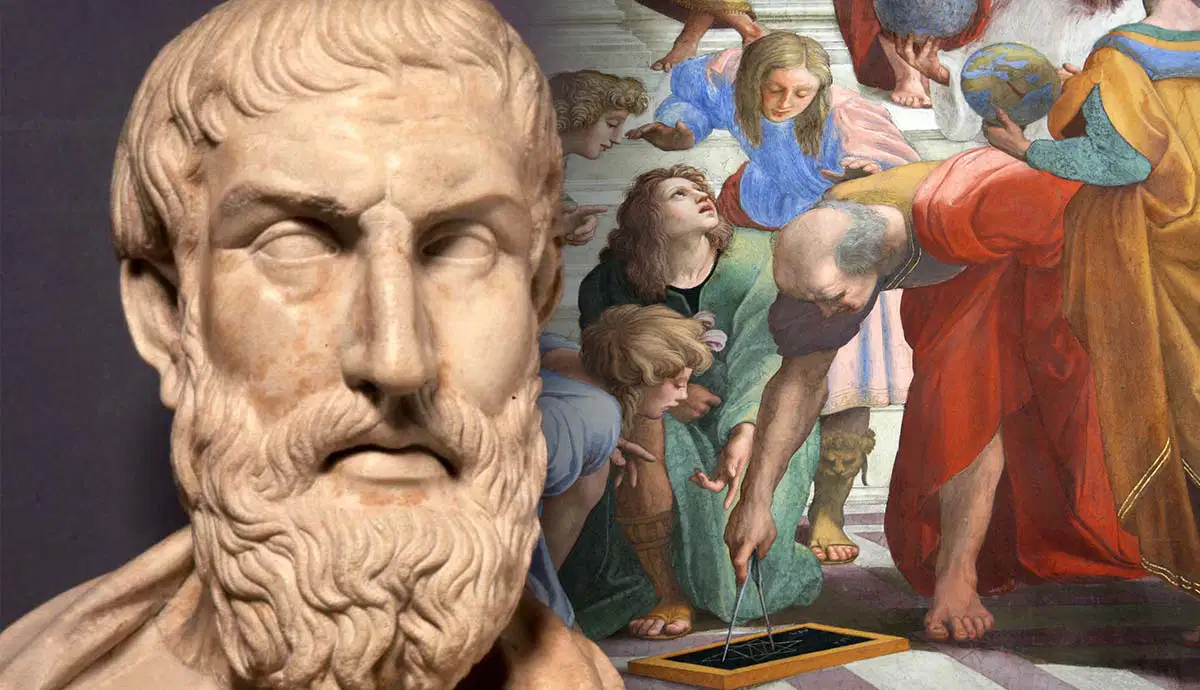
This exact thought experiment occupied the minds of two ancient Greek philosophers in the 5th century BCE: Leucippus and his brilliant student Democritus of Abdera. In an era when most thinkers believed the universe was made of continuous, malleable elements like water, air, or fire, these two radicals proposed a mind-boggling alternative: the universe is actually composed of an infinite number of microscopic, un-cuttable, indestructible building blocks. They called these particles atomos ($\alpha\alpha\tau\alpha\omicron\mu\omicron\varsigma$), meaning "indivisible" or "uncuttable." This philosophical spark was the true, distant ancestor of modern atomic theory.
1. The Core Theory: Atoms and the Void
Democritus condensed the entire complexity of the cosmos down to an incredibly simple, elegant binary formula:
$$\text{All reality} = \text{Atoms} + \text{The Void}$$
To the Atomists, everything else—color, taste, warmth, sweetness—was merely a subjective human illusion. The only things that truly existed in objective reality were atoms moving through empty space.
       [ The Atomic Universe ]
       _______________________________
      |  o      o          o      o   |
      |     o       o   o      o      | <- Atoms (Immutable matter)
      |  o      o          o      o   |
      |_______________________________|
        ▲
      The Void (Empty space allowing motion)
The Nature of the Atom: Atoms were completely solid, completely packed with matter, and contained absolutely no empty space inside them. Because they had no internal voids, they could never be crushed, split, worn down, or destroyed. They were eternal.
The Nature of the Void: The void was simply empty space. Democritus argued that without a void, motion would be entirely impossible. Matter would be completely locked in a cosmic traffic jam, unable to shift or rearrange itself.
2. The Mechanics of Matter: Shape, Arrangement, and Position
If all atoms are made of the exact same uniform, primordial substance, how do they combine to form such a wildly diverse world? How does the same atomic material make up both a hard iron sword and a soft drop of water?
Democritus explained this using a brilliant analogy involving the Greek alphabet. Think of atoms like letters. The letters A, N, and T are made of the exact same ink, but by changing their shapes, ordering them differently, or flipping them around, you can create entirely different words and meanings. He categorized these atomic variations into three distinct rules:
Atomic AttributeDemocritus's AnalogyHow it Manifests in the Physical WorldShape (Rysmos)Letter A vs. Letter NControls texture and density. Water atoms are smooth and round, allowing them to roll past one another like marbles. Iron atoms are jagged, hooked, and rough, locking tightly together into a rigid solid.Arrangement (Diathege)Word AN vs. Word NAControls how substances change form. The exact same atoms can create totally different materials simply based on who their neighbors are.Position (Trope)Letter Z flipped into Letter NControls how orientation alters properties, such as how a crystal reflects light depending on the angle it is held.
Even human sensations were explained mechanically. Sweet things were made of large, smooth, rounded atoms that bathed the tongue pleasantly. Bitter or sour tastes were caused by sharp, hooked, jagged atoms that physically scratched and tore at the taste buds.
3. Epicurus and the "Swerve": Introducing Free Will
A century later, the philosopher Epicurus (341–270 BCE) adopted Democritus's atomic model but realized it suffered from a massive psychological flaw: absolute determinism.
If atoms simply fall through the void in straight lines due to their weight, colliding like predictable billiard balls, then every human thought, action, and choice is entirely predetermined by past atomic collisions. This left zero room for human free will or moral responsibility.
    [ Deterministic Fall ]            [ The Epicurean Swerve ]
              │                                  │
              │ (Straight line)                  │ (Unpredictable veer)
              ▼                                  └──► (Collision!)
To solve this, Epicurus introduced a revolutionary, highly controversial concept: the clinamen, or the swerve. He argued that at absolutely random times and in uncertain locations, atoms exhibit a tiny, unpredictable swerve from their straight paths.
This mechanical "swerve" served two vital philosophical purposes:
It caused atoms to collide, bounce off one another, and cluster together to form the physical world.
It broke the rigid chain of cause-and-effect, providing a physical, atomic explanation for human consciousness and free will.
4. The Bridge to Modern Science: Philosophy vs. Chemistry
It is vital to recognize both the brilliant predictive power and the severe limitations of the ancient Greek atomic model. Democritus was not a modern scientist; he did not arrive at his theory through laboratory experiments, particle accelerators, or mathematical calculations. He arrived there through pure deductive logic.
   [ Ancient Atomism ]                    [ Modern Atomic Theory ]
   • Arrived at by pure logic             • Arrived at by physical testing
   • Atoms are solid & indivisible        • Atoms are mostly empty space
   • Infinite variety of shapes           • Fixed elements (Protons/Neutrons)
Because of this, ancient atomism differs from modern chemistry in several massive ways:
The Interior of the Atom: Democritus believed atoms were entirely solid. Today, we know an atom is mostly empty space, consisting of a dense nucleus orbited by a cloud of electrons.
Indivisibility: The very name atom became a historical misnomer in the 20th century when physicists successfully split the atom, discovering subatomic particles like protons, neutrons, electrons, and quarks.
A Continuous Spectrum vs. Elements: The Greeks believed atoms could come in an infinite variety of shapes and sizes. Modern science recognizes a strictly organized periodic table of specific chemical elements defined by the precise number of protons in their nuclei.
Despite these differences, the intellectual legacy of Democritus and Epicurus is monumental. They were the first to boldly claim that the complex macro-world we see is governed by a hidden micro-world of mechanical laws. By stripping magic and superstition out of matter, they laid the conceptual runway that modern physics would eventually take off from.