To the ancient Greeks, a building was not merely a shelter or a monument to political power—it was an embodiment of cosmic order ($kosmos$) made physical through the language of mathematics. Greek architects (architektones) did not separate structural engineering from geometry, philosophy, or aesthetics; they viewed them as a single, unified discipline.
By applying rigorous geometric proportions, optical corrections, and mathematical ratios, they transformed heavy, inanimate stone into structures that appeared to breathe with organic life, harmony, and balance.
1. The Power of Proportion: The Module System
Greek architecture was built from the ground up using a system of commensurability (symmetria). This meant that every single component of a building—from the massive height of its outer columns down to the tiny grooves carved into its base—was mathematically linked to every other part by a strict ratio.
Instead of relying on fixed, standardized units of measurement like modern meters or feet, an architect established a module ($embater$) based on a single element of the building itself, typically the lower radius or diameter of a column.
          [ Capital ]  ──► Width = 2 Modules
               │
               ▼
         =============
         │  Column   │ ──► Height = 16 Modules (8:1 Ratio)
         │  Shaft    │
         =============
               │
               ▼
          [ Base ]     ──► Diameter = 2 Modules (The Core Unit)
Once this single module was decided, the blueprint for the entire building unfolded through simple mathematical multiplication and division:
The total height of the column might be set to exactly 16 modules ($8:1$ height-to-diameter ratio).
The space between each column (intercolumniation) might be set to exactly $2.25$ modules.
The height of the decorative roof frame (entablature) would be scaled to exactly 4 modules.
Because the entire temple grew proportionally from a single mathematical seed, the building achieved an overwhelming visual harmony that the Roman architect Vitruvius compared to the perfect structural proportions of a healthy human body.
2. Geometry in Action: The Mathematical Layout
Before a single block of marble was quarried, the entire perimeter of a temple was mapped out using basic geometric operations executed with nothing but a peg, a stretched cord, and a straightedge.
The $4:9$ Ratio and the Parthenon
The Parthenon in Athens, constructed between 447 and 432 BCE by the architects Iktinos and Kallikrates, is a masterclass in a specific mathematical proportion: the ratio of $4:9$. This precise algebraic relationship controls both the flat layout and the vertical elevation of the building:
Even the ratio of the temple's total width to its vertical height up to the roof line perfectly mirrors this exact same $4:9$ proportion. By repeating this single mathematical fraction across every spatial dimension, the architects created a rhythmic, visual resonance throughout the entire structure.
3. Optical Refinements: The Mathematics of Deception
If you build a massive stone temple using perfectly straight lines, perfectly flat floors, and perfectly vertical columns, a strange thing happens when a human looks at it: it looks completely crooked.
Because of the natural curvature of the human eye and the distorting effects of bright Mediterranean sunlight, long horizontal lines appear to sag down in the middle, and tall vertical columns look like they are leaning outward, ready to collapse. The Greeks recognized this psychological illusion and used sophisticated, active mathematical distortions to counteract it. These corrections are known as optical refinements.
    [ The Optical Illusion ]               [ The Greek Correction ]
  Columns appear to flare outward        Columns lean gently inward
  and look top-heavy.                    with a subtle swelling (Entasis).

       \   │   /                                /   │   \
        \  │  /                                /    │    \
    ═══════════════                        ═══════════════
    Floor looks like it sags               Floor is built with a
    in the center.                         subtle upward curve.
Entasis: The Swelling Column
Greek columns are never straight cylinders. If they were, they would look concave and top-heavy. To correct this, architects engineered entasis—a subtle, mathematically calculated swelling of the column's profile that peaks roughly one-third of the way up the shaft. The column curves gently outward by only a fraction of an inch before tapering back in toward the top, giving the heavy stone the illusion of muscular tension, as if it is actively flexing to hold up the weight of the roof.
Curvature of the Horizon
To prevent the foundation (stylobate) from appearing to sag, architects built the floors with a gentle, dome-like upward curve. On the Parthenon, the center of the long sides sits roughly $4.3$ inches higher than the corners.
The Inward Lean
To give the building a sense of solid, grounded stability, every single outer column leans gently inward toward the center of the temple by about $2.4$ inches. If you were to extend the vertical lines of all the Parthenon’s columns thousands of feet up into the sky, they would eventually meet to form a massive mathematical pyramid.
4. Architectural Aesthetics vs. Pure Mathematics
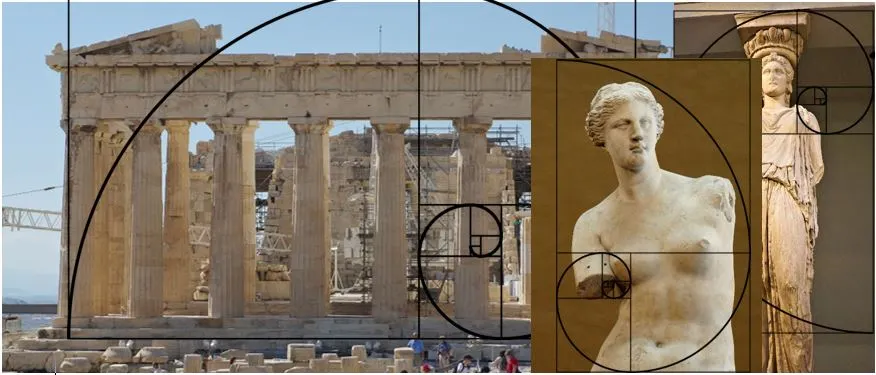
For centuries, a popular romantic myth claimed that the Greeks designed their temples entirely around the Golden Ratio. Modern architectural surveys, however, have thoroughly debunked this idea.
MetricThe Golden Ratio MythReal-World Greek
The true genius of Greek architecture lies right at this intersection of math and humanity. The architects did not worship mathematical formulas for their own sake. They understood that geometry was a tool to serve human perception, proving that sometimes, a line must be mathematically curved so that it can look perfectly straight to the human soul.