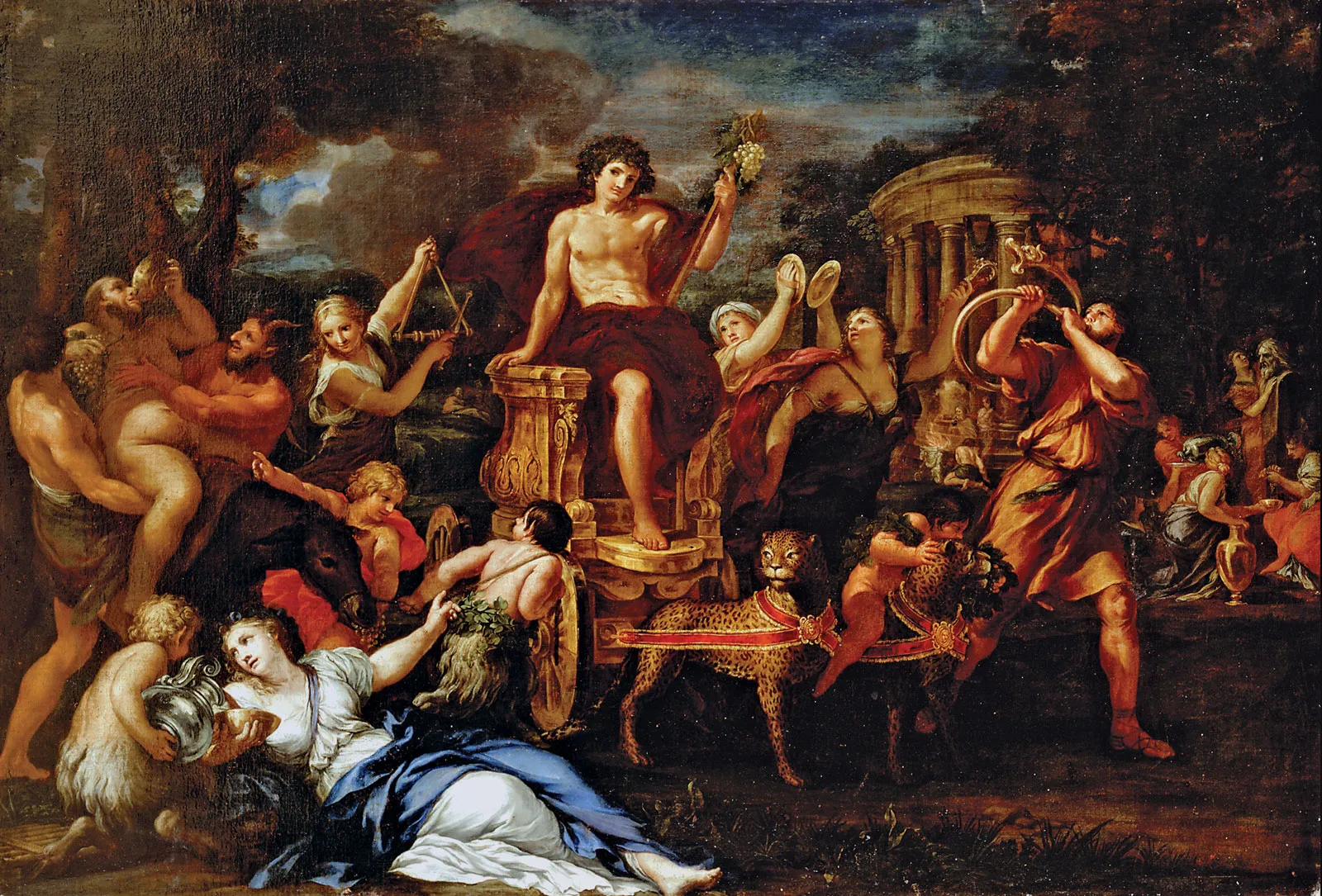
To look at ancient Greek theater as a night of secular entertainment is to misunderstand it entirely. In ancient Athens, theater was a holy, ecstatic, and intensely competitive religious ritual.
The birthplace of Western drama was a massive spring festival known as the City Dionysia (or Great Dionysia), held in honor of Dionysus, the god of wine, madness, fertility, and ritual ecstasy. For five to six days, the entire city-state paused. Courts were closed, businesses shut down, prisoners were temporarily bailed out of jail, and up to 14,000 people packed into the open-air theater carved into the southern slope of the Acropolis.
1. Why Dionysus? The Theology of Performance
It is no accident that the god of wine was also the god of the stage. Dionysus was the god of alterity—of becoming someone else, breaking boundaries, and escaping the rigid constraints of daily identity.
 [ Drink Wine ] ────────► Lower Inhibitions ────────► Divine Frenzy / Altered State
                                                                  │
                                                                  ▼
 [ Put on a Mask ] ─────► Shed the Everyday Self ────► Embody a God, Hero, or Satyr
By putting on a mask, an actor literally surrendered their identity to channel another soul. The audience, swept up in the story, experienced a collective illusion. To the Greeks, this psychological shift wasn't mere acting; it was a profound religious experience driven by the god's divine presence.
2. Anatomy of the Festival: From Revelry to Ritual
The City Dionysia was structured to transition the city from chaotic celebration into deep, collective reflection.
1.The Procession and Carnival (Pompe):Day 1.
A wooden cult statue of Dionysus was escorted into the city with a vibrant, raucous parade. Citizens carried large phallic symbols representing fertility, while others wore costumes. The night ended in the Komos—a wild, wine-fueled street party.
2.The Dithyrambic Competitions:Day 2.
The civic tone was set. Citizen choruses representing the ten political tribes of Athens performed dithyrambs—passionate, traditional choral hymns sung and danced around the altar of Dionysus in the center of the theater orchestra.
3.The Dramatic Showdowns:Days 3 to 5.
The main event. Over three consecutive days, three chosen tragic playwrights each took center stage for a full day, presenting three tragedies followed by a chaotic, mythological satyr play. Comedies were interspersed or given their own dedicated blocks.
4.The Verdict and Judging:Day 6.
Ten randomly chosen citizens—one from each tribe, explicitly guided by divine chance—cast their ballots into an urn to crown the winning playwright, who received a crown of ivy and immense civic glory.
3. The Great Tragic Trilogy and the Comic Relief
The plays themselves were monumental tasks for the audience, who sat on stone benches from sunrise to sunset.
Playwrights like Aeschylus, Sophocles, and Euripides didn't write light entertainment. They used well-known mythological stories to confront the audience with grueling moral, political, and philosophical paradoxes: Is a son justified in killing his mother if she murdered his father? What happens when civic law clashes with divine burial rites?
To cleanse the emotional palate after three consecutive tragedies, the day wrapped up with a Satyr Play. In these rowdy performances, the chorus dressed up as satyrs (mythological half-man, half-goat creatures) to engage in slapstick, dirty jokes, and irreverent mockery of the very heroes the audience had just wept over.
4. Catharsis: The Civic Value of Shared Emotion
The ultimate goal of attending these performances was catharsis ($ \kappa \alpha \dot{\theta} \alpha \rho \sigma \iota \varsigma $)—a term popularized by Aristotle meaning "purification" or "cleansing."
Aspect of DramaRitual & Political FunctionThe Mask (Prosopon)Allowed a small cast of two or three male actors to play multiple roles, including women and gods, amplifying the universal scope of the narrative.The ChorusActed as the stand-in for the audience inside the play, reacting with fear, pity, and song to the actions of the doomed royal protagonists.The Shared EmotionForcing thousands of citizens to simultaneously experience grief, terror, and laughter purged the community of internal tensions.
By witnessing legendary kings fall to ruins because of pride (hubris), Athenian citizens were reminded of their own fragile mortality and the absolute supremacy of cosmic law. Theater at the City Dionysia was the ultimate democratic gym: it trained the citizens' capacity for empathy, political judgment, and religious humility under the watchful eye of Dionysus.