While the Olympic Games drew athletes from across the entire Greek world to a remote sanctuary, the Panathenaic Games were a spectacular, hyper-localized projection of raw imperial pride. Held in Athens in midsummer, this festival was the city's ultimate birthday party for its patron goddess, Athena.
Every year featured the Lesser Panathenaia, but every four years, the city poured staggering wealth into the Great Panathenaia. Lasting over a week, the event transformed Athens into a sprawling theater of competitive athletic prowess, high-stakes artistic performance, and massive civic pageantry.
1. The Core Ritual: The Great Panathenaic Procession
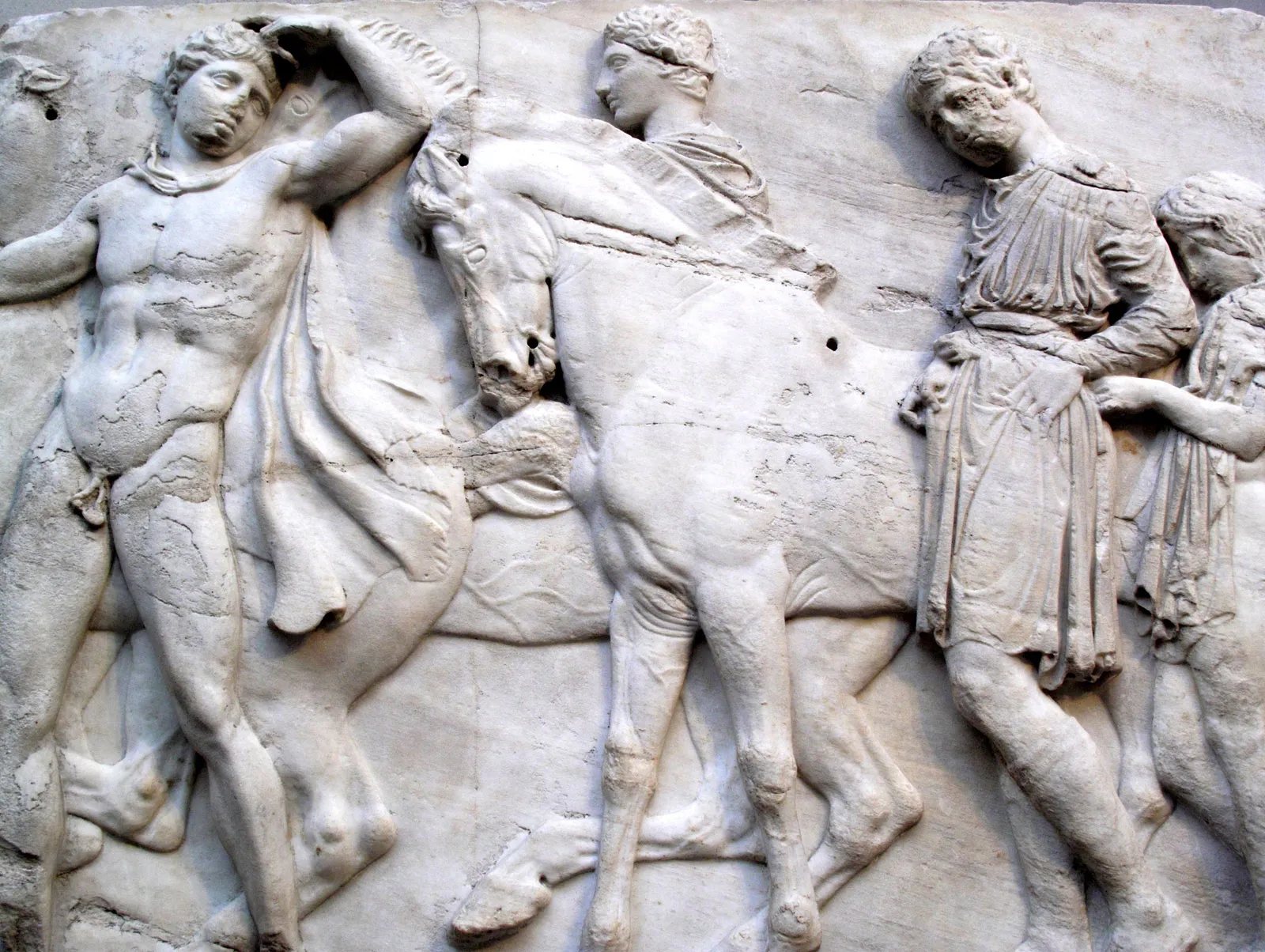
The absolute climax of the festival occurred on Athena's birthday. At dawn, the entire population of the city gathered at the Dipylon Gate to participate in a massive, structured procession (Pompe) that cut right through the heart of Athens up to the Acropolis.
The primary purpose of this march was to deliver the Peplos—a massive, magnificent saffron-and-purple robe woven over nine months by the young aristocratic girls of Athens (ergastinai). The robe was embroidered with scenes of the battle between the Gods and the Giants, celebrating Athena's tactical brilliance.
 [ Dipylon Gate ] ──► Across the Agora Market ──► Up the Acropolis ──► Draped over Athena's Statue
                             │
                             ▼
              The Peplos is rigged like a sail
              to a wheeled ceremonial ship-cart
Following the ship-cart was an immense line of citizens: calf-herders leading over a hundred sacrificial cattle (hecatomb), maidens carrying sacred baskets, musicians playing the flutes and lyres, and hundreds of armed Athenian cavalrymen on prancing steeds.
2. The Schedule: A Week of Art and Athletics
The Great Panathenaic Games were highly structured, balancing musical and intellectual contests against physical combat.
1.Musical, Poetic, and Open Athletic Contests:Days 1 to 3.
The festival kicked off at the Odeon with contests for rhapsodes—professional storytellers who competed to see who could give the finest dramatic recitation of Homer’s Iliad and Odyssey. This was followed by instrumental musical showdowns and open athletic track-and-field events (footraces, wrestling, boxing) open to all Greeks.
2.Equestrian Events and Chariot Races:Days 4 to 5.
Staged at the hippodrome, these events included traditional chariot races. They also included highly dangerous, uniquely martial spectacles like the Apobates race, where an armor-clad warrior had to leap off a speeding chariot, sprint alongside it, and jump back on at full speed.
3.Tribal Contests (Athenians Only):Day 6.
Designed to foster democratic camaraderie and military readiness, Athens' ten political tribes competed against each other in specialized events. This included the Pyrrhic Dance (a synchronized military mock-combat dance performed to flute music) and the Euandria (a male beauty and physical fitness competition judging athletic posture, stamina, and build).
4.The Regatta and Civic Feast:Day 7.
A prestigious boat race held in the waters off the port of Piraeus, testing naval rowing coordination. The games concluded back on land with the slaughter of the hecatomb, providing a massive public meat barbecue for the entire populace.
3. The Grand Prize: Liquid Gold
Unlike the Olympics, where victors received a simple olive wreath, the Panathenaic Games handed out staggering material wealth. Winners of the athletic events were awarded Panathenaic Amphorae—massive, beautifully painted ceramic storage jars.
The value lay inside the jars. Each one was filled to the brim with top-tier, sacred olive oil harvested from the state-protected groves of Athena (moriai).
Event WinnerNumber of Amphorae AwardedEstimated Modern EquivalentYouth Footrace Champion~30 AmphoraeA comfortable down payment on a modest home.Sprint (Stadion) Champion~60 AmphoraeRoughly equivalent to two full years of an artisan's daily wages.Chariot Race Champion140 Amphorae (~1,400 gallons of oil)A small fortune capable of catapulting an athlete into the upper economic class overnight.
Victorious athletes could easily sell this high-demand commodity across the Mediterranean world, turning their athletic victory into instant generational wealth.
4. The Political Statement: An Imperial Mirror
Ultimately, the Panathenaic Games were an exercise in soft power. During the height of the Athenian Empire, Athens forced its subject ally city-states to send a mandatory tribute of a sacrificial ox and a full suit of armor to be presented at the festival.
By merging religious devotion with competitive athletics and the aggressive display of military and artistic dominance, the Panathenaic Games broadcasted a clear, uncompromising message to the visiting Greek world: Athens is wealthy, Athens is favored by the gods, and Athens is entirely unassailable.