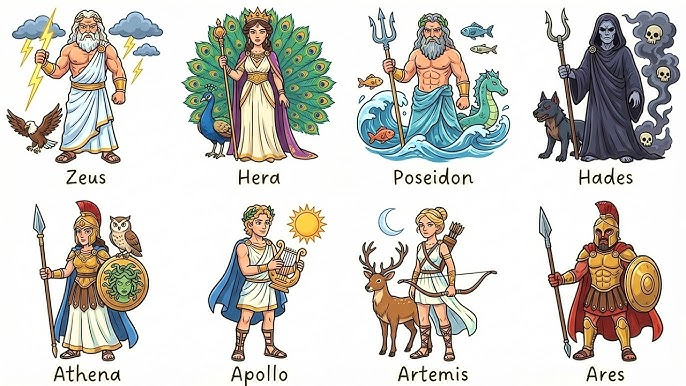
When we think of the Greek pantheon, our minds naturally drift to Mount Olympus—to Zeus hurling thunderbolts, Athena clad in armor, or Poseidon stirring up the seas. These twelve Olympian deities formed the grand aristocratic upper crust of Greek religion, commanding the largest temples and the most lavish civic festivals.
But the everyday world of an ancient Greek citizen was actually populated by a sprawling, intricate ecosystem of lesser-known, specialized deities. These minor gods did not sit on golden thrones; instead, they operated in the margins of human experience. They managed the hyper-specific, mundane, and psychological realities of daily life—from the sudden panic that grips a lonely forest traveler to the quiet threshold of a home’s front door.
1. Deities of the Mind and Body
The Greeks were brilliant at anthropomorphizing (giving human shape to) abstract psychological concepts and physical states. If you experienced a sudden rush of a specific emotion, you weren't just having a thought—you were being visited by a god.
Phobos and Deimos: The Twins of Terror
The sons of Ares (the god of war), Phobos (Panic/Fear) and Deimos (Terror/Dread), accompanied their father onto the battlefield. While Ares represented the physical act of warfare, his sons governed the psychology of combat.
 [ Phobos Arrives ] ───► Sudden, blind panic ───► Shield drop and total military rout
                                 │
                                 ▼
 [ Deimos Arrives ] ───► Paralyzing, freezing dread ───► Total inability to advance
Phobos was so feared by military commanders that Alexander the Great actually offered sacrifices to him on the eve of the Battle of Gaugamela, praying that the god would strike the Persian ranks with blind panic instead of his own.
Hypnos and Thanatos: The Gentle Brothers
Deep in the underworld lived the twin brothers Hypnos (Sleep) and Thanatos (Peaceful Death).
While Thanatos was occasionally depicted as a grim, winged figure cutting a lock of hair from the dying, he was explicitly distinct from Hades or the monstrous furies; he represented peaceful, natural passing. His brother Hypnos used a poppy branch or an inverted horn to pour sleep over humanity, gently easing the physical burdens of the day.
2. Gods of the Hearth, Threshold, and Home
While state religion focused on monumental temples, domestic religion focused on the protection of the family unit and the structural boundaries of the house (domus).
Hestia: The Silent Core
Though technically an elder sibling of Zeus, Hestia (the goddess of the hearth) routinely gave up her seat on Olympus to avoid conflict. She has almost no narrative myths and was rarely depicted in grand statues. Yet, she was culturally vital.
The hearth fire was the source of heat, cooking, and spiritual security for every household. Every time a Greek family cooked a meal, a small offering was swept into the hearth for Hestia. Furthermore, when a new colony was founded, explorers carried a coal from the mother city’s sacred civic hearth to light the new colony's fire, structurally linking the two cities across the ocean through Hestia's flame.
Hecate and Hermes Propylaios: Guardians of the Gate
The boundary where the private home met the chaotic public street was a spiritually vulnerable zone. To protect this threshold, Greeks installed small shrines to Hecate (goddess of boundaries, crossroads, and witchcraft) and Hermes Propylaios (Hermes before the gates) right outside their front doors.
 [ Public Street (Chaos) ] ───► [ Hecate's Shrine at Doorway ] ───► [ Private Home (Security) ]
                                              │
                                              ▼
                                 Neutralizes evil curses,
                                 thieves, and wandering ghosts
These simple stone pillars or multi-faced statues acted as spiritual filters, neutralizing negative energy, curses, thieves, or wandering ghosts before they could step across the threshold into the family space.
3. The Specialized Pantheon of Daily Life
Beyond the home and the mind, a host of minor deities managed everything from childbirth to agricultural luck.
Deity NameCore Domain & MeaningIconography / AttributesEveryday Cultural RoleEileithyiaGoddess of childbirth and labor pains.Depicted holding torches to lead a child out of the darkness of the womb into the light.Women in labor prayed desperately to her to either accelerate a safe birth or hold back labor if a midwife hadn't arrived.PlutusGod of agricultural and material wealth.A youth holding a cornucopia (horn of plenty), often depicted as blind.He represented physical, tangible abundance (grain, coin). His blindness symbolized that wealth is arbitrary and doesn't care about moral goodness.NemesisGoddess of divine retribution and cosmic balance.Carrying a measuring rod, a whip, or a wheel.She targeted humans guilty of hubris (arrogant pride). If a person became too successful or wealthy without honoring the gods, Nemesis arrived to knock them back down to their proper station.PanGod of the wild, shepherds, and rustic music.A faun-like creature with the legs, horns, and ears of a goat, holding a pan flute.He ruled the uncultivated wilderness. The word "panic" comes directly from Pan; he was blamed for the sudden, inexplicable terror that fills a person when they hear a strange rustling sound in an empty forest.
4. The Daimones: Your Personal Spiritual Guide
Finally, Greek religion featured a massive class of lesser deities known as daimones (singular: daimon—the linguistic ancestor of the word "demon," though originally entirely neutral or benevolent).
  [ THE GENIUS CLASSIFICATION ] ───► Agathos Daimon (Good Spirit of the Vineyard/Fields)
                                           │
                                           ▼
                                 Eudaimonia (A state of human flourishing /
                                 literally "having a good, well-aligned daimon")
A daimon was a minor guiding spirit that acted as a bridge between the supreme gods and individual humans. The philosopher Socrates famously spoke of his personal daimonion—an internal divine voice that would speak up to warn him whenever he was about to make a catastrophic moral or practical mistake.
To the Greeks, achieving absolute happiness was called Eudaimonia ($ \epsilon \dot{\upsilon} \delta \alpha \iota \mu o \nu \iota \alpha $), which literally translates to "possessing a good, well-aligned spirit."
By populating their world with these highly specialized, minor entities, the ancient Greeks created a psychological safety net. No matter how small, weird, or intensely personal a human experience was, there was always a specific god who understood it, had a name for it, and could be reasoned with through a simple prayer.