To understand ancient Greek religion, one must first discard the modern concept of faith. The Greeks had no holy scriptures, no official commandments, and no centralized priestly hierarchy. They did not care what an individual internally believed about the gods.
Instead, Greek religion was defined by orthopraxy—meaning "correct practice." Religion was a system of actions: performing rituals, making vows, offering sacrifices, and gathering for massive civic festivals. It was a cosmic transaction based on the principle of do ut des ("I give so that you might give"). You honored the gods through physical actions, and in return, they kept your city safe, your crops growing, and your armies victorious.
1. The Dynamic of the Pantheon: Reciprocity and Ritual
The Greek gods were not moral exemplars. From Zeus down to Hermes, the twelve Olympians were depicted as volatile, fiercely protective of their own honor, and deeply embedded in human affairs.
[ Human Invocations ] ──► Libations & Sacrifice ──► Kharis (Reciprocal Goodwill) ──► Divine Protection
To maintain a good relationship with these powerful entities, the Greeks relied on two primary ritual acts:
Libations (Spondai): The daily pouring out of a small amount of wine, milk, honey, or oil onto the ground or an altar before eating or starting a journey.
Animal Sacrifice (Thysia): The absolute focal point of public worship. In a civic sacrifice, a domestic animal (like an ox, sheep, or pig) was led to an altar outside a temple. The inedible portions (bones wrapped in fat) were burned on the altar so the fragrant smoke could ascend to the gods. The edible meat was then cooked and distributed to the citizens.
The Social Reality: Public sacrifices were the rare occasions when the general population ate fresh meat. Consequently, religious rituals doubled as vital community barbecues and civic feasts.
2. Civic Festivals: The Heart of the City-State
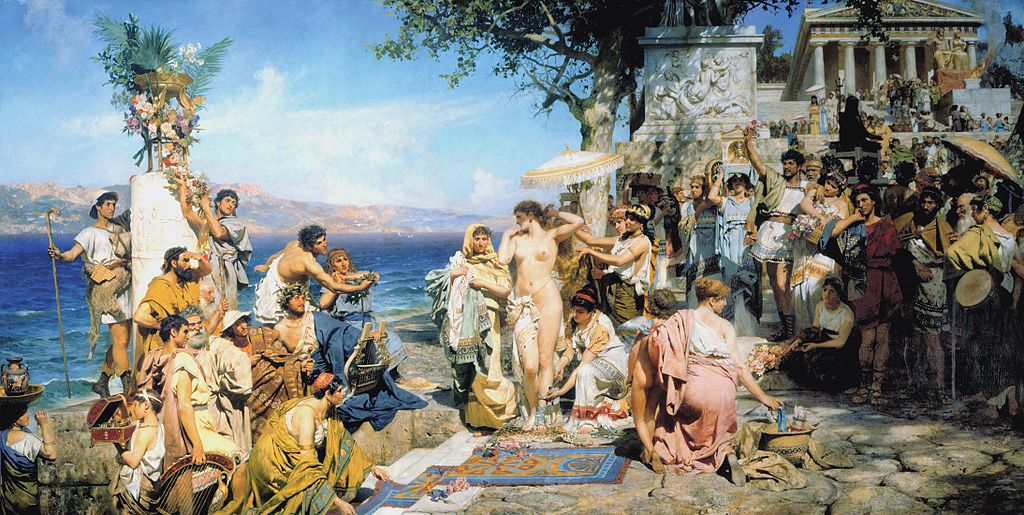
Because religion was intertwined with civic life, the calendar of an ancient city-state (polis) was structured around religious festivals. These events paused all public business, unified the population, and allowed cities to showcase their wealth and cultural prestige.
The Panathenaia: Honoring the Patron Goddess
Held in Athens every four years, the Great Panathenaia honored Athena Polias (Athena of the City). The climax of the festival was a massive grand procession that wound its way from the city gates, through the marketplace, and up onto the Acropolis.
The entire purpose of this magnificent parade was to present the ancient wooden cult statue of Athena with a brand-new, saffron-colored robe (peplos) woven by the young women of Athens. The festival also featured athletic, musical, and poetic competitions, with winners receiving massive clay amphorae filled with high-grade Athenian olive oil.
The City Dionysia: The Birth of Theater
Religion wasn't just solemn processions; it was also subversive, emotional, and creative. The City Dionysia, held in spring to honor Dionysus (the god of wine, madness, and theater), transformed Athens into a dramatic competition hub.
Prisoners were temporarily released, business stopped, and citizens packed into the open-air theater beneath the Acropolis. For days, they watched playwrights compete by presenting trilogies of tragedies followed by a raucous comedy. Theater was a deeply religious act; the actors were considered Ministers of Dionysus, and the performances served as a collective psychological cleansing (catharsis) for the entire city.
3. Panhellenic Festivals: Unifying a Fractured World
While cities had their local cults, certain sanctuaries transcended local politics. These were Panhellenic ("All-Greek") sites, where a sacred truce was declared so that citizens from warring city-states could gather in peace.
FestivalLocationHonored DeityPrimary Feature & LegacyThe Olympic GamesOlympiaZeusAthletic contests (running, wrestling, chariot racing) held every four years since 776 BCE. Winners received an olive wreath and immortal fame.The Pythian GamesDelphiApolloHeld every four years, emphasizing musical, theatrical, and poetic competitions alongside athletics, celebrating Apollo's arts.The Isthmian GamesCorinthPoseidonHeld every two years on the narrow Isthmus, featuring intense athletic and equestrian competitions for seafaring states.
4. Mystery Cults: Seeking Personal Salvation
Public civic festivals focused on the survival of the community, but they offered very little comfort regarding personal mortality or the afterlife, which the Greeks generally viewed as a bleak, shadowy existence in Hades. To fill this spiritual void, many turned to Mystery Cults.
[ Secular Life ] ──► Sacred Secret Invocations ──► Ritual Rebirth ──► Promised Blissful Afterlife
The most famous were the Eleusinian Mysteries, held annually outside Athens near the sanctuary of Demeter and Persephone.
The Vow of Silence: Initiation was open to anyone (including women and enslaved people) provided they spoke Greek and had not committed murder. However, initiates were forbidden from revealing the inner rituals under penalty of death.
The Promised Outcome: Through a ritual reenactment of Persephone’s descent into the underworld and her joyful return to the sun, initiates were relieved of their fear of death. As the poet Pindar wrote: "Blessed is he who has seen these things before going beneath the earth; he knows the end of life, and he knows its god-given beginning."
Through this dual system of public civic festivals and private mystery initiations, Greek religion provided both the social glue that held their fractured political world together and the personal framework needed to navigate the challenges of human existence.