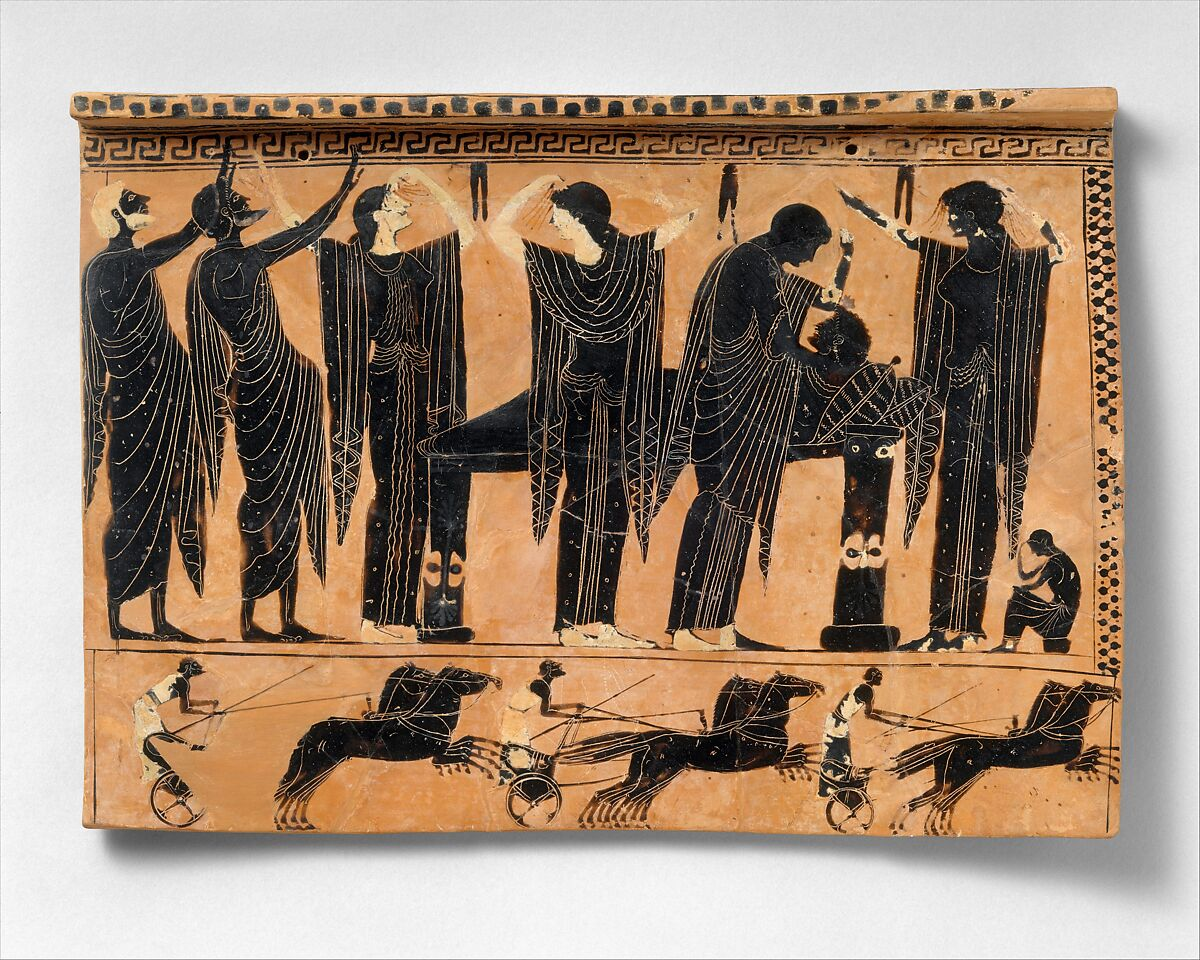
In ancient Greece, a person's life didn't simply end when their heart stopped beating. The transition from the world of the living to the realm of the dead was a highly volatile, multi-stage journey fraught with spiritual danger.
If a family failed to perform the correct funerary rites (ta nomizomena), the consequences were catastrophic: the deceased's soul (psyche) would be left stranded as a hostile, restless ghost on the wrong side of the River Styx, bringing down severe spiritual pollution (miasma) upon the entire community.
To prevent this, the Greeks developed a strict, three-part funeral ritual designed to safely guide the soul underground and restore civic order to the living.
1. The Prothesis: The Wake and the Coin
The moment an individual died, the women of the household took immediate, absolute control of the body. Men were largely excluded from this first phase, which took place inside the home.
[ CLEANSE THE BODY ] ──► [ ANOINT WITH OILS ] ──► [ THE OBOLE IN THE MOUTH ] ──► [ LAMENTATION ]
The women washed the corpse with well water, anointed it with scented olive oils (like lekythos perfumes to mask the scent of early decay), and dressed it in a clean white shroud.
Most importantly, they placed a small silver or bronze coin—an obol—directly into the deceased’s mouth or over their eyes. This wasn't a gift for the gods; it was Charon’s toll. It was the exact fee required by the ferryman of the underworld to row the soul across the Styx. Without it, the soul was doomed to wander the bleak marshes of the shore for a century.
The body was then laid out on a high couch (kline) in the central courtyard for the Prothesis (the wake). Here, female relatives cut their hair short, wore black robes, and beat their breasts in a highly theatrical, rhythmic ritual lamentation called the goos, singing mournful dirges to guide the dead away.
2. The Ekphora: The Final Procession
Before the sun rose on the third day, the body had to be moved out of the domestic sphere to avoid spreading pollution to the rest of the neighborhood. This public transport was known as the Ekphora.
The corpse was placed on a wheeled cart or carried on a wooden bier by close male relatives through the dark streets. A long line of mourners followed behind, their loud wailing echoing through the silent city.
The destination was always outside the defensive city walls—such as the famous Kerameikos cemetery in Athens. The Greeks believed that burying bodies within the city limits offended the sky gods and threatened the public health of the living polis. At the cemetery, the body was either buried in a wood or stone sarcophagus or cremated on a massive timber pyre, along with personal items like jewelry, weapons, or favorite clay cups.
3. The Perideipnon: Re-Establishing the Living
Once the earth was piled high over the grave, the family returned home for the Perideipnon (the funeral feast).
Critically, this feast was held at the house of the deceased, but the dead individual was viewed as the spiritual host of the meal. A portion of food was set aside specifically for them. This dinner served as a vital psychological release valve: it allowed the broken family to gather, share memories, and symbolically welcome themselves back into the world of the living after days of intense isolation and grief.
4. Keeping the Memory Alive: The Ancestral Calendar
An Egyptian tomb was built to last forever without human intervention, but Greek graves required constant, ongoing maintenance. The dead only stayed at peace if they were continually remembered and fed.
The Greeks returned to the tomb on strict calendar intervals: on the 3rd, 9th, and 30th days after the funeral, and annually thereafter during state festivals like the Genesia (All Souls' Day).
During these grave visits, family members performed specific maintenance rituals:
The Ribbons: They wrapped the stone grave markers (stelai) in bright wool ribbons and garlands of myrtle or celery.
The Libations: They poured liquids directly into the porous earth over the grave. These choai consisted of water, wine, milk, honey, and olive oil, which seeped down into the dirt to metaphorically quench the thirst of the parched souls below.
The White Lekythoi: They left behind specialized, highly delicate pottery called white-ground lekythoi (as seen above). These elegant white oil jugs were manufactured exclusively for funerals, often painted with touching scenes of Charon waiting in his boat or families weeping at the tomb, serving as a permanent monument of the family's love.
Through this rigorous architecture of grief, the ancient Greeks turned a terrifying biological reality into an artful social transition—ensuring that while the body crumbled to dust outside the walls, the memory of the citizen remained anchored to the heart of the city.