To the ancient Greeks, Egypt was the ultimate land of mystery, ancient wisdom, and deep religious devotion. The Greek historian Herodotus famously wrote that the Greeks inherited the names of almost all their gods from Egypt, asserting that the Egyptians were the first to establish solemn assemblies, processions, and litanies.
While modern historians view Herodotus’s claims of total derivation as an exaggeration, the cross-pollination between Egyptian and Greek religion was profound. Over centuries of trade, colonization, and eventual conquest, Egyptian concepts fundamentally reshaped Greek theology, ritual practices, and mystery cults.
1. Interpretatio Graeca: The Equal Sign Between Gods
The Greeks practiced interpretatio graeca—the habit of translating foreign deities into their own pantheon based on shared roles or traits. When Greek merchants and mercenary soldiers settled in the Egyptian trading port of Naucratis around the 7th century BCE, they immediately began matching their deities with Egyptian equivalents.
  [ EGYPTIAN DEITY ]                       [ CORE ATTRIBUTES ]                      [ GREEK EQUIVALENT ]
  Amun (King of Hidden Power)  ───────►  Ram horns / Sky sovereign      ───────►  Zeus (Zeus-Ammon)
  Osiris (Lord of Afterlife)   ───────►  Rebirth / Agriculture / Wine   ───────►  Dionysus
  Thoth (God of Wisdom/Writing)───────►  Moon / Magic / Guide of Souls  ───────►  Hermes (Hermes Trismegistus)
  Isis (Maternal Protector)    ───────►  Magic / Motherhood / Fertility ───────►  Demeter / Aphrodite
This was not a superficial relabeling; it altered how the Greeks worshipped. In Libya, the oracle of Zeus-Ammon became so famous that even major Greek cities sent official delegations to consult it. Alexander the Great famously detoured to the Siwa Oasis in 332 BCE, where the oracle confirmed him not just as a king, but as the literal son of Ammon (Zeus).
2. Monumental Architecture and the Birth of the Kouros
The very way Greeks honored their gods through stone was learned on the banks of the Nile. Before the 7th century BCE, Greek cult statues (xoana) were small, crude, wooden figures.
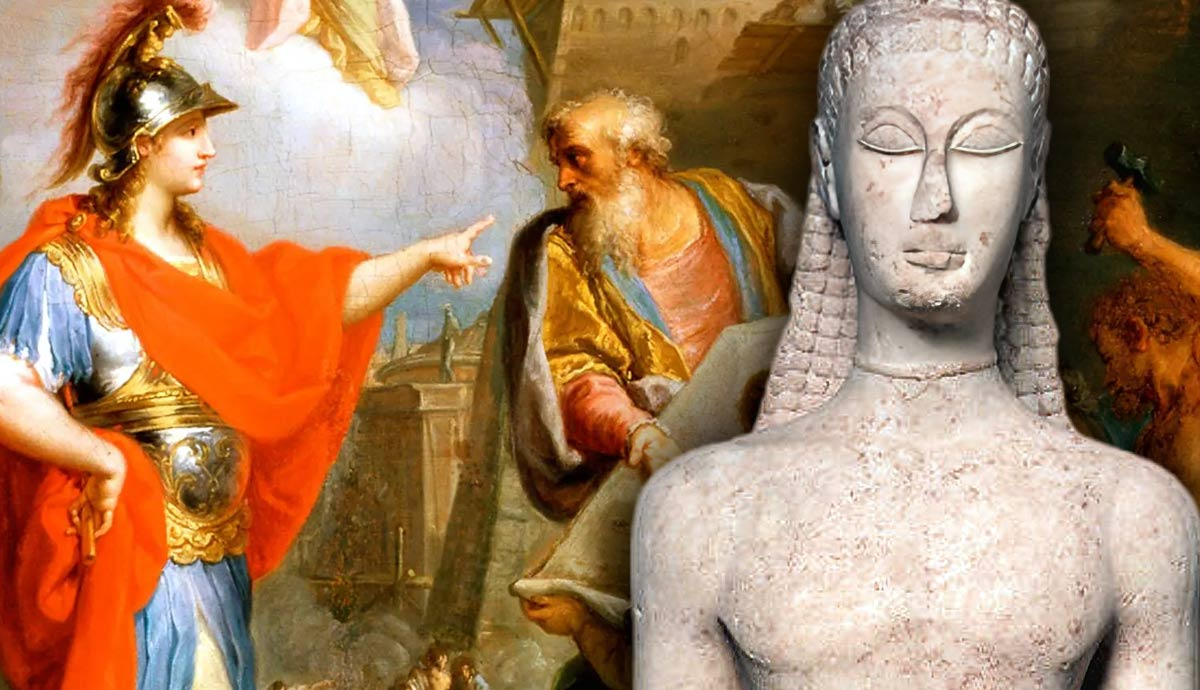
When the Greeks encountered the breathtaking, colossal stone temples of Luxor and Memphis, they were transfixed. Greek craftsmen adopted Egyptian grid systems, masonry tools, and engineering techniques to create the Kouros—the earliest monumental stone statues of young men in Greece, dedicated to gods like Apollo.
The rigid, forward-facing posture, clenched fists, and left-foot-forward stance of early Greek statues were direct artistic adaptations of traditional Egyptian pharaonic portraiture, transformed to fit a Greek aesthetic.
3. The Orphic and Dionysian Shift in the Afterlife
Early Greek ideas about death, as described by Homer, were deeply pessimistic. When you died, your soul became a strengthless, drifting shadow in the bleak, muddy fields of Hades. There was no reward for a good life, and no punishment unless you personally offended the gods.
Contact with Egyptian religion changed that layout entirely. The Egyptian preoccupation with the judgment of the soul (the weighing of the heart against the feather of Ma'at) and the promise of an idyllic agricultural paradise in the afterlife (the Field of Reeds) heavily influenced emerging Greek mystery cults, such as Orphism and the Dionysian mysteries.
These secret groups promised initiates that through purification rituals and sacred knowledge, they could escape the dreary fate of Hades and achieve a blessed, joyous immortality—a theological paradigm shift heavily indebted to the myth of Osiris’s death and resurrection.
4. The Ptolemaic Fusion: Serapis and the Global Cult of Isis
The climax of this religious synthesis occurred during the Hellenistic period, after Alexander the Great conquered Egypt and his general, Ptolemy I Soter, established the Ptolemaic Dynasty. To unite his Greek-speaking ruling class and his native Egyptian subjects, Ptolemy deliberately engineered a new, synthetic god: Serapis.
[ SERAPIS ] ──► Osiris (Afterlife) + Apis Bull (Fertility) + Hades (Underworld) + Zeus (Sovereignty)
Serapis was depicted entirely as a Greek deity with long hair and a beard, wearing a grain-measuring basket (modius) on his head to symbolize abundance, but his theological core was purely Egyptian.
During this period, other hybrid gods emerged, such as Hermanubis (above), who combined the jackal-headed Egyptian guide of the dead, Anubis, with the Greek psychopomp (soul guide), Hermes.
At the same time, the cult of Isis burst out of Egypt and swept across the Mediterranean, becoming one of the most popular religions in the Greek and later Roman worlds.
The Greeks completely re-imagined Isis, casting her as a universal goddess of seafaring, magic, laws, and cosmic order. Her image as Isis Lactans (Isis nursing the infant Horus, known to the Greeks as Harpocrates) became so deeply embedded in the Mediterranean consciousness that it set a visual standard for maternal religious iconography for centuries to come.
Through this profound syncretism, the ancient world proved that its religious boundaries were never borders, but fluid spaces of translation, adaptation, and shared spiritual awe.