The Role of Military Alliances in Greek History
In ancient Greece, the political fragmentation of the Mediterranean into hundreds of independent city-states (poleis) made military alliances, or symmachia (literally "fighting together"), essential for survival, defense, and power projection. These alliances evolved from temporary coalitions against foreign invaders to long-standing hegemonic leagues and, eventually, to advanced federal states.
1. The Peloponnesian League (c. 550–366 BCE)
Formed in the 6th century BCE, the Peloponnesian League was the oldest and most stable coalition in ancient Greece, spearheaded by Sparta.
Structure: Unlike later Athenian models, this alliance operated on a bilateral basis. Members swore to have the same friends and enemies as Sparta, but allied states did not hold reciprocal treaties with each other.
Purpose: The league was initially formed to protect Sparta from internal threats (such as the Helot population) and external aggression, ultimately becoming a tool for Spartan hegemony in the Peloponnese.
The Spartan Hegemony: The league provided Sparta with unparalleled land forces, allowing it to dominate neighboring states and eventually challenge Athens during the Peloponnesian War.
2. The Delian League (478–404 BCE)
Following the second Persian invasion of Greece, Athens organized a maritime alliance to protect Ionian Greek cities from Persian retaliation and to liberate occupied territories.
The Athenian Empire: Over time, Athens transformed the voluntary contributions of ships and money into a strict tribute system. Cities that tried to leave, such as Naxos or Thasos, were besieged and forced back into the fold.
Funding the Golden Age: The immense wealth gathered from the league's treasury (initially kept on the island of Delos, then moved to Athens in 454 BCE) was used to fund the Athenian navy and construct major public works, including the Parthenon.
The Catalyst of Conflict: The conversion of a defensive alliance into an imperial power caused acute friction with Sparta and the Peloponnesian League, directly leading to the Peloponnesian War.
3. The Second Athenian League (378–338 BCE)
After the defeat of Athens in the Peloponnesian War, the city-states of Greece sought a new coalition model.
Restricted Powers: Learning from their past mistakes, the Athenians prohibited the acquisition of property by Athenians on allied land, preventing the exploitation that defined the Delian League.
Purpose: The league was explicitly formed to counter the growing supremacy of Sparta after the King's Peace of 387 BCE.
4. The Boeotian League and Theban Hegemony (4th Century BCE)
Led by Thebes, the Boeotian League was a highly innovative federal alliance where member cities had proportional voting rights.
Theban Rise: Using this system of shared resources, Thebes was able to break the Spartan military tradition. At the Battle of Leuctra in 371 BCE, Theban-led allied forces dealt a devastating blow to Spartan infantry.
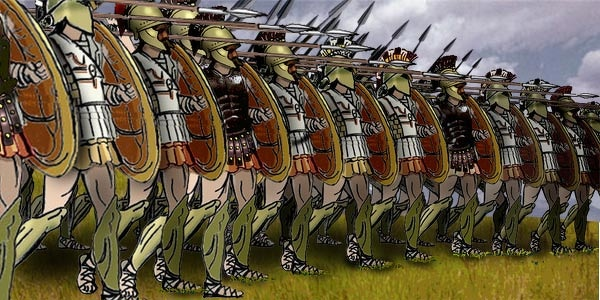
Tactical Integration: The alliance allowed Thebes to pool heavy infantry (such as the Sacred Band) and specialized cavalry units to dominate the Boeotian region.
5. Hellenistic Federal Leagues: Aetolian and Achaean
By the 3rd and 2nd centuries BCE, Greek alliances transformed from hegemonic structures into genuine federal states capable of dealing with the expanding Roman Republic.
The Achaean League: A coalition of Peloponnesian cities that adopted unified citizenship, currency, weights, and a shared general assembly.
The Aetolian League: A loose coalition of tribes and cities in central Greece that used a combination of diplomacy and raiding to preserve their independence.