The Contributions of Galen to Medicine
Galen of Pergamum (129–c. 216 CE) was the most influential medical writer, physician, and philosopher of the Roman Empire. His comprehensive synthesis of earlier medical traditions, combined with his own anatomical observations and clinical insights, formed the foundation of Western and Islamic medicine for more than 1,300 years.
By integrating philosophy, anatomy, and pharmacology into a structured system, Galen transformed medicine from an empirical trade into a formal scientific discipline.
1. Advancements in Anatomy and Physiology
Although Roman law prohibited the dissection of human cadavers, Galen circumvented this by dissecting and vivisecting animals, most notably pigs, goats, and Barbary macaques, extrapolating his findings to human anatomy.
The Nervous System: Galen conducted pioneering work on the nervous system. He distinguished between sensory and motor nerves, demonstrated that the brain controls the voice via the recurrent laryngeal nerve, and established that the spinal cord is responsible for sensation and movement in the limbs.
The Circulatory System: Before Galen, many physicians believed that arteries carried pneuma (a mystical air or spirit) rather than blood. Galen demonstrated through experiments that arteries contain blood.
Physiological Flaws: While his observations were detailed, Galen posited that blood was continuously created in the liver from ingested food, flowed to the right side of the heart, and passed through microscopic pores in the ventricular septum to the left side of the heart. This specific model remained unchallenged until the 17th century.
2. The refinement of the Four Humors
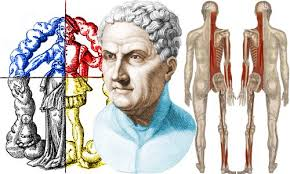
Galen expanded upon the Hippocratic theory of the four humors (blood, yellow bile, black bile, and phlegm), creating a comprehensive diagnostic framework that dominated medical treatment until the Renaissance.
Temperaments: He linked the balance of the humors to both physical health and emotional and mental temperaments.
Diagnostics by Pulse and Urine: Galen developed a sophisticated art of pulse and urine analysis. He wrote extensive treatises detailing how rhythm, volume, and frequency of the pulse could diagnose specific underlying conditions and fevers.
Venesection (Bloodletting): He championed bloodletting as a primary method to rebalance the humors, a practice that remained standard medical protocol for well over a millennium.
3. Pharmacology and Therapeutics
Galen was a prolific writer on the preparation and use of herbal and mineral remedies. He collected and tested hundreds of botanical substances, establishing rules for combining ingredients.
"Galenicals": He formulated complex compound drugs—often involving dozens of ingredients—that came to be known as Galenicals.
Cold Cream: He is credited with inventing one of the first iterations of modern cold cream, combining water, olive oil, and beeswax to create a soothing topical ointment.
4. Medical Philosophy and Ethics
Galen believed that a true physician must also be a philosopher, insisting on the rigorous use of logic and deductive reasoning in medical practice.
Treatise That the Best Physician is Also a Philosopher: In this work, Galen argued that a physician must understand the natural order of the body and possess self-control, avoiding the pursuit of wealth to truly heal the sick.
Teleology: Influenced by Aristotle and Plato, Galen viewed every part of the human body as purposefully designed, arguing that anatomical structure directly serves biological function.