For the ancient Greeks, justice was not merely a matter of legal codes, courtrooms, and punishments. It was a cosmic, psychological, and political virtue. The Greeks used the word Dikaiosyne (${\Delta\iota\kappa\alpha\iota\iota\sigma\upsilon\nu\eta}$) to define justice, viewing it as the ultimate measure of moral rightness, balance, and the proper alignment of things both within the human soul and across the universe.
As Greek civilization evolved from an aristocratic warrior culture into a hub of democratic debate, the definition of justice underwent a radical intellectual evolution.
1. The Pre-Socratic Era: Cosmic Balance
Before philosophers turned their attention to human behavior, the earliest Greek thinkers (the Pre-Socratics) viewed justice as an immutable, physical law of nature.
Anaximander (c. 610–546 BCE): Viewed the universe as a continuous battleground between opposing forces (hot and cold, wet and dry). He argued that when one force encroached too far upon another, it committed an "injustice." Order was restored through Dike (the goddess of justice), who forced the elements to recede, ensuring a cosmic equilibrium.
Heraclitus (c. 535–475 BCE): Famously declared that "strife is justice." He believed that the universe is kept stable precisely through the permanent, tense conflict of opposites, regulated by a divine, rational blueprint (${\text{Logos}}$).
2. The Sophists: Might Makes Right
In the 5th century BCE, the rise of radical democracy in Athens created a new class of professional teachers known as the Sophists. They stripped justice of its divine, cosmic status, arguing instead that it was a purely human invention.
The Sophists were cultural relativists. They observed that what was considered "just" in Athens was "unjust" in Sparta or Persia. Therefore, they argued that justice is nothing more than a social convention (nomos) created by the weak to protect themselves from the strong—or conversely, a tool used by the ruling class to maintain power.
In Plato’s Republic, the Sophist Thrasymachus delivers the ultimate cynical definition of the concept:
"Justice is nothing other than the advantage of the stronger."
To the Sophists, a truly wise person recognizes that laws are artificial constraints. If you can commit an "unjust" act (like stealing or seizing power) and completely get away with it without punishment, it is naturally smart and advantageous to do so.
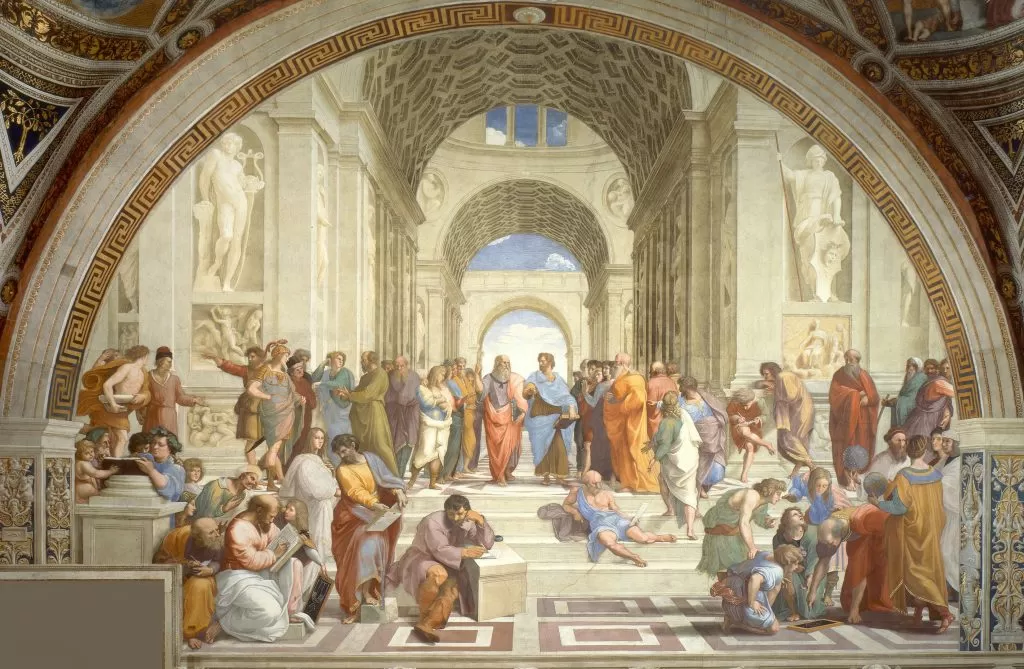
3. Plato: Harmony of the Soul and State
Plato was deeply horrified by the relativism of the Sophists, which he believed had corrupted Athenian morality and led to the unjust execution of his mentor, Socrates. In his masterpiece, the Republic, Plato sets out to systematically dismantle the Sophist worldview and discover the true, objective nature of justice.
Plato argues that justice is a state of harmony and functional efficiency. To explain this, he famously compares the structure of a healthy city-state (polis) to the structure of an individual human soul.
The Tripartite Soul
Plato argues that the human soul is divided into three distinct psychological parts, and justice is achieved only when each part performs its specific, natural function under the guidance of reason:
The Rational Part (Reason): Seeks truth and intellect. It is the natural ruler of the soul. Its characteristic virtue is Wisdom.
The Spirited Part (Thumos): The seat of anger, courage, ambition, and pride. Its characteristic virtue is Courage.
The Appetitive Part (Desires): Craves physical pleasures, food, sex, and material wealth. It must practice Temperance.
For Plato, individual justice occurs when Reason rules the soul, using the emotional fire of the Spirited part to keep the boundless appetites and desires in check. An unjust person is someone whose soul is in a state of civil war—where raw, unchecked physical desires or blind ambition overthrow reason.
The Ideal State
Plato maps this exact psychological layout onto his utopian city (Kallipolis), dividing society into three distinct social classes:
The Guardian-Rulers (Philosopher Kings): Correspond to Reason. They govern the state with wisdom.
The Auxiliaries (Soldiers): Correspond to Spirit. They defend the borders with courage.
The Producers (Workers/Merchants): Correspond to Appetite. They fuel the economy through temperance and obedience.
Political justice, therefore, is defined as everyone minding their own business and doing the job they are naturally suited for, without interfering with the duties of others. When a shoemaker tries to become a politician, or a soldier tries to seize control of the laws, the state collapses into injustice.
4. Aristotle: Geometric Proportionality and Equity
Plato's most brilliant student, Aristotle, brought the concept of justice down from abstract utopian ideals into the practical realm of human relationships and legal frameworks. In the Nicomachean Ethics, Aristotle broke justice down into highly specific, operational categories:
                          [ ARISTOTELIAN JUSTICE ]
                                      │
           ┌──────────────────────────┴──────────────────────────┐
           ▼                                                     ▼
 [ Universal Justice ]                                 [ Particular Justice ]
(Obeying laws & virtue)                                (Fairness among equals)
                                                                 │
                                       ┌─────────────────────────┴─────────────────────────┐
                                       ▼                                                   ▼
                            [ Distributive Justice ]                            [ Corrective Justice ]
                             (Wealth/Honor by merit)                             (Restoring balance)
Distributive Justice
This form of justice governs how a society hands out wealth, honors, rewards, and political power among its citizens. Aristotle argued that distributive justice must follow geometric proportionality based on merit.
True equality does not mean giving everyone an identical share. Instead, rewards must match a person's contribution to society. If two citizens contribute unequally to the state, giving them equal rewards is inherently unjust. As Aristotle wrote: "Injustices arise when equals are treated unequally, or unequals are treated equally."
Corrective (Rectifactory) Justice
This form of justice treats all individuals as absolute equals under the law, regardless of their social standing or moral merit. It focuses entirely on rectifying a wrong after an unfair transaction or crime has occurred (such as theft, assault, or a broken contract).
The judge acts as a living embodiment of justice, stepping in to strip away the unfair gain from the wrongdoer and return it to the victim, restoring the conceptual baseline of equality between them.
The Concept of Equity (Epieikeia)
Aristotle recognized that written human laws are inherently universal and general, meaning they cannot possibly anticipate every bizarre, highly specific scenario that occurs in real life. If a judge applies the strict letter of the law blindly, it can sometimes result in a grotesque injustice.
To solve this, Aristotle pioneered the concept of Equity (Epieikeia). Equity is a correction of legalistic justice when the law fails due to its universality. A just judge must possess the flexibility to bend the rigid rule of law to fit the unique moral realities of a specific human dilemma—comparing it to a flexible lead ruler used by builders on the island of Lesbos to measure irregular, curved stones.
5. Summary of Philosophical Definitions
The Pre-Socratics: An objective, cosmic law of nature that maintains an equilibrium between opposing physical forces.
The Sophists: An artificial, relativistic human convention designed either by the weak to restrict the strong, or by the strong to dominate the weak.
Plato: An internal and structural harmony where every part of the soul and every class of the state performs its natural function under the rule of reason.
Aristotle: A practical civic virtue divided into proportional distribution based on merit, equal correction of wrongs under the law, and equitable flexibility.
The evolution of Greek thought on justice reflects a civilization grappling with the core challenges of human coexistence. By moving the conversation away from the capricious whims of mythological gods and grounding it in cosmic balance, psychological health, and proportional fairness, the Greek philosophers forged the foundational vocabulary of political philosophy and jurisprudence that continues to govern the modern democratic world.