Before the 5th century BCE, the earliest Greek philosophers (the Pre-Socratics) were primarily physicists. Thinkers like Thales, Anaximenes, and Heraclitus looked at the material world and tried to identify its physical foundation—whether it was water, air, or a constant state of fire and change.
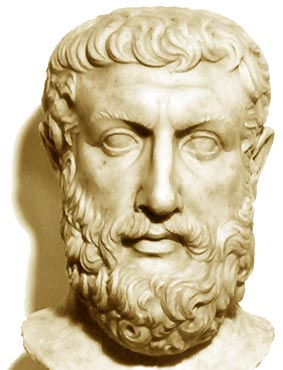
Then came Parmenides of Elea (c. 515–450 BCE).
Parmenides staged a radical, scorched-earth coup in Greek thought. He shifted philosophy away from observing the physical cosmos (cosmology) and invented metaphysics—the philosophical study of the fundamental nature of reality and existence itself. By rejecting the evidence of the human senses in favor of absolute, unyielding deductive logic, Parmenides introduced the concept of Ontology (the study of Being) and forced every philosopher who followed him to completely re-evaluate how we define what is real.
1. The Poem: "On Nature"
Parmenides revealed his revolutionary philosophy through a single, monumental work: a poem written in Homeric hexameter verse titled On Nature. The poem describes a mythic journey where Parmenides is swept up in a chariot to the realm of a nameless goddess, who promises to reveal to him the absolute truth about reality.
The goddess presents Parmenides with two mutually exclusive pathways of thought:
The Way of Truth (Alétheia): The path of strict, deductive reason, which reveals reality as it truly is.
The Way of Opinion (Doxa): The path of human sensory perception, which is fundamentally deceptive, illusory, and false.
2. The Logical Engine: "What Is, Is"
The foundation of Parmenides's metaphysics rests upon a seemingly simple, yet devastatingly rigid logical axiom:
"What is, is; and it is impossible for it not to be. What is not, is not; and it cannot possibly be."
From this basic starting point, Parmenides deployed the world's first strict application of the Law of Non-Contradiction. He argued that it is completely impossible to speak or think about "Nothing" (Non-Being). To think about nothing is instantly to turn it into a subject of thought, which means it is something. Therefore, "Nothingness" simply does not exist.
By completely banishing Non-Being from the universe, Parmenides used pure deductive logic to systematically destroy our everyday understanding of reality, proving that the true nature of Being must have four strict characteristics:
It is Unborn and Undying (No Beginning or End)
If Being had a beginning, it must have come from something else. But before Being existed, there was only Non-Being (Nothing). Since Nothing does not exist, Being could not have emerged from it. Likewise, it cannot die, because it would have to turn into Nothing. Therefore, reality is eternal and uncreated.
It is Changeless and Immovable
For anything to change, it must become something that it currently is not. (For example, a cold cup of water becoming hot means it "is not" cold anymore). But Parmenides argues that "is not" is a logical impossibility. Therefore, all change, growth, decay, and movement are absolute illusions.
It is Indivisible and Continuous
Being cannot be broken into separate pieces, because what would separate the pieces? It would have to be an empty space—a void of Nothingness. Since a void is Non-Being, and Non-Being cannot exist, there are no gaps in reality. Being is perfectly uniform and packed tight with itself.
It is One (Strict Monism)
Because there is no empty space to separate things, and no change to differentiate things, reality cannot be plural. There are not "many things" in the universe; there is only The One—a single, unchanging, homogenous, timeless, and indestructible sphere of pure existence.
3. The Rejection of the Senses: Rationalism vs. Empiricism
Parmenides’s philosophy created a profound epistemological crisis. If you look around you right now, your eyes, ears, and fingers tell you that change is real: people are born, seasons turn, things move, and the world is filled with a plurality of distinct objects.
Parmenides looked at this contradiction and made a radical choice: he chose logic over reality.
   [ HUMAN SENSES ] ──────► Perceive Change, Movement, and Plurality ───► FALSE ILLUSION (Doxa)
                                                                                   ▲
                                                                           (The Great Divide)
                                                                                   ▼
   [ PURE LOGIC ] ────────► Deduces Eternal, Changeless, Unified Being ──► ABSOLUTE TRUTH (Alétheia)
He argued that our human senses are completely untrustworthy dogs that warp our minds with illusions. True knowledge cannot be found by looking at the physical world (Empiricism); it can only be unlocked through the independent operation of pure, mathematical logic (Rationalism). He famously proclaimed: "For thinking and being are the exact same thing."
4. The Tectonic Impact on Later Metaphysics
Parmenides’s Monism acted like a philosophical brick wall. He had logically proved that change and multiplicity were impossible, leaving Greek philosophy dead in its tracks. The entire subsequent history of ancient metaphysics was a frantic, brilliant series of attempts to rescue the physical world from Parmenides’s logical trap.
Every major system of Classical Greek philosophy was engineered specifically to respond to the Eleatic challenge:
Zeno of Elea: Parmenides’s most loyal student constructed a series of world-famous paradoxes (such as Achilles and the Tortoise) to mathematically prove that movement and space are logical absurdities, defending his master's monism.
The Atomists (Democritus & Leucippus): To restore movement to the world, they boldly accepted Parmenides's rule that you cannot have change without a void, and then declared that the void actually exists. They argued reality consists of infinite, indivisible Parmenidean "Ones" (atoms) moving through a sea of literal nothingness.
Plato: Plato bypassed the issue by dividing reality into two distinct worlds. He assigned Parmenides’s eternal, changeless, indivisible "Being" to the World of Forms, while relegating Heraclitus’s world of constant flux and sensory change to the lower, physical World of Matter.
5. Summary of Pre-Socratic Paradigms
The Milesian Materialists: Reality is defined by a single, physical substance (water, air, or the infinite) that constantly shifts and changes forms.
Heraclitus: Reality is defined by permanent change, flux, and strife (${\text{Panta Rhei}}$), regulated by a hidden cosmic tension.
Parmenides: Reality is a single, eternal, changeless, indivisible, and immovable sphere of pure Being. All change and multiplicity are logical impossibilities and sensory illusions.
By prioritizing abstract logical consistency over the physical world, Parmenides fundamentally altered the trajectory of Western thought. He ripped philosophy away from simple natural science and anchored it in the realm of pure ontology. Every time a modern philosopher or scientist asks whether time is an illusion, whether space is a vacuum, or what defines the core architecture of existence, they are continuing a conversation that began when a 5th-century BCE Greek poet dared to declare that nothingness is impossible.