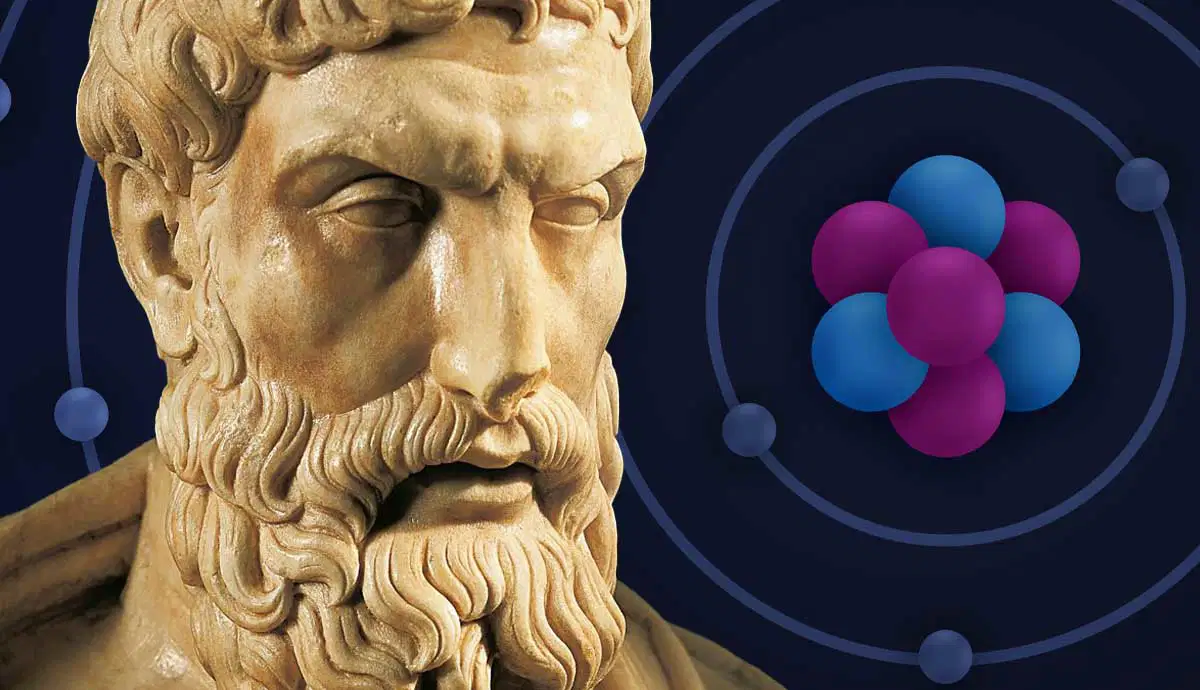
Long before modern laboratories, scanning tunneling microscopes, and particle accelerators, the concept of the atom was born in the minds of ancient Greek philosophers. Emerging in the 5th century BCE, Atomism was the world's first comprehensive atomic theory.
It was engineered not to explain chemistry, but to solve a massive philosophical crisis: how could the physical world experience constant change, growth, and decay if the fundamental laws of logic dictated that something cannot be created out of nothing?
1. The Dynamic Duo of Atomism: Leucippus and Democritus
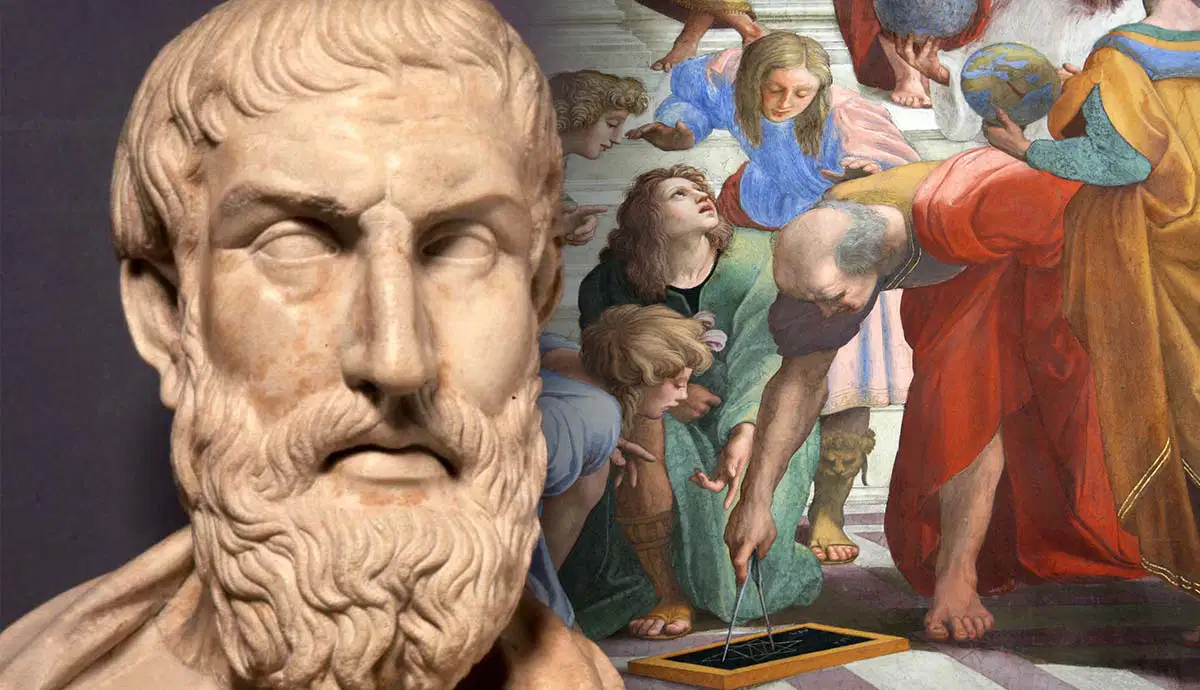
The foundations of atomic theory were laid by Leucippus of Miletus (c. 5th century BCE) and systematically expanded by his brilliant student, Democritus of Abdera (c. 460–370 BCE).
At the time, the philosophical world was reeling from the logic of Parmenides, who had argued that change is impossible because for something to change, it must move into empty space—a void of "nothingness." Since nothingness by definition does not exist, Parmenides claimed there are no gaps in reality, meaning everything is a single, frozen, immovable block of existence.
Leucippus and Democritus staged a brilliant intellectual coup to rescue the physical world. They accepted Parmenides's logic but boldly flipped the script by declaring that the void actually exists. They proposed that the universe is composed of two fundamental realities:
The Atom (Atomos): Infinite, uncreated, indestructible, and completely solid particles of matter that are too microscopic to be seen by the human eye. The word atomos translates literally to "uncuttable" or "indivisible" (${\alpha\text{-}}$, not + ${\tau\acute{o}\mu\text{o}\varsigma}$, cut).
The Void (Kenon): Literal empty space. The void acts as an infinite, non-material stage that gives atoms the structural freedom to move, vibrate, collide, and rearrange themselves.
2. The Properties of Ancient Atoms
Unlike modern atoms, which are composed of subatomic particles (protons, neutrons, and electrons) and are mostly empty space, the Greek atom was a completely solid, homogenous unit of pure matter. However, Democritus argued that atoms were not all identical. They possessed distinct geometric and physical characteristics that dictated how they interacted.
Infinite Shapes and Sizes: Because there was no cosmic reason for atoms to be limited to a few designs, Democritus argued they came in a limitless variety of shapes. Some were spheres, some were jagged, some were twisted, and others possessed complex hooks and eyes.
No Secondary Qualities: In their raw, isolated state, atoms possess no color, smell, taste, or temperature. They only possess primary geometric properties: size, shape, weight, and arrangement.
Perpetual Motion: Driven by cosmic necessity, atoms are in a state of eternal, chaotic vibration through the infinite void, constantly colliding with one another like dust motes dancing in a beam of sunlight.
3. The Mechanics of the Material World
To explain how a universe made of identical, invisible particles could produce the vibrant, colorful world of human sensory experience, Democritus developed a mechanical theory of emergence. He argued that all physical objects are temporary clusters of atoms, and all physical change is merely the rearrangement of those clusters.
The macroscopic properties of any substance were directly determined by the microscopic shapes of its constituent atoms:
Solid Iron: Composed of jagged, hard, interlocking atoms with complex hooks that latch onto one another tightly, resisting separation.
Fluid Water: Composed of exceptionally smooth, round, spherical atoms that cannot lock together, allowing them to slide past one another effortlessly and pour smoothly.
Bitter or Acidic Tastes: Caused by sharp, needle-like, or multi-angled atoms tearing across the pores of the human tongue.
Sweet Tastes: Caused by large, perfectly smooth, round atoms rolling pleasantly across the sensory receptors.
Democritus famously summarized this mechanistic framework by stripping the universe of its mystical qualities:
"By convention sweet is sweet, by convention bitter is bitter, by convention hot is hot, by convention cold is cold, by convention color is color. But in reality, there are only atoms and the void."
4. The Rejection of Purpose: A Mechanical Universe
The most radical aspect of Greek Atomism was its total rejection of teleology—the idea that the universe was designed with a specific purpose, goal, or divine plan.
   [ THE VOID ] ◄─────── (Infinite Stage for Collision) ───────► [ ATOMS ]
                                    │
                        (Blind, Cosmic Necessity)
                                    │
                                    ▼
                     [ Vortex of Mechanical Impact ]
                                    │
         ┌──────────────────────────┴──────────────────────────┐
         ▼                                                     ▼
 [ Entanglement / Creation ]                           [ Fragmentation / Decay ]
(Hooks latch to form matter)                         (Collisions shatter bonds)
In the atomist cosmos, there is no room for intelligent design by Olympian gods, no cosmic love or strife, and no destiny. Everything happens purely through mechanical necessity (Ananke).
When atoms collide in the void, they naturally form massive, spinning vortices. In these cosmic whirlpools, larger atoms migrate to the center to form planets and earths, while lighter atoms are flung outward to form the atmosphere and stars.
Even the human soul was stripped of its transcendent mystery; Democritus explained the soul as a physical cluster of highly volatile, spherical fire-atoms. When a person stops breathing, these fire-atoms escape the flesh and scatter back into the infinite void, ending personal consciousness permanently.
5. Summary of the First Atomic Paradigm
The Problem: Parmenides logically claimed that change requires a void, a void is "nothing," nothing cannot exist, therefore change is a complete illusion.
The Atomist Solution: Formulated by Leucippus and Democritus. They declared that the void does exist as physical empty space, allowing indivisible, solid particles (atomos) to move and rearrange.
Material Properties: Atoms are solid, eternal, and uncuttable, varying in geometric shapes (hooks, spheres, spikes) to create different physical states of matter.
Cosmic Viewpoint: A completely godless, mechanical universe running on blind necessity, where creation and destruction are merely the locking and unlocking of microscopic particles.
The Greek concept of the atom represents one of the most stunning achievements of ancient rationalism. Though later rejected by Plato and Aristotle—who preferred a universe organized by cosmic purpose and continuous elements—Atomism refused to die. It was preserved by Epicurus, immortalized by the Roman poet Lucretius, and eventually resurrected during the Scientific Revolution. By daring to strip the cosmos of magic and reduce reality to particles moving through space, these ancient thinkers forged the exact materialist framework that defines modern physics and chemistry today.