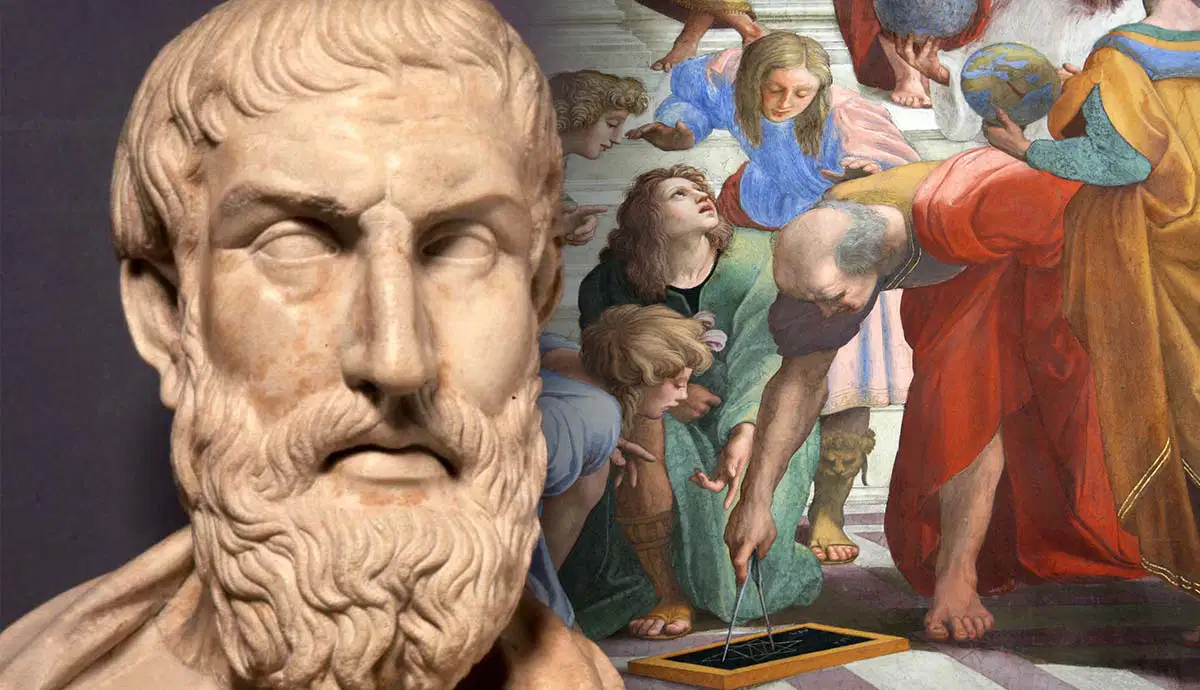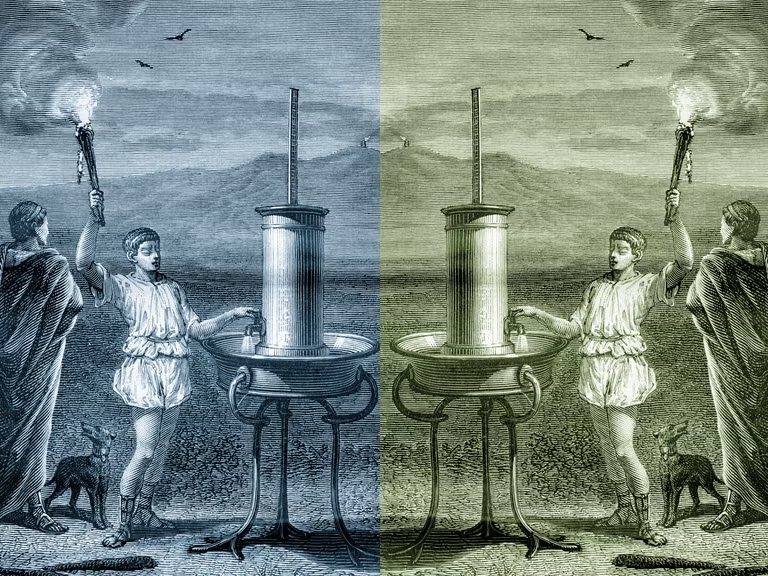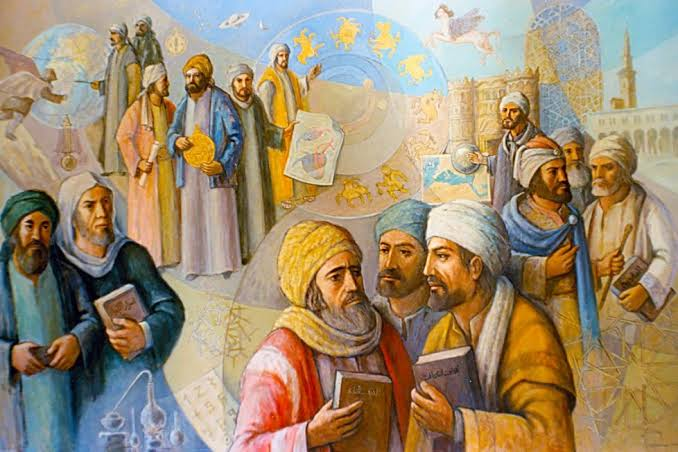
During the European Middle Ages, when much of Western Europe had lost direct access to the original writings of classical antiquity, the legacy of Greek science did not vanish. Instead, its intellectual capital migrated east, where it became the foundational engine for the Islamic Golden Age (roughly the 8th through the 14th centuries).
Centering in cities like Baghdad, Cairo, and Córdoba, Islamic scholars, scientists, and polymaths did not merely preserve Greek manuscripts as passive archivists. They launched a massive intellectual movement that translated, cross-examined, tested, and ultimately revolutionized Greek physics, mathematics, medicine, and astronomy, laying the direct structural foundations for modern global science.
1. The Translation Movement and the House of Wisdom
The catalyst for this scientific fusion was the Translation Movement, an elite, state-funded intellectual initiative launched by the Abbasid Caliphate in the late 8th century.
The epicenter of this movement was the House of Wisdom (Bayt al-Hikma) in Baghdad. Abbasid Caliphs like Harun al-Rashid and Al-Ma'mun recognized that knowledge was a vital tool for statecraft, navigation, and administration. They sent emissaries across the Byzantine Empire to purchase or trade for original Greek manuscripts written by Aristotle, Euclid, Ptolemy, Hippocrates, and Galen.
The Polyglot Scholars: The work was executed by a highly diverse, multicultural team of scholars, including Nestorian Christians, Jews, Muslims, and Sabians.
The Master Translator: The most famous translator was Hunayn ibn Ishaq (known to the West as Johannitius), a Christian scholar who mastered Greek, Syriac, Arabic, and Persian. Hunayn established the world's first rigorous philological methods for translation, comparing multiple damaged copies of Greek texts to reconstruct an accurate, pristine Arabic version.
The Linguistic Revolution: This movement transformed Arabic from a poetic, tribal language into a precise, highly sophisticated technical instrument capable of expressing complex mathematical, philosophical, and medical concepts.
2. Medicine: The Refinement of Galen and Hippocrates
Islamic physicians inherited the secular, fluid-based medical traditions of Hippocrates and Galen. However, operating within a vast empire that spanned from Spain to India, they encountered new diseases, drugs, and anatomical anomalies that forced them to rigorously update Greek medical theory.
Ibn Sina (Avicenna) and the Canon of Medicine
The Persian polymath Ibn Sina (980–1037 CE) took the fragmented, often contradictory medical writings of Galen and synthesized them with Aristotelian logic to create The Canon of Medicine (Al-Qanun fi al-Tibb).
While Ibn Sina respected Galen's foundational Theory of the Four Humors, his empirical observations led him to breakthroughs far ahead of his time. He was the first to recognize the contagious nature of tuberculosis, accurately map the structure of eye muscles, and identify that diseases could be transmitted through contaminated water and soil. The Canon became the absolute gold standard of medicine, serving as the primary textbook in both Islamic and European universities for over six centuries.
Ibn al-Nafis and the Discovery of Pulmonary Circulation
For over a thousand years, Galen’s anatomical authority was absolute. Galen had claimed that blood passed directly from the right side of the heart to the left side through invisible, microscopic pores in the thick muscular wall (septum) separating the ventricles.
In the 13th century, the Syrian physician Ibn al-Nafis performed careful dissections and flatly contradicted Galen. He logically and physically demonstrated that the septum is solid and has no pores. Instead, he correctly deduced pulmonary circulation: blood must flow from the right ventricle through the pulmonary artery to the lungs, where it mixes with air, before traveling back through the pulmonary vein to the left side of the heart.
3. Astronomy and Mathematics: Correcting the Cosmos
In astronomy, Islamic scientists inherited the geocentric (earth-centered) model perfected by Claudius Ptolemy in his book, the Almagest. While they utilized Ptolemy’s geometry, Islamic astronomers noticed significant mathematical errors when they matched his theories against actual observations of the night sky.
Building the Mega-Observatories
To correct these errors, Islamic rulers funded the construction of massive, state-of-the-art observatories, such as the Maragheh Observatory in modern-day Iran. These facilities were equipped with giant astrolabes, quadrants, and sextants designed to track planetary positions with unprecedented precision.
The Tusi Couple
The astronomer Nasir al-Din al-Tusi (1201–1274 CE) realized that Ptolemy’s complex mathematical mechanisms (such as the equant point) violated the classical Greek rule that all heavenly motions must be perfectly uniform and circular.
To solve this, Al-Tusi invented a revolutionary geometric model known as the Tusi Couple: a mathematical device where a small circle rotates inside a larger circle that is exactly twice its diameter. This geometric breakthrough successfully modeled linear motion out of uniform circular motion, providing a highly accurate way to calculate planetary orbits without Ptolemy's flawed shortcuts. Centuries later, Nicolaus Copernicus utilized the exact same Tusi Couple diagrams to construct his heliocentric (sun-centered) universe.
4. Physics and Optics: Ibn al-Haytham’s Empirical Revolution
The absolute apex of Islamic interaction with Greek science occurred in the field of physics and optics. For centuries, the Greek world had been split over how human vision operated:
The Emission Theory (Euclid/Ptolemy): Claimed the eye shoots out active visual rays to touch distant objects.
The Intromission Theory (Aristotle): Claimed the form of an object passes instantly through a transparent medium to the eye.
The Invention of the Scientific Method
The physicist Ibn al-Haytham (Alhazen, 965–1040 CE) dismantled both theories in his landmark work, the Book of Optics (Kitab al-Manazir). Ibn al-Haytham realized that the Greeks relied too heavily on pure logic and lacked experimental proof.
   [ GREEK INTUITIVE LOGIC ] ────► Formulate an elegant, abstract theory.
                                              │
                                   (The Islamic Evolution)
                                              │
   [ THE EMPIRICAL METHOD ] ─────► Hypothesize ──► Experiment ──► Collect Data ──► Verify Theory
Ibn al-Haytham designed the world's first rigorous, reproducible physical experiments to test light. Using darkened rooms with small pinholes (the camera obscura), lenses, and mirrors, he mathematically proved that light travels in straight, physical lines from a luminous source (like the sun or a candle), reflects off physical objects, and enters the human pupil.
By insisting that every scientific theory must be backed by rigorous, quantifiable, and repeatable experimentation, Ibn al-Haytham effectively invented the Modern Scientific Method.
5. Summary of Scientific Advancements
Methodology: Transitioned from a classical Greek reliance on deductive logic and geometry to the Islamic development of the empirical scientific method, mathematics-driven verification, and controlled experimentation.
Medicine: Transitioned from Galen's unexamined canine/primate anatomical models to the systematic clinical tracking of Ibn Sina and the accurate discovery of pulmonary circulation by Ibn al-Nafis.
Astronomy: Transitioned from Ptolemy’s flawed geometric shortcuts to mega-observatory tracking, precise star charts, and the invention of advanced mathematical devices like the Tusi Couple.
Optics: Transitioned from the ancient debate over eye-beams to the experimental mechanics of light paths, lenses, and the physics of the camera obscura.
The intellectual explosion of the Islamic Golden Age demonstrates that science is a global, continuous relay race. Rather than treating Greek science as a sacred, static museum piece, Islamic polymaths treated it as a dynamic hypothesis that demanded validation. By merging the abstract geometry and logic of the Greeks with a fierce commitment to empirical testing, mathematical precision, and clinical truth, they didn't just preserve the ancient torch of learning—they amplified its brilliance, lighting the path that led directly to the European Renaissance and the birth of modern global technology.